Thursday, July 16, 2020

How To Secure Trailer Hooks

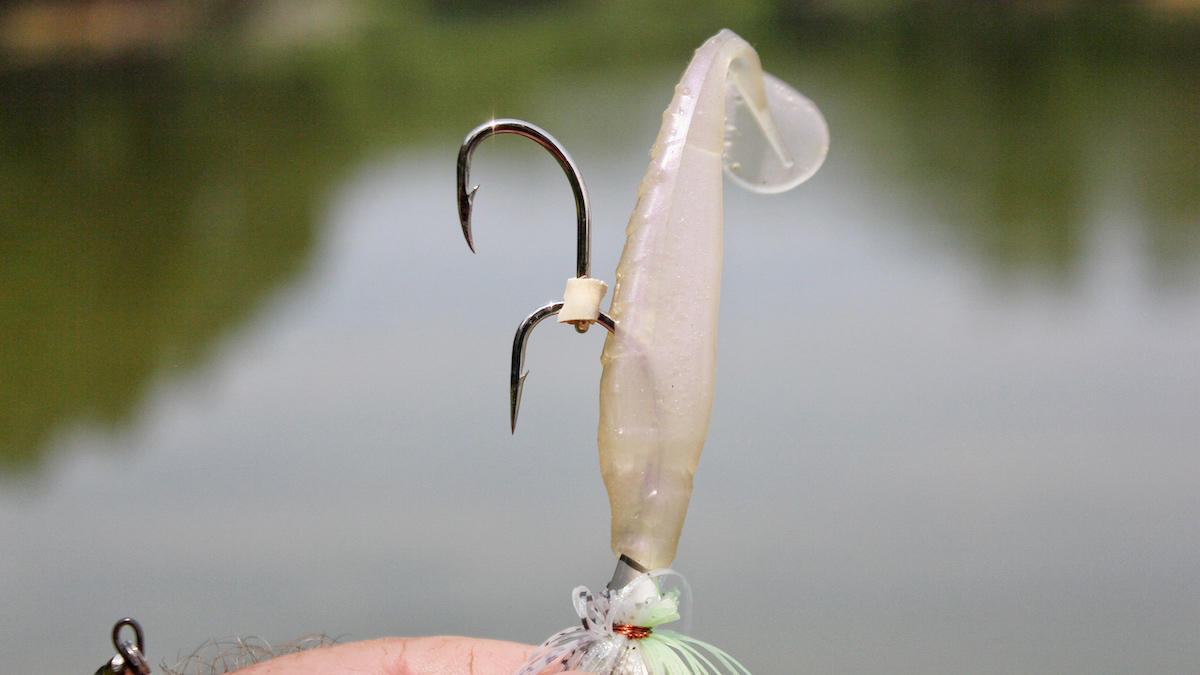
Have you ever put a fish in the boat and thought, "Man but I'm so glad I used a trailer hook!"? According to Shaye Baker of Wired2Fish, he has caught dozens of key fish that either were hooked only by the trailer hook or were pinned way better by a combination of the trailer hook and the main hook. Following are some of the options he prefers for securing a trailer hook:

Tubing on the main hook shaft.
 Spacer tubing like you can find at Jann's Netcraft is the perfect diameter to slide over the barb of the main hook and not quite allow the eye of the trailer hook to slide back over it and reach the barb. With this method, the hook swings freely and takes away some of the leverage a bass otherwise has to throw the bait.

Rubber over the eye of the trailer hook.
 This is the way most people probably started off securing a trailer hook...and the way a lot of 'em still do. You simply slide a piece of rubber or plastic tubing over the eye of the trailer hook and then run the main hook through the tubing and the eye of the hook simultaneously. This method works better for trailer hooks with a large eye. It keeps the trailer hook locked in an upward position, making it more weedless.

Small ziptie.
 With this method, you just put a trailer hook on the main hook, then run the point of the main hook through the clicker part of a 4-inch ziptie until it passes the barb. Then cut off all but the clicker part. You also can take a ziptie and use it to secure a trailer hook by looping it around the main hook, then running the end of ziptie through the clicker, the way it was designed. Pull it tight and cut off the excess, and there's no way a fish can pull off the trailer hook.

Open the eye and close it.
 You also can use a little Mustad circle hook (designed for saltwater fishing) as a trailer. Because the eye of a circle hook is just a bit too small to get some main hooks through, take side cutters and open the eye of the circle hook enough to slip it onto the main hook. Then use pliers to close the eye again. The best part of this method is that you don't have to add anything to keep the trailer hook attached.

Decoy versatile keeper.
 This new product works like the spacer tubing but allows you to use trailer hooks with larger diameter eyes as well. Simply place your trailer hook on the main hook and then slide one of these keepers over the main hook point, and you're good to go. The decoy versatile keeper is good for other things, too...like securing a soft-plastic trailer in place. Just slide your soft plastic up the hook shaft and into place, then slide the versatile keeper up the hook and into position right against the trailer.

All of these methods will work. Some, however, are better suited for certain situations. Shaye's recommandation is to try them and see if you increase your bite-to-catch ratio. If you don't, "then don't fool with them anymore," he says.


My thanks to Jim B. for providing the link to this item.

Sunday, July 12, 2020

'Twas a Typical Dog-Days Tournament


The heat of the day was all any of us wanted plus some, but we survived the test, and all but one of the 20 anglers in 11 boats brought fish to the scales. The 46 bass weighed in had a cumulative total weight of 98.03 lbs., for a 2.13-lb. average weight per fish and an 8.91-lb. average weight per boat.

Those who took home well-earned pay envelopes at the end of the day included the following:

1st Place
, the team of (from left) Rob Peppers and Don Carter, with five fish weighing 16.60 lbs. They also claimed the day's lunker pot with a 4.74-lb. bass.

2nd Place
, the team of (from left) Andy Morath and John Harmon, with five fish weighing 11.90 lbs., and a 2.90-lb. big fish.

3rd Place,
 the team of David Dozier and Richard Hall (not pictured), with five fish weighing 11.51 lbs., and a 3.18-lb. big fish.
Here is how the rest of the field finished:

     * The team of Mark Ingram and Gabe Himmelwright, five fish weighing 11.49 lbs., and a 2.75-lb. big fish.
     * The team of Gary Coderre and Dave Anderson, five fish weighing 10.87 lbs. (after 0.50 deduction for one dead fish), and a 4.12-lb. big fish.
     * The team of Jesse Munden and Jon Guzman, five fish weighing 9.87 lbs., and a 3.20-lb. big fish.
     * The team of James Calhoun and Rusty Girard, five fish weighing 8.16 lbs., and a 3.32-lb. big fish.
     * The team of Steve Bailey and Bobby Moore, five fish weighing 7.51 lbs., no big fish.
     * The team of Chris Fretard and Mike Miller, three fish weighing 5.10 lbs., no big fish.
     * Ken Testorff, three fish weighing 5.02 lbs., and a 2.52-lb. big fish.
     * Wayne Hayes didn't weigh any fish.

Congratulations to all of today's winners, and thanks to everyone who showed up for the contest. Our next scheduled event is Saturday, July 25th, from safe light to weigh-in at 2 p.m. Hope you can find a way to join us.


One Last Cast

As is so often the case, I had a game plan when I left the house this morning, but as luck would have it, my day started on a sour note and only went downhill from there. I hadn't much more than pulled up to my first spot this morning when a case of heartburn hit me. I subsequently had two giant blowups on a topwater bait that made me look like it was the first time I ever had held a rod in my hand.

I subsequently messed around for a few minutes with a jerkbait and a crankbait, neither of which produced even slight interest. I then picked up my worm rod and never looked back the rest of the day, given how warm it was. By this time, I had shed the case of heartburn, but you'd never have known it from the way I was swingin' and missin'. I had three fish nearly rip the rod out of my hand when I chunked the worm up next to some wood, but the best I got each time was a momentary feel of the fish, and then it was gone as fast as it had hit. All three of those fish had some size to 'em.

With only 30 minutes remaining before weigh-in, I decided to throw in the towel. Quickly weighed my fish and then headed to the ramp to recover my boat, where I was met with a host of boats and jet-skis that, for lack of a better way of putting it, simply didn't demonstrate the first ounce of handling ability. One fella in particular easily took 15 minutes just to get his trailer in the water like he wanted it. He then took another 25 or 30 minutes to get the boat on the trailer...and that was with the help of the two jet-skiers...need I say more? By the time he finally pulled off the ramp, there easily were eight or more boats waiting behind me to trailer their rigs...and I must say there didn't appear to be a happy camper in the bunch.

Such is the usual scene on any given Sunday this time of year. Just hope that guy ahead of me at the ramp couldn't read what I was thinking. If he could, I dare say his ears were burning by the time he had gotten out of my road.

Thursday, July 9, 2020

State Is Asking Virginia Anglers for Their Help


The Virginia Department of Wildlife Resources (formerly VDGIF) is once again reminding anglers that the introduction of Alabama bass into our waterways represents a tremendous threat to largemouth and smallmouth bass fisheries throughout the state. Anglers are reminded that it is illegal to stock fish into a public body of water without an authorization from DWR. Furthermore, anyone with knowledge of intentional stockings of Alabama or spotted bass should contact DWR law enforcement by phone at 800-237-5712, or send an email to WildCrime@dgif.virginia.gov.

Anglers who suspect they have captured an Alabama bass should take a picture of the fish, clip off a thumbnail-sized portion of one of the pelvic fins, and store the fin clipping dry in an envelope. The pelvic fins are located at the bottom of the fish, just under the head. Anglers then should either contact DWR by phone at 804-367-1293 or send an email to fisheries@dwr.virginia.gov.

As evidence of the invasiveness posed by Alabama bass, consider that the relative abundance of largemouth bass in Lake Norman, NC, declined to less than 8 percent of their former abundance following introduction of the Alabama bass. Lakes with relatively clear water and limited vegetation, such as Smith Mountain, Lake Anna, South Holston Reservoir, and Lake Moomaw, are likely to also see declines if Alabama bass are introduced there.

Once established, Alabama bass populations often hybridize and increase to the point where stunting occurs, resulting in greater abundance of smaller bass. Fisheries are likely to shift from being dominated by 2-to-3-lb. largemouth or smallmouth bass to being dominated by 1-lb. Alabama bass...not a matter to be taken lightly.

Monday, July 6, 2020

For Week Ending Sunday, July 12, 2020


Monday, July 6 (from Ron)...
Did a rare mid-day heat-buster in the saltwater in search of a flat-fish dinner. Got a nice pole-bender that took some drag, and I thought I had a big flounder. However, it turned out to be a puppy drum...odd for mid-day, as I usually only find them in the early morning or late evening. Was nice to hear the drag and feel the fight.
Monday, July 6 (from DMac)...I slipped out to Back Bay today. Had a fair to good day of froggin. Lipped 10. Weather peeps said south 5 to 10, but by 11 o'clock, it was blowin' 15, with gusts to 20. Makes for a less-than-relaxing day. Still managed to end with a minor case of bass thumb. Left my nice HUK shirt at home, so I had to deploy an old motorcross jersey for anti-dermatological protection. Had three bass that weighed between 3 and 4 lbs. The rest were legitimate keepers...well, OK, one dink. Does my soul good to see the game department actively pursuing the comeback of this fishery. I caught the heel end of the hey day. Between 1978 and 1980, there were gobs of 8-lb. bass out there. Redhead Bay, just outside of Davis' boat launch, had grass all the way across. So much for history, though.

Tuesday, July 7 (from Ken)...
For the first two hours this morning, I flailed with a couple of topwater baits, trying to find some fish. I finally managed to put a small white perch and a decent-sized crappie in the boat but only after whipping some braided line into a bunch of knots that I ended up cutting out. I barely had enough line left on the baitcaster spool to keep using the same rod but eventually tired of the topwaters and finally just put the rod down and forgot about it. Tossed a spinnerbait around then for about a half-hour with no takers before picking up the rod to which I had tied on a soft plastic. In a matter of about 15 minutes and about 40 or 50 feet of shoreline, I had boated three keeper bass, so just kept going the same direction. Between 8 a.m. and 12 p.m., I boated a total of eight bass, the best two of which weighed in at 1-12 and 1-13. Also recorded several swings and misses with the soft plastic. I cut the day short by a couple of hours, 'cause I wasn't anxious to deal with the dreaded heat any longer. And besides, my sole purpose in hitting the water today was to form some kind of game plan for our next tournament this coming Sunday. I now know the baits I'll be using. The only thing still up in the air is location, which will be determined by water level and water color on tournament day. Only saw a couple of other boats on the water today, not including the one big boy I encountered while running back to West Neck. Managed to ease over his wake and pass him in a wider section of the river with no bouncing around.

Thursday, July 9 (from Ron)...
With the high wind, I decided to dust off the freshwater gear. Fished Ashville Bridge Creek, and the weather was near perfect. Caught 11 bass on plastics and topwater between 6:30 and dark. Biggest was only a 1-10, but it was nice to be back out in the freshwater and not chasing the flatfish while battling the crowds for a change.
Friday, July 10 (from Ron)...
Still trying to find a keeper flounder. Not working well, but no skunk.
Saturday, July 11 (from Ron)...
I finally found a keeper flounder for dinner. Got a couple dinks as has been the norm and then one decent one that will make for a great dinner for two.
Sunday, July 12 (from Ron)...
Weatherman lied. It was supposed to be mostly cloudy. Instead, we had bluebird heat-wave skies, with zero wind. Caught a keeper puppy drum, as well as a 16.75-inch flounder.

Saturday, July 4, 2020

Who Says You Can't Catch Fish From the Back Seat of a Boat?

I have a good friend (and boat mechanic) who has owned a boat for a long time now and thus understandably enjoys being "in the driver's seat." More times than not, Wayne Hayes is a force to be reckoned with from that position, but the truth is that he also has demonstrated he can be equally formidable from the back seat.

In January 2003, for example, he finished first as a non-boater in a Bassmaster Tour event on Lake Okeechobee, weighing a total of 28 lbs. 2 ozs. and walking away with a $36,000 bass boat for his efforts. He backed that victory up just six months later, in July 2003, with another first-place finish as a non-boater in the Northern Open on the Potomac River. In that event, he weighed a total of 37 lbs. 10 ozs., and claimed ownership of a $24,000 bass rig.

When asked, he'll quickly tell you that he doesn't like fishing as a non-boater, but he certainly knows how to make the most of a day on the back seat.

Another angler with that ability is Walker Smith, who writes for Wired2Fish. I just read an article with his byline in which, for the first time in 10 years, he had accepted a buddy's offer to ride along as the co-angler for a day of fun fishing.

As a result of that one day return to his roots, Smith came away wanting to share some tips to help others catch more bass from the back of their buddy's boat. As he explained, "I won a state championship as a co-angler more than a decade ago, and this day brought back a lot of helpful lessons I've learned along the way." Following is his five-step primer for success as a co-angler:

Always watch which rod your boater picks up. Differentiating your offering from your boater's choice is probably the most important thing a co-angler can do. Essentially, you want to "train" your peripheral vision to notice the second your boater bends over to pick up a rod from the front deck. Always pay attention to what your boater is using. Don't zone out when it comes to this, especially early in the day when you're both trying to establish a pattern or prevailing bite together.

If your buddy is tossing a frog around shallow cover, don't throw a frog behind him. Instead, consider something subsurface, such as a soft jerkbait. By doing something different, both of you might quickly learn that the bass won't come to the top that particular day, but they'll crush a Fluke twitched a few inches below the surface. Those little adjustments can pay enormous dividends for both you and your buddy throughout the day.

Pay attention to what your boater is throwing, and unless he's knocking their lights out with a particular bait, try to keep changing up. One day, this will pay off in a huge way for you.

Don't wait for the boater to call for the net. It's always better to have the net ready and not need it, than the other way around. Grab the net as soon as your buddy sets the hook. If the fish turns out to be one not worth netting, you always can scramble back to the rear deck.

Speak up. This can be a touchy subject for some people. In most cases, the boater is the one who leads the decision-making process in a random-draw event. If the boater and non-boater are friends, they may come to an agreement to the contrary, especially if the action slows down. An alternative viewpoint in those cases often can be helpful. Instead of saying something, though, like "I think we need to do thus and such," perhaps offer a suggestion along this line, "Since what we've been doing seems to have slowed down (or stopped working), why don't we try something different?" Your tone and the words you choose can make a big difference.

Pay close attention to where your boater casts. Bass fishing can be a game of inches. A slightly inaccurate cast can be the difference between a 6-pounder and nothing at all. When you're on the back deck, this is even more magnified. Smith mentioned an experience he had had while fishing from the back deck for a full college season.

"I quickly learned that I would never get bit flipping or pitching my bug into the same areas the front-seater was hitting. He was a very accurate caster, and once his bait hit the water, he was very patient and thorough throughout the retrieve... . I couldn't buy a bite behind this dude. It was making me crazy.

"But as we fished more together, and as I matured as an angler, I quickly learned to watch him like a hawk. I'd start noticing that each one of his pitches was targeting an indentation within a grass bed. So, I started pitching my bait to small points in the grass bed. And what do you know? I started catching a bunch of fish and contributing to our limits. If he was skipping underneath boat docks, I'd start skirting the edges of the docks with a squarebill. It yielded a bunch of big fish for me over the years."

Etiquette matters. To be safe, it's always a good idea for non-boaters to bring some cash with them anytime they're invited to fish from the back of someone's boat. After all, there are a lot of hidden costs to owning a boat. Boaters often won't accept offers to pay, but the thought and gesture nevertheless matters. It also doesn't hurt to offer to clean up the boat afterward. Any offer at all is better than leaving the boater high and dry. Doing so very well may earn you another invitation down the road...and another chance of catching the bass of a lifetime. 

Friday, July 3, 2020

More Than One Way To Skin a Cat...


But I don't think you ever would catch me trying the afore pictured method of respooling. According to Shaye Baker of Wired2Fish, though, just tossing a spool over the side is a viable method if you happen to be on a lake by yourself and need to replace your line. You also can toss the spool in a bucket or bowl of water at home.

"This method has been gaining popularity," said Baker, "but it's not my favorite...the main reason being that some spools of line sink...fast. I found out the hard way. While the resistance of the water does help keep tension on the line, you have to reel at the exact right speed to make sure the line comes off the spool the right way.

"The line will naturally want to come off the spool the right way, since that is the easiest way for it to unspool," he continued. "But if you don't reel fast enough, then the spool won't necessarily orient itself correctly. If you reel too fast, the spool will flip and flop around in the water."

Baker went on to note that, if you choose to spool a reel this way, " Make sure the filler spool is rolling in the water with the line coming over the top of the spool for baitcasters, and that it's spinning in the water for spinning reels, with the line coming off the spool counterclockwise."

So, the next time you're feelin' froggy enough to respool just by tossing the spool over the side, make sure your timing is good. "Pay attention, or else it could sink like a rock," cautioned Baker. "Whatever method of respooling you choose, always keep a little tension on the line, and you'll be all set."

Tuesday, June 30, 2020

A New Species Invading Virginia Waters

Alabama Bass

Read the story at this link:

For Week Ending Sunday, July 5, 2020


Monday, June 29 (from Ron)...
Got out this evening and caught a few bass near the Beggar's Bridge. Grass is coming up nicely, and there was baitfish everywhere. Landed seven bass, with a 1-12 and a 3-2 best of the bunch. Most were in the 1-to-1.5-lb. range, and they were enjoying the Zoom Flukes and SwimSenko. Tried topwater but didn't get any bites.

Sunday, July 5 (from Ron)...
Been fishing a lot the last few days, but have been chasing the flat fish, 'cause I really want a flounder dinner. Hasn't been going too well, though.

Saturday, June 27, 2020

It Was All About the Heat in Today's Tourney


With water temperatures in the 80s, and an air temperature of 98 when I left the marina today for home, it's little wonder why so many of the 19 anglers in 12 boats on hand for the contest had something to say about the conditions. At least everyone managed to bring fish to the weigh-in. Our collective total weight was 123.95 lbs., which produced an average weight per fish of 2.21 lbs. and an average weight per boat of 10.32 lbs.

Standing tall in the winners' circle at day's end were the following contestants:


1st Place, the team of Mike Miller and Chris Fretard (not pictured), five fish, total weight 17.91 lbs., big fish 5.31 lbs.


2nd Place, the husband-wife team of Andy and Diana Morath, five fish, total weight 15.85 lbs., big fish 4.61 lbs.


3rd Place, the team of (from left) Gabe Himmelwright and Mark Ingram, five fish, total weight (after 0.50 deduction for one dead fish) 15.33 lbs., big fish 4.47 lbs.


Lunker of the Day, Jim Wilder, five fish, big fish 5.40 lbs. His total weight was 14.12 lbs.


Here is how the rest of the field finished:

     * The team of Rob Peppers and Don Carter, five fish, total weight 13.13 lbs., big fish 4.11 lbs.
     * The team of Gary Coderre and Dave Anderson, five fish, total weight 12.72 lbs., big fish 5.04 lbs.
     * The team of Dave Dozier and Richard Hall, five fish, total weight 9.82 lbs., big fish 3.10 lbs.
     * The team of Jim Crist and Danny Harris, five fish, total weight (after 2.00 deduction for four dead fish) 8.25 lbs., big fish 3.01 lbs.
     * Wayne Hayes, five fish, total weight 7.89 lbs., big fish 3.17 lbs.
     * Rusty Girard, four fish. total weight 7.28 lbs., big fish 2.70 lbs.
     * Bobby Moore, four fish, total weight 5.49 lbs., big fish 1.65 lbs.
     * Ken Testorff, three fish, total weight 3.95 lbs., big fish 1.67 lbs.

Congratulations to all of today's winners, and thanks to everyone who came out to participate. For planning purposes, our next event is scheduled for Sunday, July 12, from safe light (about 5:30) to 2 p.m. Hope you can join us.


One Last Cast
You may have noticed in the above commentary that Jim Crist had a problem with his livewell in what is a nearly new boat. That being said, he was left scratching his head in bewilderment after losing four of his fish and taking a 2-lb. penalty at the end of today. After all, he had followed the textbook advice and done everything right to keep his fish alive.

I couldn't help remembering another angler a few years ago who had a similar problem. As he eventually learned, the gremlin turned out to be a short in the livewell wiring. In reality, the short had electrocuted every single fish in the livewell that day.

I'm not saying that Jim has a short in his livewell wiring, but it certainly seems bizarre that he lost so many fish today when, up 'til now, he has had a perfect record of weighing in all live fish. As depicted by the above commentary, only one other boat lost a fish today, so it's not like we had an overall high mortality rate.

It seems a pretty safe bet that Jim will have someone troubleshoot his problem before the next tournament, and I'll be anxious to find out what he learns.

Friday, June 26, 2020

What Ever Happened to Everyday Common Courtesy on the Water?

I have lived through an era when fishermen, pleasure boaters, and watercraft operators in general usually showed considerable respect for one another on any given body of water. Not so much today, though. Hence, the reason for my title on this post.

Consider the following real-life example of what can happen when someone takes their eye off the ball:

I was anchored at night, near a bridge on a local lake, when a 24-foot cabin cruiser crossed over the middle of my boat, with his hull resting on my center console and the front pedestal seat. His estimated speed was 30 to 40 mph. I took on an estimated 75 to 100 gallons of water as the other boat forced the front of my boat underwater. This whole incident took between 30 and 45 seconds from the time I initially saw him until he was on my boat and over it. Fortunately, no one was seriously injured.

As noted by the editor of the publication which ran that account, "We must maintain safety and courtesy if our sport and those who participate in it are to remain free of stigmas. Tournament competitors, crappie fishermen, sailing enthusiasts, and anyone else have a right to be on the water. It's up to each of us to respect the other's space. Accidents can happen, but they'll happen less if people are more courteous and conscientious while on the water. Be safe, not sorry."

As the numbers of vessels on our waterways continue to increase each year, such marine customs as common courtesy, good manners, and the golden rule on the water become prime ingredients of boating safety. Practicing these traditional amenities, Coast Guard Auxiliary instructors point out, is largely the exercising of common sense and fair play, as well as respecting the rights of other boaters. This practice also sets a great example for the novice skipper.

There are a number of boating courtesies and examples of good and bad manners covered in the Coast Guard Auxiliary boating classes. Here are some of the more important ones:

Speed. Keep your speed down in narrow channels, anchorages, harbors, near docks, and in the vicinity of fishing vessels, water skiers, small sail boats, and kayaks.

Wakes. Severe damage to moored vessels, docks and seawalls can result from heavy wakes. Keep your wake down in confined areas. It not only is good manners, but it's the law as well...and you can be liable for any damage caused by your heavy wake.

Buzzing. The "hot rodder" boater shows a lack of courtesy by buzzing piers, swimming areas, and other vessels. Such practice isn't only very dangerous but will draw the attention of law-enforcement personnel very quickly, resulting in severe penalties.

Pollution. The considerate boater retains used cans, cartons, garbage, and other debris in a container until the cruise ends.

Right of way. If the other boat fails to recognize your right of way, the well-mannered and prudent skipper will avoid a collision by giving way.

Anchoring. Only the thoughtless skipper anchors in mid-channel or ties illegally to a buoy or navigation aid while fishing.

Bow riding. An extremely dangerous practice, especially where children are concerned. Please do not allow this practice on your vessel.

Boozing. Drinking alcohol while operating a vessel can be a deadly practice, so don't do it! Very severe legal penalties await the boater who is arrested and charged with "boating under the influence of alcohol." You owe it to your family, passengers on your boat, and to other boaters who share the water with you to stay sober.

Giving the other fellow a helping hand when you spot a distress signal is the mark of a considerate boater and long has been the tradition and law of the sea. Even at the launch ramp, courtesy and good manners come into play. It may be something as simple as helping another boater launch his craft.

Your Coast Guard Auxiliary boating instructors stress that practicing courtesy and good manners is not only elementary but essential as well in developing boating skills and seamanship.

Wednesday, June 24, 2020

Everything Comes at a Price, Even Fishing


According to a BassFan special report from 2010, an injury crisis already existed in pro fishing. Estimates of the extent varied at that time, but pro angler Clark Wendlandt said he believed that 20-year pros over the age of 40 experienced nagging injuries at a rate of 85 to 90 percent. Scott Suggs, on the other hand, estimated that 60 percent of all anglers had some type of issue with their shoulders, elbows or hands.

The bottom line here is that, while pro fishing is a major sport, it lacks one thing all other major sports have: trainers and medical staff able to deliver immediate care and advice. There hasn't even been a major study of the toll pro fishing takes on the human body and what can be done to prevent injury.

Billy Brewer, a former pitcher who threw in the majors for seven years, developed fishing elbow in just one season with the Bassmaster Elite Series. He was a left-handed pitcher but worked the rod with his right hand.

"You're out there 14 hours a day, sometimes all week long, and you make so many casts, and use your arm so many times," said Brewer. "You see a lot of guys out there wearing braces on their elbows, but like in baseball, you have to do exercises for the elbow. I think if more guys did that, it would help prevent a lot of injuries.

"The one thing that really gets me," added Brewer, "is my lower back. You stand on your feet 12, 13 and 14 hours a day, every day, all week long, so you've really got to have a strong core for that not to hurt. Guys like John Crews and Mike Iaconelli work out during the off-season to strengthen their core, and I think that's a real smart thing to do."

Athletes of all kinds often push themselves too much during competition--in other words, play with pain--but the cumulative micro-trauma through the years escalates. As a result, injuries then can happen while doing something simple, like loading tackle into a truck or strapping down a boat.

For example, Chad Grigsby had fished hard for a week, then was on his way home when he decided to stop at a buddy's house. A 70-pound bow was there, and like all outdoorsmen, Grigsby felt the need to draw the bow. In the process, he tore a muscle in his shoulder and had to complete a rehab program.

In most cases, victims of fishing injuries are those who compete in tournaments, but recreational anglers also pay a price for enjoying their favorite sport.

Was reading a related article by outdoor columnist Bobby Peoples the other day in which he noted that many bodily injuries to both recreational and competitive anglers don't show up for years. He was in his early 20s when he began serious competitive fishing for largemouth bass, but it was 20 years later before he was diagnosed with his first serious problem: tennis elbow.

Said Peoples in a February 2020 account, "My elbow was swollen to the size of a large orange, and the injury required me to stop fishing for a few weeks. During that time, I had cortisone injections, fluid removal, and took medications to relieve the pain."

As more injuries occurred, Peoples was forced to swap competitive angling for slower-paced recreational angling. Additional injuries made him have to slow down even more. After elbow surgery, arm surgery, multiple hand and back surgeries, knee surgery, plantar fasciitis, and foot surgery, he didn't have any other choice. While not all of these could be tied directly to his fishing, Peoples felt sure that fishing played a major role in all of them.

His most recent encounter was a left-thumb problem that resulted in a visit to an orthopedic doctor and eventual surgery. The doctor asked him what type of repetitive things he had done with his left thumb, because the thumb joint was completely worn out. As Peoples explained, he had for years held his rod and reel in his left hand and thumbed the spool and put pressure on that joint. Whether holding the reel, casting, thumbing the line, or pulling in a fish, he had been applying pressure to that joint.

The surgery required removing a bone from his thumb, taking a ligament from his arm, and putting it in place of the bone that was removed. He subsequently had to wear a cast for six weeks, and once the cast was removed, take physical therapy.

"Many anglers don't realize until it's too late that they need to take care of their fishing bodies," said Peoples. "That means exercising and understanding the physics of repetitive casting and other related fishing activities. While repetitive casting accounts for most hand, arm, elbow, and shoulder injuries, standing up in the front of a bass boat for several hours can cause many back, leg, knee, and foot problems.

"A boat ride in even mild wave turbulence can put pressure on your back," he continued. "I recently tried to determine how many miles I had driven my boats over the years but finally gave up. It's safe to say, though, it's hundreds, if not thousands, of miles over 40 years of fishing. Riding in a boat definitely can contribute to back problems."

Most anglers think very little about personal injury to their body until an injury has occurred. Even then, most of them just shrug off the pain until it gets to the point where they have to visit a doctor. Ice, heat and over-the-counter inflammatory creams and pills may help for a while. On the other hand, you may never suffer an injury that requires surgery. If that's the case, count yourself lucky.

The No. 1 thing that can be done to help avoid injury is exercise. Most anglers, however, don't participate in any because if they're not working, they usually are fishing.

And, yes, there's no doubt that young anglers in their 20s, 30s or 40s scoff at any discussion like this one. They say to themselves, "I'm healthy as can be and don't have a single problem." As in the words of that old Western swing standard, though, "Time changes everything."

Tuesday, June 23, 2020

There's Bad, And Then There's Super Bad

Seems there was this angler who lived in West Virginia and planned to fish a lake in Virginia. He got up and left his house at 7 a.m. on the Saturday in question. He figured that would put him at the lake around 9 a.m., and he then would fish 'til dark.

Everything was looking good until he was about 30 minutes from the lake. Out of the blue, his stomach started making those dreadful rumbling sounds. "No big deal," he thinks. "I'll pull off at the next exit."

He pulls off as planned and quickly sees that the only thing which appears to be open is a McDonald's. "I'll take care of my stomach and grab a quick breakfast," he thinks. One problem, though: The only service is drive-thru...the doors are locked. "OK, I'll just go at the ramp"...or so he assumes.

One look around when he arrives there reveals nearly a hundred trailers in the parking lot. "Wouldn't you know I would have to pick a date when there's a Saturday tourney" was the phrase running through his head. Nevertheless, he preps the boat for launch, then walks over to the bathrooms, only to find the doors locked. "Great...that means a trip to the woods!" he thinks.

Following launch, the angler has been on the water a while without even a sniff of a bite when he looks up and sees the game wardens coming. Luckily, everything was good with them, and they were gone in no time after wishing him a good day.

Two more hours pass without a bite yet, then four more hours, and still no bite. The angler then pulls up on a johnboat with a dude and his girl, who both appear to be in their 20s, and he sees the girl catch two fish just as he passes by. He changes lures to what she's throwing but still has nothing to show for it after another half-hour has passed. This is where things go from bad to ugly.

As the angler tries to crank up the gas motor for a run down the lake, it won't even turn over. "Oh great, now I have a dead cranking battery," he thinks. Moments later, he opens the lid to the bilge to try jump-starting from the trolling battery and finds both batteries halfway under water. "What the crap is this!" he thinks as he begins pumping out gallon after gallon of water.

After an hour's troll, the angler arrives at a ramp halfway up the lake from where he launched. He ties off the boat and leaves the bilge pump running while he bums a ride with a kid back to the launch ramp. He then drives back to where the boat is and loads it up...getting all his clothes wet in the process.

Once he pulls the boat plug, he sees why the boat has been taking on water. There's a big crack in the hull in the seam of a weld on the right side of the transom. He utters an F bomb and makes the two-hour drive home. He just gets the boat parked and is walking around to plug in the battery charger when he notices the license plate on his trailer is missing...apparently having blown off on the trip home.

"What a freaking day!" he exclaims..."and all for not a single bite" as he trudges toward the house.

Monday, June 22, 2020

For Week Ending Sunday, June 28, 2020


Monday, June 22 (from "Doc")...
Went out this morning and fished about two and a half hours. The heat hit me about 8:30 a.m. and ran me off the water (LOL). Fished southern West Neck Creek and caught three dinks, the biggest a 13-incher, weighing 1 lb. I'd swear two of them were the same fish, but I'm claiming I caught a total of three bass...all on a crankbait. I can't seem to make it out the creek.

Saturday, June 27 (from Ron)...
Glad to be back from a business trip. Made short evening trip to upper North Landing. Caught 12 bass, but they were all small. Biggest was only 13 inches. Was fun, and I was happy to wet a line and catch a few. U-Vibe worms and Pop-R were working well. Odd I couldn't find any bowfin because this area is my go-to for them.