Sunday, August 2, 2020

A Look at How Covid-19 Is Impacting Our Sport


As for yours truly, my time on the water has been reduced somewhere between 50 and 60 percent in the last few months. Granted, I can't chalk it all up to the coronavirus, but that, along with the heat and humidity in recent weeks, certainly has been involved. For the most part, I've been limiting my trips to the scheduled Dewey Mullins Memorial Bass Tournaments.

Accordingly, I decided to research what was been happening in other circles as a result of the pandemic. It didn't take very long to find how Walker Smith of the Wired2Fish staff weighed in. "I'm certainly not taking this virus lightly, but what is it going to hurt to let us keep fishing?" was his response to learning that Illinois had closed all of its state-owned fisheries, wildlife areas, and parks.

"This is our pastime, and we're not hurting a soul," he continued. "Is there a better, more enjoyable way to practice social distancing...? Personally speaking, I can launch my boat and not touch a single thing that's not mine... . I'm not talking to anyone, and I'm dang sure not any closer than 6 feet from anyone. Heck, I won't even be 200 yards from someone."

One of the worst things for your immune system is stress. As Smith explained, "Myself and millions of others combat stress with fishing. Let us continue to take our kids on the water. Let us continue to breathe fresh, clean air... ."

I might add, "Let us enjoy what we can of the new normal."

During my research for this post, I also stumbled across an interview of Ken Duke, the managing editor of Fishing Tackle Retailer Magazine. It was done by Lyons Nida, a guest writer for Six Mile Post, the student news site of Georgia Highlands College.

"Potentially devastating" is how Duke described Covid-19's effect on the fishing industry. "Our very way of life has been fundamentally altered," he said, adding, "many industries have found themselves negatively impacted... ."

It first hit the production chain.

"So much is made in China," noted Duke, "and because of Covid-19, many of these products either have not been made at all or in a timely manner. This hit to the supply chain would be devastating enough on its own, but it's been made much worse by the impact on major retailers."

According to John Nida, president of a small Georgia fishing company, "60 percent of my company's revenue comes from business with big box retailers. When Covid-19 hit, big box retailers, such as Bass Pro Shop, Dick's Sporting Goods, and Academy Sports, immediately began to reduce the number of operating hours and reduce staff. It eventually led to their closing in-store sales to consumers, relying instead on consumer sales through online orders to be picked up curbside. For us, this had a dramatic negative impact."

Duke explained that the timing of the virus also was extremely unfortunate for the fishing industry. "The biggest time for sales is March, April and May, which, of course, is around the time the virus hit America. The entire industry essentially is missing out on their biggest season for sales... ."

While people are less likely to spend money on non-essential goods during a crisis like the current one, Duke noted there has been some good news for stores like Walmart that have remained open and continued selling fishing goods. "Unfortunately, though," he said, "the issue of supply has kept this from being a massive positive. There just aren't enough products to reload these stores."

"On the flip side, however," as explained by Nida, "roughly 40 percent of our small-business sales comes from independent dealers, and when consumers can't go to the big box retailers, they often go to local retail shops instead. To that extent, we've seen a jump in sales."

As earlier noted by Walker Smith of Wired2Fish, fishing is a sport that has built-in social distancing, so it still can be performed during a pandemic. Otherwise, the situation would be a lot more grim than it already is.

Tuesday, July 28, 2020

Bass Fishing Injuries--A Joke?

Photo by James Overstreet

Don't try to convince someone like veteran Oklahoma bass pro Tommy Biffle of that. Here's a 62-year-old tournament angler who, after a lifetime of piloting little boats through big waves, can't really pivot his neck or torso.

When he started, the standard craft was an 18-footer powered by a 150-h.p. outboard. Granted, today's bigger, sleeker bass boats provide a much better ride, but anglers still take a pounding when they're fishing places like Erie, Okeechobee or Sam Rayburn and have to run 30 miles in 30 minutes for weigh-in.

Someone else who can tell you a few stories about piloting little boats through big waves is 1998 Bassmaster Classic champion Denny Brauer. This 71-year-old has endured at least five back surgeries.

As 2008 Bassmaster Classic champion Alton Jones explained, "Nothing takes a toll on a person's back like driving a boat in the conditions that pro anglers often face on Lake Erie. In the worst of times, you may be running 75 miles per hour while negotiating torrential rain and/or winds that cause 6-foot waves.

"Young anglers feel it," continued Jones. "More experienced anglers, with, say 20 or more years of tournament history, feel it more acutely, and many routinely wonder how long they can stay anywhere near the top of their games."

Veteran outdoor writer Pete Robbins added, "The problem with being on tour and suffering these injuries is that, unlike other professional sports, there are no trainers, masseuses, or team doctors to work out the kinks. You just get back in the truck and drive 12 hours to the next 12 rounds of battling a watery environment. The simple truth is that, if you don't fish, you don't earn, and if you don't earn, you don't eat."

What pro anglers do believe is that if they can live relatively pain-free, they can compete at a high level. That's where BACAS, the Houston, Texas-based interventional pain-management practice comes in.

Whereas BACAS has been treating a variety of patients since opening in 2006, their doctors have developed specific sports-injury and recovery programs designed for professional athletes, including more recently an angler-specific initiative.

When working with anglers, BACAS addresses pain from head to toe, with aggressive treatments for such ailments as tendonitis, neck and back stiffness, migraines, torn rotator cuffs, dislocations, sprains, hamstring pulls, natural wear and tear and overtraining issues.

The BACAS team includes four physicians with varying specialties and backgrounds. This allows BACAS to offer what Senior Executive Vice President Melonie Butler terms a "multidisciplinary approach" that is unlike any other.

"Our physicians collaborate in order to deliver an accurate diagnosis," she said. "They are methodical and diligent in pursuing a patient's pain triggers. They absolutely will find and deal with the root causes of pain," she assured.

Both Biffle and Jones now are free of lower-back pain and say they feel years younger as a result of what the BACAS team has done for them, which, according to BACAS founder and physician Nelson K. Bond, is typical.

Incidentally, BACAS is an official physician sponsor of Major League Fishing. The physical demands on the body and the repetitious nature of anglers' actions eventually generate pain (acute or chronic) and injury. Through the RESET program, BACAS physicians reset tired and overworked bodies without surgery or long-term narcotic pain medications. BACAS experts identify, treat and correct issues that produce pain, limit function, or cause weakness from injuries, wear and tear, and/or overuse. BACAS treats patients from all over the United States. For more information, visit the website at http://www.bacasmd.com.

Saturday, July 25, 2020

Lots of Anglers on the Water


Our tourney anglers were sharing the water today with a group of kayakers, who also were holding a tournament. As usual, however, my diatribe will focus only on our tournament, which consisted of 11 boats and 18 anglers. Our collective total weight was 116.88 lbs., which translates into an average weight per fish of 2.24 lbs. and an average weight per boat of 10.62 lbs. Everyone but yours truly weighed a limit (I caught five fish, but only two of them were keepers).

Those who went home with a pay envelope in their grasp included the following:

1st Place
, the team of (from left) David Dozier and Nelson Anderson, 16.78 lbs. total weight, 4.82-lb. big fish.

2nd Place
, Eddie Sapp, 13.78 lbs. total weight, 4.12-lb. big fish.

3rd Place
, the team of (from left) Rob Peppers and Don Carter, 12.57 lbs. total weight, 4.85-lb. big fish, which also gave them braggin' rights for the day's Lunker Bass.
And, as Paul Harvey, always used to say, "Now, for the rest of the story:"

     * Rusty Girard, 11.21 lbs. total weight, 3.62-lb. big fish.
     * The team of Bobby Moore and Steve Bailey, 11.04 lbs. total weight, 3.14-lb. big fish.
     * The team of Fred Crawford and Gabe Himmelwright, 10.85 lbs. total weight, 3.02-lb. big fish.
     * The husband-wife team of Andy and Diana Morath, 10.03 lbs. total weight, 3.22-lb. big fish.
     * Jim Wilder, 9.30 lbs. total weight (after 0.50 deduction for one dead fish), 2.51-lb. big fish.
     * The team of Gary Coderre and Dave Anderson, 8.98 lbs. total weight, 2.93-lb. big fish.
     * The team of Chris Fretard and Mike Miller, 8.49 lbs. total weight, no big fish.
     * Ken Testorff, 3.85 lbs. total weight, 2.83-lb. big fish.

As a result of having fished a total of six tournaments since the beginning of the year, the following anglers now are qualified to fish the season-ending two-day Classic: Andy Morath, Gary Coderre, Gabe Himmelwright, Chris Fretard, Mike Miller, and Ken Testorff.

Congratulations to all the winners today, and thanks to everyone who participated. For planning purposes, the next event is scheduled for Saturday, Aug. 8. Launch time will be safe light, with weigh-in at 2 p.m. Hope you'll try to join us.


One Last Cast


Can't remember another time since the beginning of the Dewey Mullins Memorial Tournament Series that a kayak tournament coincided with one of our events. Despite the increased number of craft on the water today, though, everyone appeared to be respecting others' rights with no visible problems...the way it always should be.

Gotta say it really got hot once the sun came out this morning. I had hoped the promise of "mostly cloudy" skies would hold throughout the day, but that wasn't the case. Have to admit, though, that I had absolutely no bite at all until it got good and hot. The highlight of my day happened when I found a tiny pocket of super shallow water where a bass appeared to be chasing baitfish. I cast my worm into the middle of the visible fray, then reached down to pick up something from the deck of my boat, only to look up and see my line cutting a path to the right. I quickly took up the slack and set the hook on my best bass of the day.

And last but not least, I want to take this opportunity to thank assistant tournament director Rob Peppers for taking charge of today's event in the absence of Wayne Hayes, who happened to be fishing a Region 7 event elsewhere. It's nice to have seamless backup when it's needed. Might I also say it's nice to just be fishing this year. Can't say I've ever been happier.

Wednesday, July 22, 2020

For Week Ending Sunday, July 26, 2020


Tuesday, July 21 (from Ron)...
Fished Ashville Bridge Creek this evening for an hour and a half before the lightning started near dark. Caught a dink, a 1-7 and a 1-9 on the SwimSenko. Nice evening but no bowfin and surprisingly no bugs. The bugs may have been killed off by the heat!
Thursday, July 23 (from Ron)...
Took advantage of the "cool" weather and fished Back bay this evening. The break I saw in the thunderstorms didn't last long. Right off the bat, I caught a nice 2-0, and then the rain started. Spent the next hour plus getting soaked and managed only a two ouncer! I thought a topwater bite was supposed to be good in the rain?

Friday, July 24 (from Ron)...
Short evening trip out of  West Neck Marina. Caught seven bass, including two dinks, a 1-1, 1-5. 1-6, 1-7, and 1-13. No rain, but it would have been welcome as the humidity was awful. Bite was better this evening on the SwimSenko and Whopper Plopper.
Saturday, July 25 (from Ron)...
Fished Tecumseh this morning, and the bite was good, if not very slow to start. Seemed they didn't wake up until about 0930, and then I had fun catching seven bass, including three dinks, a 1-6, 1-10, 2-12, and a nice 4-1. Zoom U-Vibe worms were the ticket.
Sunday, July 26 (from Ron)...
Wanted to fish Milldam Creek this morning. Launched about 0630 and headed eastward. About 0730, I realized that I forgot my Hoo Rag face covering and didn't have sunscreen, so headed back to the launch creek where I could find some shade. Managed to catch a few fish. Not a total loss, but would have liked to fish the hot spots along the sun-drenched Milldam.

Monday, July 20, 2020

105 Years Old and Still a Viable Fish-Catcher

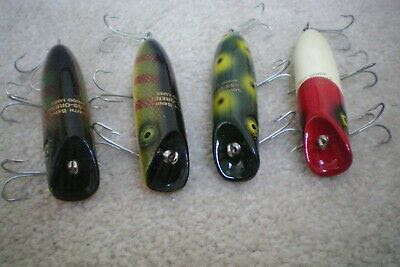
That speaks well for the South Bend Bass-Oreno, which was patented in 1915 by James S. Olds of Benton Harbor, Michigan. He sold the rights to his lure to the South Bend Bait and Tackle Company shortly after he received his patent.

Production of the lure started in 1916, and it became the company's signature lure. Among the earliest fishermen who used it, the lure came to be known as "Old Redhead." And it still can be found in a lot of old-timers' tackle boxes to this day. As a matter of fact, I have about nine of them in my box now.

This topwater bait quickly earned a reputation as being the best surface lure sold, and some fishermen took that idea one step farther. Many of them called it the "best surface lure ever made."

With a production run of more than 80 years, the Bass-Oreno has become the longest and oldest production-run lure in history. Millions of Bass-Orenos were manufactured during those years. As a result, its value as a collectible is small, compared to some other vintage lures.


As I was researching this item, I came across a Field & Stream article titled "30 Antique Fishing Lures and Why They're Collectible." Authors Robbie Pavey and John Merwin afford you a look at some unusual specimens. Here's the link if you're interested: fieldandstream.com/collecting-antique-fishing-lures/.

Sunday, July 19, 2020

Milking It for All It's Worth

That's the concept bass pro and 2017 Bassmaster Classic champion Jordan Lee (at left) applies to each and every one of his fishing outings. Rather than just concentrate on how bad an outing may have been, he works on learning something from it that he didn't know the day before.

"For example, I've fished Florida's Kissimmee chain of lakes in three different tournaments," he said. "In two of those tournaments, I finished in the bottom 100. I never really felt I was fishing in the right areas to catch bass. So, I learned all the things I'd done wrong in those two bad tournaments. In the third tournament, I'd learned how to break down the water better to identify the areas I needed to fish. I searched for cleaner water than I'd fished in the two previous tournaments, and I finished much higher in the third tournament than in the previous two... ."

According to Lee, the secret to consistently catching bass everywhere at different times of the year is to take what you've learned from a bad fishing trip and store it in your memory bank. "The next time you fish the same body of water, you'll be better prepared to find and catch the bass there," he explained.

He contends everyone should gain experience fishing all types of waters under all kinds of water and weather conditions. Doing so will help you solve the problems more quickly and easily the next time you're not catching bass.

Like a lot of other anglers, Lee believes in that saying, "There are no substitutes for spending time on the water to become a better bass fisherman."

Saturday, July 18, 2020

Another Blast From the Past


The Gurgling Joe lure is a plastic lure dating to the early 1940s. National Fishing Lure Collectors Club (NFLCC) member and author, George Richey, documented this lure in his book as "Made in Michigan Fishing Lures" (1995). It came in a red cardboard tube with a paper label that reads "Gurgling Joe, Large Mouth Chub, Manufactured by Van Hee Bros. Co., Exclusive Representative, North American Products Company, Wayne, Michigan."

The Gurgling Joe is a sinking lure that measures two and three-fourths inches long from the tip of the lip to the tail and has two treble hooks. It has a large, flat, molded lip and four holes that extend completely through the body, from belly to spine. These holes angle forward at the bottom and apparently would cause the lure to "gurgle" or bubble when retrieved (likely in a short jerking motion).

The body is made of a transparent plastic, and as far as collectors can determine, came in four different body colors, including clear, yellow, red, and blue, with the latter being the most difficult to find.

The holes are of a different color, including yellow, red, white, and black. It's suspected there probably were a total of 15 different lure body-hole color combinations in the beginning, but only 10 different combinations have been discovered so far.

The red cardboard tubes these lures came in have been found with two different labels: one with a silver background, and the other with a white background. These labels come off rather easily, so many are found with no label.

Current collector values usually range from $25 to $40 in excellent condition, with tube. Anyone who buys one of these lures off eBay, however, should be advised not to expect any paperwork in the tube. For some unknown reason, no one ever finds instructions, color charts, etc. when buying one of these lures.

Friday, July 17, 2020

Look at One of the Latest "Toys" for Kayak Anglers


As noted by Jay Kumar in his latest BassBlaster, where I happened upon this piece, "Ain't a kayaker but got a friend or two who are... . And if they ain't stoked to learn about this, there must be somethin' wrong with 'em."

The MotorGuide Xi3, 55-lb.-thrust, 36-inch shaft on this rig comes with or without Pinpoint GPS. The lightweight design and SecureStep system of this trolling motor makes it simple to stow and deploy, even in a seated position. Along with its nearly silent operation and wireless remote, it's the perfect addition to any kayak.

Xi3, with available Pinpoint GPS, allows anglers to focus on fishing while taking advantage of GPS functions, such as anchor, heading lock, route record, and more.

In the words of Yak pro Derek Brundl, "It's an absolute game changer...using the Pinpoint GPS anchor mode to hold on a certain piece of structure and pick it apart without having to constantly adjust my boat position has been invaluable to improving my offshore fishing success."

With wireless control out of the box, there's no need for an expensive add-on. And the SecureStep system makes stowing and deploying Xi3 50 percent easier than the competition. You also get best-in-class quiet operation that's up to 40 percent quieter than the leading competitor.

Available at retailers in January, the MSRP is $1,199.99 with GPS, and $739.99 for a non-GPS model. Click on this link for an install/operate video: https://www.youtube.com/watch?v=mS-ZDzp0fUE&feature=youtu.be.

Day Late and a Dollar Short

For what? you may be asking. The answer: World Snake Day! That's the word from Virginia Department of Wildlife Resources and the email I received from them yesterday, which noted that July 16, 2020, marked the official date of celebration.

Can't say I've ever celebrated this event to date, or that I will in the future either. You see, snakes and I, in general, have an agreement: I won't bother them if they don't bother me. And the more "social distancing" there is between us, the better.

In keeping with the premise of this annual celebration, though, "to raise awareness of the nearly 3,500 species of snakes that inhabit our planet," the Virginia Department of Wildlife Resources chose to feature what many folks consider to be "America's snake," the timber rattlesnake. Incidentally, did you know this snake nearly became our national symbol?

Native only to the eastern United States, no other animal better represents America's colonial history than the timber rattlesnake--the department's words, not mine. Its image has been used as a symbol of the American colonies, beginning with the French and Indian War (Join, or Die) and lasting to the end of the American Revolution. It has been featured on the first Navy jack and Gadsden (Don't Tread on Me) flags, and in 1775, Benjamin Franklin was so enamored with the rattlesnake that he wrote about why he believed it was the ideal image for the colonies.

"She [rattlesnake] never begins an attack, nor, when once engaged, ever surrenders. She is, therefore, an emblem of magnanimity and true courage," Franklin wrote.

The timber rattlesnake is found primarily in the mountains of western Virginia and extreme southeastern Virginia, where it is commonly referred to as the canebrake rattlesnake. Like all snakes, they play a critical role in ecosystem health as both predator and prey. As a predator, they consume a wide range of rodents, which inadvertently can remove up to 2,500 ticks annually from the wild. This is great news, considering the ever increasing problem of Lyme disease throughout the northeast.

Unfortunately, timber rattlesnake populations are in decline as a result of habitat loss, road mortality, illegal collection for the pet trade, and human persecution. If you're "lucky enough" (really...are you kidding me?) to encounter one of these magnificent creatures, practice social distancing (no sh**, Sherlock!) and just leave them alone. As Benjamin Franklin noted 225 years ago, rattlesnakes are not aggressive unless provoked (so what if they just don't like your looks?).

If you're interested in learning more about the different snakes you may come across in the Commonwealth, you might consider getting a copy of the Guide to the Snakes and Lizards in Virginia.

The 2nd Edition of this 72-page field guide includes more than 170 photos covering the ecology, distribution and conservation of Virginia's 32 species of snakes and nine species of lizards. It is an expanded version of the current snake guide, with more technical information and new photos. The price is $16.95.

For Week Ending Sunday, July 19, 2020


Thursday, July 16 (from Ron)...
Took a short evening trip to upper North Landing. The first bass was a 1-4. Numbers 2 through 12 were all less-than-a-pound dinks, and the 13th was a 1-12. Swim senkos, Zoom Flukes and micro-spinners all produced. I really wanted to throw some topwater lures, but one of the dinks made off with my lip grip, which broke off my lanyard somehow. I hope he throws it. I didn't want to mess around with treble hooks without my lip grip, so decided not to use a topwater. Was very nice to be back in the solitude of the skinny freshwater creeks. Didn't see a single boat, jet ski or any other fisherman.

Saturday, July 18 (from Ron)...
Fished upper West Neck around Indian River Road this morning. Found five dinks, and the bite was slow, to say the least.  

Thursday, July 16, 2020

Ever Hear of the Li'l Tubby?


That's right. I'm talkin' about a fishing lure that was a smash hit when it first came on the market in the mid-1970s. As described by Glenn Titus, The Oklahoman outdoor writer in 1975, the Li'l Tubby (pictured above) was a "two-inch-long, half-ounce, wobbling crankbait, with a fish-calling rattle and a quivering, squirming, twister tail."

The headline on that '75 story read "Li'l Tubbys Come in 36 Flavors and Fish Love 'Em."

What made Li'l Tubbys unique was the assortment of tails that could be attached to the bait. The lure came in six different colors, but with the assortment of tails available, anglers could have 36 different combinations.

Storm Manufacturing Company, located near Norman, OK, where Jerry Rhoton (right), the Li'l Tubby inventor, worked for four years, made and sold the lure. (NOTE: Rhoton, 81, passed away July 8, 2020.)

According to fellow Oklahoman Jimmy Houston, who was good friends with Rhoton for more than 50 years after meeting him at a bass tournament, "Everybody called him Tubby after he built that bait. It was an incredibly great bait. We just smoked 'em on it. It was like a Wiggle Wart with a tail pretty much."

Houston went on to note that Rhoton was "a good Oklahoma bass fisherman and definitely a pioneer in the game. I would like to see us bring the lure back."

Storm later produced variations of the lure, such as Deep Diving Tubby, Tiny Tubby, and a spinnerbait manufactured under the Tubby name. Eventually, however, Storm was bought by the company that produces the Rapala brand of lures. Li'l Tubbys subsequently were discontinued, but they still are bought and sold on eBay.


I must confess that, until I followed up a tip from my wife earlier today, I knew absolutely nothing about the Li'l Tubby. She got the tip while watching a video feed from Jimmy Houston. If any readers happen to have any of these lures...and perhaps still use 'em...I would welcome any info you might like to share.

How To Secure Trailer Hooks

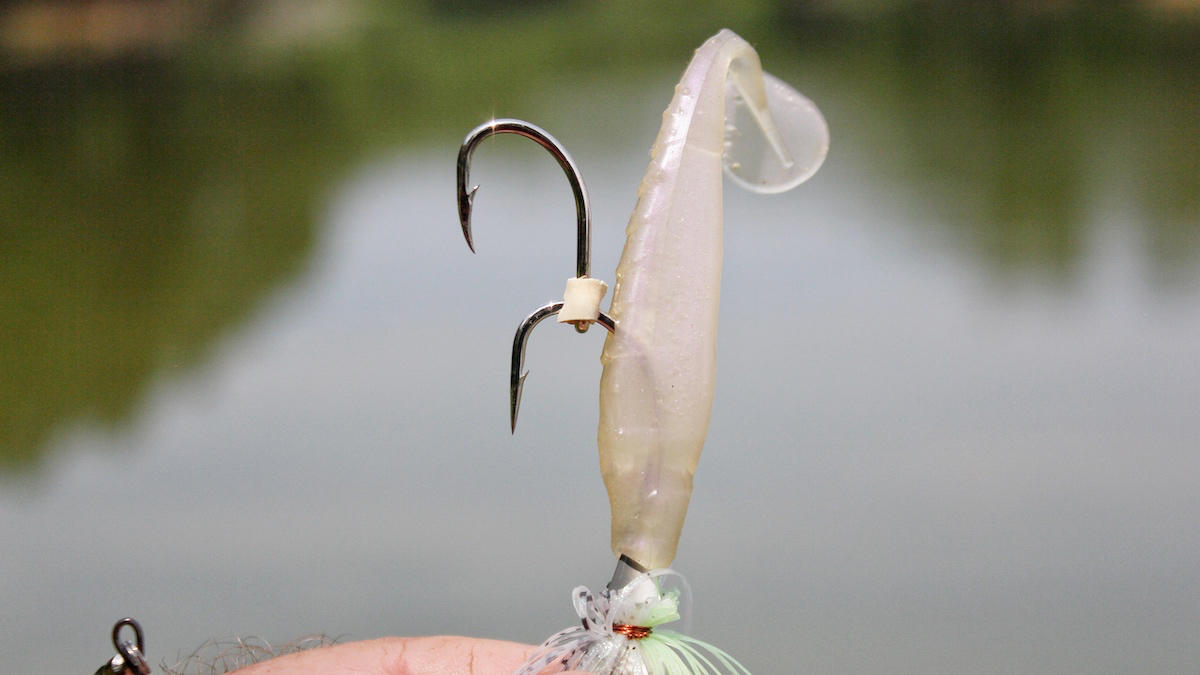
Have you ever put a fish in the boat and thought, "Man but I'm so glad I used a trailer hook!"? According to Shaye Baker of Wired2Fish, he has caught dozens of key fish that either were hooked only by the trailer hook or were pinned way better by a combination of the trailer hook and the main hook. Following are some of the options he prefers for securing a trailer hook:

Tubing on the main hook shaft.
 Spacer tubing like you can find at Jann's Netcraft is the perfect diameter to slide over the barb of the main hook and not quite allow the eye of the trailer hook to slide back over it and reach the barb. With this method, the hook swings freely and takes away some of the leverage a bass otherwise has to throw the bait.

Rubber over the eye of the trailer hook.
 This is the way most people probably started off securing a trailer hook...and the way a lot of 'em still do. You simply slide a piece of rubber or plastic tubing over the eye of the trailer hook and then run the main hook through the tubing and the eye of the hook simultaneously. This method works better for trailer hooks with a large eye. It keeps the trailer hook locked in an upward position, making it more weedless.

Small ziptie.
 With this method, you just put a trailer hook on the main hook, then run the point of the main hook through the clicker part of a 4-inch ziptie until it passes the barb. Then cut off all but the clicker part. You also can take a ziptie and use it to secure a trailer hook by looping it around the main hook, then running the end of ziptie through the clicker, the way it was designed. Pull it tight and cut off the excess, and there's no way a fish can pull off the trailer hook.

Open the eye and close it.
 You also can use a little Mustad circle hook (designed for saltwater fishing) as a trailer. Because the eye of a circle hook is just a bit too small to get some main hooks through, take side cutters and open the eye of the circle hook enough to slip it onto the main hook. Then use pliers to close the eye again. The best part of this method is that you don't have to add anything to keep the trailer hook attached.

Decoy versatile keeper.
 This new product works like the spacer tubing but allows you to use trailer hooks with larger diameter eyes as well. Simply place your trailer hook on the main hook and then slide one of these keepers over the main hook point, and you're good to go. The decoy versatile keeper is good for other things, too...like securing a soft-plastic trailer in place. Just slide your soft plastic up the hook shaft and into place, then slide the versatile keeper up the hook and into position right against the trailer.

All of these methods will work. Some, however, are better suited for certain situations. Shaye's recommandation is to try them and see if you increase your bite-to-catch ratio. If you don't, "then don't fool with them anymore," he says.


My thanks to Jim B. for providing the link to this item.

Sunday, July 12, 2020

'Twas a Typical Dog-Days Tournament


The heat of the day was all any of us wanted plus some, but we survived the test, and all but one of the 20 anglers in 11 boats brought fish to the scales. The 46 bass weighed in had a cumulative total weight of 98.03 lbs., for a 2.13-lb. average weight per fish and an 8.91-lb. average weight per boat.

Those who took home well-earned pay envelopes at the end of the day included the following:

1st Place
, the team of (from left) Rob Peppers and Don Carter, with five fish weighing 16.60 lbs. They also claimed the day's lunker pot with a 4.74-lb. bass.

2nd Place
, the team of (from left) Andy Morath and John Harmon, with five fish weighing 11.90 lbs., and a 2.90-lb. big fish.

3rd Place,
 the team of David Dozier and Richard Hall (not pictured), with five fish weighing 11.51 lbs., and a 3.18-lb. big fish.
Here is how the rest of the field finished:

     * The team of Mark Ingram and Gabe Himmelwright, five fish weighing 11.49 lbs., and a 2.75-lb. big fish.
     * The team of Gary Coderre and Dave Anderson, five fish weighing 10.87 lbs. (after 0.50 deduction for one dead fish), and a 4.12-lb. big fish.
     * The team of Jesse Munden and Jon Guzman, five fish weighing 9.87 lbs., and a 3.20-lb. big fish.
     * The team of James Calhoun and Rusty Girard, five fish weighing 8.16 lbs., and a 3.32-lb. big fish.
     * The team of Steve Bailey and Bobby Moore, five fish weighing 7.51 lbs., no big fish.
     * The team of Chris Fretard and Mike Miller, three fish weighing 5.10 lbs., no big fish.
     * Ken Testorff, three fish weighing 5.02 lbs., and a 2.52-lb. big fish.
     * Wayne Hayes didn't weigh any fish.

Congratulations to all of today's winners, and thanks to everyone who showed up for the contest. Our next scheduled event is Saturday, July 25th, from safe light to weigh-in at 2 p.m. Hope you can find a way to join us.


One Last Cast

As is so often the case, I had a game plan when I left the house this morning, but as luck would have it, my day started on a sour note and only went downhill from there. I hadn't much more than pulled up to my first spot this morning when a case of heartburn hit me. I subsequently had two giant blowups on a topwater bait that made me look like it was the first time I ever had held a rod in my hand.

I subsequently messed around for a few minutes with a jerkbait and a crankbait, neither of which produced even slight interest. I then picked up my worm rod and never looked back the rest of the day, given how warm it was. By this time, I had shed the case of heartburn, but you'd never have known it from the way I was swingin' and missin'. I had three fish nearly rip the rod out of my hand when I chunked the worm up next to some wood, but the best I got each time was a momentary feel of the fish, and then it was gone as fast as it had hit. All three of those fish had some size to 'em.

With only 30 minutes remaining before weigh-in, I decided to throw in the towel. Quickly weighed my fish and then headed to the ramp to recover my boat, where I was met with a host of boats and jet-skis that, for lack of a better way of putting it, simply didn't demonstrate the first ounce of handling ability. One fella in particular easily took 15 minutes just to get his trailer in the water like he wanted it. He then took another 25 or 30 minutes to get the boat on the trailer...and that was with the help of the two jet-skiers...need I say more? By the time he finally pulled off the ramp, there easily were eight or more boats waiting behind me to trailer their rigs...and I must say there didn't appear to be a happy camper in the bunch.

Such is the usual scene on any given Sunday this time of year. Just hope that guy ahead of me at the ramp couldn't read what I was thinking. If he could, I dare say his ears were burning by the time he had gotten out of my road.