Wednesday, January 29, 2020

For Week Ending Sunday, Feb. 2, 2020


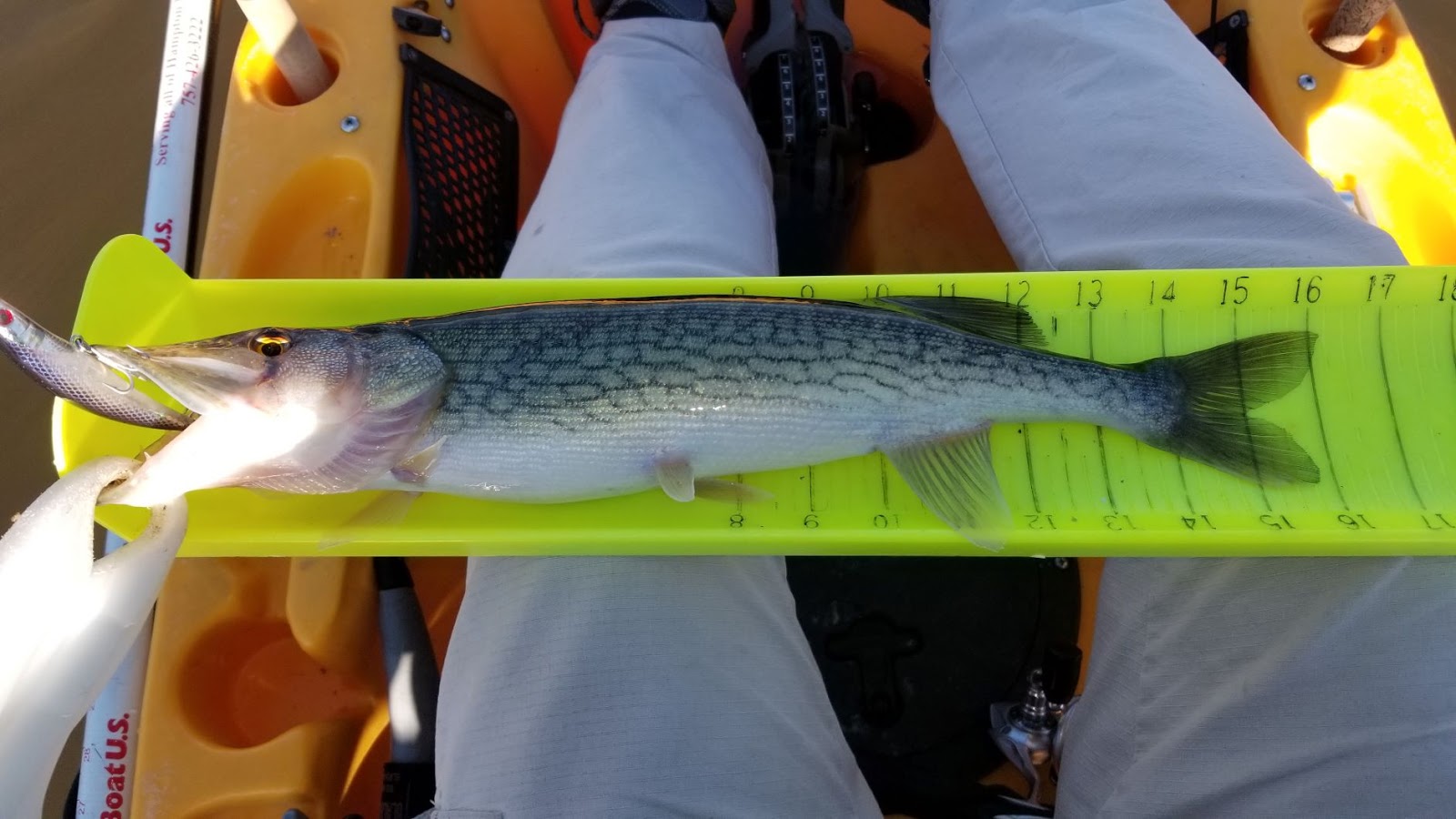
Tuesday, Jan. 28 (from Ron)...I went back to Tecumseh this evening but opted for a creek that I know holds some chain pickerel. Caught seven of them and fortunately only had to unhook three. I let the smaller ones flop around alongside the yak in hopes they throw the hooks, and they usually do. Spinnerbait and XTS Minnow were on the menu. Tried Craws, small red crankbait and Zoom flukes, but none got hit. It was chilly, and that last sliver of light at sunset didn't provide any warmth! Wind died down a bit, and that helped make the trip bearable.

Wednesday, Jan. 29 (from Ron)...Fished upper North Landing this evening from 3:40 to 5:20. Was throwing the micro spinner and had three on that threw the hook about 4 o'clock, then nothing for a spell. As the sun lowered, along with the temperature, I was convinced I would end with a skunk, but low and behold, right about 5:00, I caught a 1-6, followed by a 1-4. Been a while since I got a chance to use my scale, and I was glad. Tried a few other lures, but micro spinner was all that worked. It was a bit chilly. The river gauge is back up and was reading 1.8.

Thursday, Jan. 30 (from Ron)...Made a short evening trip to upper North Landing, even though the gauge was 1.4. Fished for an hour and found one dink to avoid the skunk. Used the micro spinner bait again. Had two more strikes on the lure, but they were not being aggressive. These north winds are not good and neither is the cold.

Sunday, Feb. 2 (from Ron)...I caught the skunk Friday and Saturday while fishing Tecumseh. The rivers and creeks have been too low, and Tecumseh was no good. With the gauge up to 1.6 this morning, was able to try Milldam and found two small chain pickerel to avoid a third skunk. Kind of breezy, though.

Tuesday, January 28, 2020

I've Heard About Acid Rain, Acid Reflux and Acid Wash, But Acid Fishing Rods?


Until two nights ago, I never had heard the term "acid rod" even mentioned. Then, while talking to my boat-mechanic buddy, he raised the issue. Not only did he talk about it, he showed me what one of the rods looks like, and even went on to say he uses it regularly for his froggin'.

Turns out that an acid or "spiral wrapped" rod is a conventional or casting rod with guides that start out on top of the blank, then rotate around the rod, leaving the final guides and tip under the blank (see photo above). To me, it looks like one of those old two-piece rods like I used to buy occasionally, and nearly every time you'd check the alignment of the guides, you'd find they wouldn't match up right. It was that annoyance that drove me away from buying any more two-piece rods in recent years.

In a nutshell, this guide placement reduces torque, allowing you to fight larger fish on lighter tackle with less fatigue. In the words of one author, "I'd go so far as to say that acid-wrapped rods represent the greatest innovation to fishing since the invention of the reel."

Acid-wrapped rod design allows for a lighter build, with better overall balance and weight distribution throughout the blank, resulting in more power and sensitivity. In short, the design makes it possible to design a conventional rod that performs and handles like a spinning rod.

With spinning rods having a "bottom guide" design (guides are located on the bottom side of the blank), fewer guides are required, which means they can be spaced farther apart from one another to maximize the blank's potential. The result is a lightweight, yet powerful, balanced rod.

A typical "top guide" conventional rod (with guides resting on top of the blank), on the other hand, requires a greater number of stronger, taller guides placed closer together to achieve the same potential. Subsequently, however, the rod becomes inherently heavier and stiffer.

More weight equals more fatigue on the user, resulting in less fishing time. While you may not think a few guides make a difference, ask someone who's into jigging, and they will tell you a few grams can make all the difference in the world when working a rod for hours on end. A good fisherman always is looking for a slight edge over the next guy and having less weight creates a clear advantage. The less you need to think or worry about your gear, the more you can focus on the task at hand: landing more fish.

When you're fishing with a top-guide conventional rod, torque is being applied to the reel seat and the tip of the rod when it's under a load. This torque forces an angler to tightly grip the rod to prevent it from twisting or rolling over your hand, resulting in more fatigue. The industry standard to correct this issue is to add more guides to reduce this twisting motion. With acid wrap, the line seamlessly is transferred to the bottom side of the blank, which eliminates the torque on both the reel seat and the rod tip. The result is a more balanced and evenly distributed weight-management system when under a load. The guides rolling over and managing the line from underneath the blank stops the rod itself from trying to roll over, stopping the need to fight your gear and letting you concentrate on fighting fish.

Another factor that inhibits balance on a standard conventional setup is that your reel naturally is heavier on the cranking side (handle side). This imbalance becomes more dramatic while under a load, causing even more instability, which cannot be eliminated from a conventional reel. However, it can be compensated for in the spiral-rod design.

The spiral always should twist away from your cranking hand, causing the rod to balance out when under a load. As the fish applies slightly heavier pressure to the side, the guides are twisting, and you're naturally applying pressure to the side you're cranking on. The outcome is an almost perfect balance. Without the need to focus on balancing your rod, your mind and body can focus on balancing more important tasks. The end result will be better quick decision-making, which ultimately makes you a better player.

Another issue caused by lack of balance related to standard conventional rods is when an angler tries to "crossover" or "roll" the line to the side of the rod that the fish is swimming on, in an attempt to stay in contact with it. This is a natural reaction and one that causes a lot of unwanted wear and tear on your equipment. As a fish repeatedly darts left or right, this motion creates friction between your guides and line, which can result in equipment failure. The transfer of the line to the bottom of the blank minimizes the friction caused by a crossover, resulting in less equipment wear.

Together, these factors lead to a better all-around fishing experience. A lighter design, with no torque and precision balance, means a conventional rod that performs and handles like a spinning rod. The weight distribution allows for a lighter, more sensitive tip, with a strong backbone for heavy lifting. This design allows manufacturers to build rods that have the power to take down giants and enough sensitivity to feel even the slightest hit.

People who make acid-wrapped rods have a warning for those who would laugh at the guy next to them with the goofy, unorthodox rod. "Know this," they say, "the battle to gain any competitive advantage over your adversary in an environment that is unforgiving to mistakes is a battle of inches, and that guy with the goofy-looking rod is starting miles ahead of you."

Saturday, January 25, 2020

For Week Ending Sunday, Jan. 26, 2020


Saturday, Jan. 25 (from Ron)...The river gauge on the website has not updated since the morning of the 22nd, so I went to recon the situation and found that it looked like about 2.0 or so. Launched at West Neck Marina at about 2 p.m. and headed north. Didn't get a tap until 3:30 and then nothing for another half hour. As the sun started to get low (along with the temperature), the bite turned on a bit. Caught 11 bass and a dink white perch. All the bass were dinks, between 6 and 12 inches, but it was fun and great to be back out again. Micro spinner was all I threw.

Sunday, Jan. 26 (from Ron)...Fished Milldam Creek from 3 to 5:20. Water was very murky--about like chocolate milk. Bite was very poor, but I managed two 12-inch bass, and one weighed in at 15 ounces. At least no skunk. Micro spinner enticed the bite. Tried jerkbaits as well. The river gauge on the Web still is not working, but I'd guess the level at about 1.8.

Bass Fishing World Suffers the Loss of Another Legend


Ranger Boats founder Forrest L. Wood, 87, passed away peacefully this morning, surrounded by family, including his beloved wife of 68 years, Nina Wood. This news comes four days after FLW announced he was in critical condition at Baxter Regional Medical Center in Mountain Home, Arkansas.

On Facebook, the family expressed their sincere thanks to the medical team who cared for Wood. Funeral arrangements are currently pending and are expected to be released soon.

Meanwhile, Arkansas Governor Asa Hutchinson posted this statement following Wood's death:

"It was my honor to know Forrest Wood, and his passing is a deeply sad moment for our entire state. Forrest embodied the best of Arkansas. He was an entrepreneur who brought thousands of jobs to northern Arkansas with his founding of Ranger Boats. His business accomplishments have been recognized in the Arkansas Business Hall of Fame, and his contributions to the world of fishing and recreation have made Arkansas a destination point for fishermen from all over the world. He loved Arkansas, and Arkansas loved Forrest Wood. Susan and I express our condolences and prayers for Nina and the entire Wood family."

FLW Fishing posted the following statement on its website:

"Forrest and Nina are best known as the founders of Ranger Boats, but their role in the formation of the tournament fishing industry extends well beyond building bass boats. They supported every tournament organization in the fledgling years and backed professional anglers across the continent. Their hard work and dedication were intrinsic to the success of the sport. When FLW was launched in 1996, Irwin Jacobs asked Forrest if he'd be willing to lend his initials to the organization, as Forrest represented the ideals that Jacobs had in mind for FLW: honor, class, integrity. Gracefully, Forrest accepted. But Forrest was more than a figurehead to all of us at FLW. He and Nina are family. He will be greatly missed by everyone in our organization."

And from Kathy Fennel, FLW executive vice president and general manager, came this:

"Forrest Wood's legacy and impact across every facet of our sport is indisputable. FLW is fortunate and honored to call him a friend and the namesake of our company. We join the rest of the fishing world in mourning the passing of this legendary man. Our thoughts and prayers go out to Nina and the entire Wood family during this time."

Wood served on the Arkansass Game and Fish Commission from 1998 to 2005. He is a member of the Professional Bass Fishing Hall of Fame, National Freshwater Fishing Hall of Fame, International Boating Hall of Fame, National Marine Manufacturers Hall of Fame, Legends of the Outdoors Hall of Fame, Arkansas Game and Fish Hall of Fame, Arkansas Walk of Fame, and Arkansas Business Hall of Fame.

Funeral services for Wood will be at Flippin First Baptist Church at noon on Wednesday, Jan. 29, 2020. Due to the expected turnout, additional parking will be available at Hickey Park (123 Hickey Park Place) and Vexus Boats (727 W. Industrial Park Road). Shuttles will be provided before and after the service.

Following the funeral, the family will receive all friends in the church fellowship hall. A reception, with appetizers, will take place in the Family Life Center in conjunction with the visitation.

A graveside burial will be private. Those who knew Forrest also should know that jeans and boots will do just fine. Memorial contributions can be made to the Flippin Cemetery by mailing to the Flippin Cemetery Fund, P.O. Box 211, Flippin, AR 72634. Services provided by Roller-Burns Funeral Home.

Friday, January 24, 2020

The Natives Are Getting Restless

Received emails this morning from a couple of my friends, and both were taking note of the low-water conditions we've had all week, thanks in no small part to all the northerly winds that have been blowing most of the time.

Ron returns home from a business trip in the morning and was eagerly looking forward to a weekend on the water until he checked the online water gauge and saw that it's standing in the "minus" range. Even a kayaker needs a little water to launch his ride, and there isn't much available when things are this bad. I have every confidence, though, that Ron will find somewhere to launch his kayak this weekend and set about making up for lost time on the water.

Also heard from Don Mc, whose favorite hole is the Northwest. He, too, is getting anxious to find more than a teacup full of water in which to ply his bass-fishin' skills. In the meantime, however, he settled for scouring the list of available YouTube videos on the Internet and found a couple that piqued his attention, as well as mine. If you, too, would like something to at least smile about, just click on the following links:

https://www.youtube.com/channel/UCi3jMEIqgvpcjbeLapWJ-UQ

https://youtu.be/ZTvZ7kTrc4k

Hope you enjoy! ...And Thanks! Don Mc.

Thursday, January 23, 2020

From Jay Kumar's Latest BassBlaster


Of particular concern in today's issue was the fact that Ranger Boats founder Forrest L. Wood (left) has been hospitalized in critical condition at Baxter Regional Medical Center since Tuesday evening, Jan. 21.

That's the word from Keith Daffron, Wood's grandson, who went on to note that "the outpouring of love and support we have already received means so much. Please pray for Nina and our entire family. We will do our best to communicate any changers as we can."

Another news item in the same issue revealed that veteran bass pro Rick Clunn is responsible for Abu Garcia adopting a thumb bar for their baitcasters. Until then, anglers had to reach across the top of the reel and push a button to release the spool.

Said Clunn, "After I won my second Bassmaster Classic (1977), I contacted Abu Garcia and inquired if they could come up with a better way... . Their introduction of the thumb bar made them the first company to ever offer that feature."

Bass: Are They Smart As a Whip, Or Dumb As a Rock?


From my research, it appears the jury is still out when it comes to answering this question. Individual opinions are all over the place--even among the experts. You might say it's like bellybuttons--everybody has one. Here's a synopsis of what I found during my research:

Professional fisheries biologist and lake-management consultant Bob Lusk (left), with a home base in north Texas, described bass as "intriguing creatures," but added, "I don't believe for a minute a bass has the ability to think. I completely believe they respond to genetic instincts and conditioning. That's it. I believe bass respond or react to stimuli conditioned by repetition."

This same biologist pointed out that if you ask any good fisherman what it takes for a bass to bite, "most will tell you the same things. The fish is hungry or angry...or both. If you can't make it bite from hunger, make it mad by throwing something noisy in its house. A bass will protect its habitat from intruders.

"Research has proven a bass has 'memory,' which lasts no longer than 15 minutes. But repetitive behaviors condition fish. That's why they become 'hook smart.' It's also why they 'learn' to come to fish food. Conditioning...nothing more, nothing less. Take away fish food, fish still come where they are conditioned. They don't think about it at all.

"Like half the human population, fish want three things: food, sex and survival," the biologist opined.

That philosophy, however, wasn't shared by the late Dr. Loren G. Hill (right), longtime fishery academic and bass angler, who was best known for inventing the Color-C-Lector. He acknowledged that "some people think that a fish can't remember--that it relies only on instinct...and forgets things in a matter of minutes. But that's not true. Our studies (in the zoology department for the University of Oklahoma) show that fish do have a memory.

"For example, if a bass is caught on a spinnerbait one day, it's almost impossible to catch that fish on the same lure the next day. And if it is exposed to that bait every couple days for a week or so, it could be 20 days before it will strike the lure again.

"It's the same way for the fish's buddies that observed that fish being caught, too," Dr. Hill believed. "When they see the lure come past, they are going to remember, and they are going to avoid it. The same holds true for lakes that are exposed to heavy fishing pressure. The more lures the fish see, the more conditioned they become and the harder they are to fool.

"There is a certain amount of validity to it when fishermen talk about educated fish," Hill said. "When you go to a virgin lake, you can catch fish on just about anything you throw. But once the fish have been exposed to lures day after day, they remember and become warier."

Dr. Hill noted, however, that there is at least one lure that fish apparently don't remember--the plastic worm.

"You can catch a bass on a plastic worm one day, and he still will come back and hit it the next day," he said. "For some reason, the worm doesn't stimulate the same memory response that other lures do.

"How long a fish's memory lasts depends on two factors: the degree of reinforcement and the diagnostic characteristics of the event (the danger or the success involved). For example, some fish remember the things it associates with danger--the sting of a hook, a boat rushing into its environment, the sight of a fisherman, or the sounds of thunder. And it will continue to remember, as long as it receives reinforcement or regular exposure to the factors.

"Not all fish have the same ability to remember, though," noted Dr. Hill. "Species such as northern pike and bluegill are known as poor learners and often will strike again only minutes after being caught and released. Other fish, such as largemouth bass, channel catfish, stripers, and carp, have better memories."

The secret to anglers' continued success, concluded Hill, "is to be willing to use different kinds of lures so that the fish don't get too familiar with what we are throwing."

The last philosophy I want to include here is that of the late Dallas Morning News outdoors writer Ray Sasser (right), who lauded catch-and-release fishing as a wonderful conservation tool. However, he also believed there was a downside to catch-and-release: "The fish may learn to avoid a lure that tricked them."

According to Sasser, "That explains why the fishing can be slow on reservoirs like Lake Fork, where we know from regular Texas Parks and Wildlife Department sampling that the bass population remains high. It also explains why new fishing lures are effective until the fish have seen them and been fooled by them, often multiple times. Now there's scientific evidence that largemouth bass not only learn to avoid lures, they're more likely to avoid loud, vibrating lures than lures that require a subtle presentation."

He cited a University of Florida study that addressed the issue of lure avoidance. Graduate students did the research at a private, 27-acre lake over the course of four weeks (12 fishing days).

The study lake historically had received little fishing pressure from the owners. It was shallow (maximum depth 15 feet), and the water was clear. Two anglers did all the fishing and were restricted to using just two lures: a chrome and black Rat-L-Trap lipless crankbait and a 4-inch soft stickbait (a Yamamoto Senko in plum with emerald flake), fished weightless with a 3/0 worm hook. Researchers first used an electro-shocking boat to capture, mark and release adult bass and estimated that the lake contained 347 total bass more than 10 inches long. Both lures always were rigged the same. The anglers used 20-pound-test braided line with 4 feet of 20-pound fluorocarbon leader. To negate possible skill difference between the two anglers, they swapped lures every hour.

Each fish caught was tagged with a unique electronic marker, so it could be identified upon recapture. After 12 fishing days, 260 fish had been caught. That represented about 75 percent of the estimated total population. The catch rate dropped from 2.5 fish per angler hour when the experiment began to .25 fish per angler hour after 12 fishing days. After three days of fishing, catch rates for the Rat-L-Trap had fallen from 2.5 fish per angler hour to .5 fish per hour. Catch rates for the soft stickbait declined from 1.8 fish per hour at the beginning of the experiment to 1 fish per lhour at the end of 12 fishing days. The Rat-L-Trap had the lowest incidence of recapture. Only two bass were fooled twice by the lipless crankbait. The soft, weightless worm recorded 25 recaptures. Five of the fish were tricked more than twice by the worm.

Researchers deduced that while the loud, flashy crankbait recorded higher catch rates when the fishing began, the same flash and vibrations that first attracted bass were easier for fish to identify and avoid a second time. With a much slower, more subtle presentation, the bass had a harder time distinguishing the worm as a temptation best avoided.

Said Sasser, "Experienced anglers could have predicted these results. That's why we keep searching tackle shops for a better, or at least different, fishing lure. It's also why we can revert to an old favorite from time to time. Bass, after all, don't live that long. The fish we're casting to today likely never have seen lures or colors that were popular 10 years ago.

"There also are days when the fish won't bite anything. Thankfully, however, there are days when they seem to bite everything."

Wednesday, January 22, 2020

Not Just Your Run-of-the-Mill Double

Came across this photo while digging around the Internet today. Said the bank angler who made the catch, "First time I've ever doubled up, and definitely my first time seeing a bass and catfish hit the same lure!"

He went on to say, "When they hit, the entire surface just exploded. I first thought one bass had hit and missed the lure (a Baby Torpedo), then tried again. Once I felt the weight, I thought I had a giant. As I was reeling them in, I noticed the entire mass was spinning--kind of felt like a crankbait when the trebles get hung in the line.

"When I flipped them up to me over the bushes lining the bank, I couldn't even process what I was seeing. The craziest thing to me was that the catfish had both trebles (one in his mouth, the other hooked in his side). Meanwhile, the bass was hooked on only one barb and flopped off as soon as I landed them.

"Just the wildest thing I've ever had happen to me while fishing. Made venturing out in the rain worth it," he concluded.

Both fish were released alive.

A Pain in the Neck--The Real Deal

Betcha Muhammad Idul, the 16-year-old Indonesian boy in this photo, never will forget the pain and agony he had to be experiencing here after being speared in the neck with the snout of a needlefish.

According to the boy's father, Saharuddin, he had taken up fishing on the weekends as a hobby. "Idul was on one of his fishing adventures last weekend," said the father, "when a needlefish (known as a 'sori,' in local dialect), suddenly leaped out of the water and speared Idul, knocking him off his boat. It pierced him under the left side of his chin, through the back of his neck, just below his skull."

For the record, needlefish (see Atlantic version at left) are capable of making short jumps out of the water at up to 60 km/h (37 mph). Since they swim near the surface, they often leap over the decks of shallow boats, rather than going around. Injuries and deaths from these fish are well-documented, among them a young snorkeler in Florida, who nearly was killed when a houndfish leapt from the water and impaled her in the heart. In October 2013, a young Saudi man died of hemorrhaging that resulted from being hit by a needlefish on the left side of his neck. And in December 2018, a needlefish killed a Thai Navy special forces cadet, after impaling him in his collarbone.

Idul managed to get to the surface and walk home, his right hand gripping the fish, while its snout still was stuck in his neck. He was then taken to a nearby hospital, but the doctor there wouldn't risk removing the fish's snout due to limited equipment. He subsequently was transferred to a second hosptial, where six surgeons took an hour to perform the necessary surgical procedure.

At last report, Idul was under close supervision in the hospital, being watched for potential infections. His stay was expected to last about a week.


Thanks, Ron, for bringing this item to my attention. His email included mention of the fact that he has caught either needlefish or houndfish in Back Bay. "Can't imagine peddling back to the launch with one of these in my neck," he said.

Monday, January 20, 2020

Life Is All About Choices...And So Is Bass Fishing

Have you stopped to consider all the bass-fishing "rigs" that are out there today? I searched the Internet for all of two or three minutes earlier this morning and came up with the following assortment: Texas Rig, Ned Rig, Carolina Rig, Drop Shot Rig, Owner Jig Rig, and Recoil Rig, to name only a few. There also was one that--at face value--sounded a bit off-colored: Dangle Berry Rig was it's name (Ever heard the slang term "dingleberry"?).

And then I further stumbled across the one pictured here. Called the Tokyo Rig, it doesn't appear to have been around much, if any, before early 2019.

It's very possible--perhaps even probable--a lot of anglers already talk about this Tokyo Rig. If they do, though, I never have been privy to those conversations, or I may have just forgotten 'em (and you can save the wisecracks, 'cause I don't have the market cornered on old age--LOL).

I found a Jan. 7, 2019, Bassmaster eNewsletter article by Seth Feider, in which he described his fond desire to visit Japan. Said he, "I love sushi, and I love fishing tackle. My plan is to go over there with just a big empty suitcase and one change of underwear and buy a ton of lures that we can't find in the U.S.

"...While we live in the birthplace of bass fishing, I recognize that many of our best techniques come from Japan. One of the latest is the Tokyo Rig."

This rig "takes a conventional rolling swivel, adds a wide-gap hook to it, and then also extends a wire out from it. Some come with a weight already on that wire and the end bent to keep it from coming off, but the one I use from VMC comes without a weight. You add your own and then bend the bottom to keep it in place. I like that better because it's infinitely customizable. I'll put a BioSpawn VileCraw on the back of it, almost always green pumpkin, because we flip a lot of clear water."

I would add here that, during my research today, I saw a video with an angler who likes to add two weights, vice one, to his Tokyo Rig, so that the weights bang together for more underwater sound.

Continued Feider, "You might not think that this setup would be any more effective than a Texas Rig or a jig or a drop shot, but I assure you that there are times when it's dominant. I fish a lot of team tournaments here in Minnesota, and my partner and I stand shoulder-to-shoulder on the front deck. Historically, we've matched bites one for one, but once I switched to the Tokyo Rig, I really put it on him. The mismatch in the number of bites was insane. Now we both have it on the deck, virtually every time we go out, and we consistently catch fish behind other anglers working the same schools.

"You can fish a wide variety of cover with the Tokyo Rig, but it's at its best in submerged milfoil. The grass starts growing on the bottom and may come up to the surface, but the first foot or so off the bottom is where most of the fish live. It's all stem at that point. The grass doesn't start to leaf out until it's a bit off the floor. You can flip or punch the Tokyo Rig in there and just sit there and shake it. You don't have to stroke it or yo-yo it, because that will take it out of the strike zone.

"While you may fish it in the same areas as a Texas Rig or a jig, the bite is a lot different, and you'll need to get used to it. When I first started experimenting with the Tokyo Rig, I felt like I was getting bites, but than I'd set the hook, and there was nothing there. I suspect it was the wire hitting a blade of grass or some other cover. They don't crush it like they do with a jig. It's more of a pressure bite. Once you dial that in, the hooking and landing percentages are through the roof.

"One other nice thing about this technique is that you don't need specialized gear to fish it. I use a 7-foot Daiwa Tatula Elite baitcasting rod, paired with a high-speed (8.l:1) Tatula SV reel. I spool it up with 30-pound Sufix braided line, with a leader of 20-pound Sufix fluorocarbon. That's what works best for me, but you probably have something in your rod locker that will do the trick, without spending a whole bunch of money.

"I've already had some success on tour and around home with this versatile presentation, and I've circled the Cayuga Elite Series event on my calendar. I expect it to be a major player there, and it won't be far from my reach during many other tournaments," concluded Feider.

Sunday, January 19, 2020

The VanDams See Red in Late Winter and Early Spring

Jonathon shows off the red crankbaits he and Kevin use.
Photo by Garrick Dixon
I'm speaking, of course, about Kevin and his nephew, Jonathon, who believe that red crawfish crankbaits are the ticket to successful late-winter/early-spring bass fishing.

"As we fish around the country," said Kevin, "we discover that specific colors are must-haves on some lakes. Oftentimes, that is due to the color of forage, or the lake has a unique water clarity.

"It's no secret that any crawfish colors are good choices in late winter and early spring, but it amazes me how universal red has become," noted Kevin. "It's not just a dirty or clear-water thing, or a Texas/Louisiana thing; we're also discovering it's a good color during the early prespawn period just about everywhere."

There is a right and wrong way to fish the red baits this time of year. Continued Kevin, "It's critical to make sure your bait is bouncing along the bottom to emulate crawfish. After that, you need to dial in the action. For example, erratic square bills often work better in warmer, stained water, while tighter actions perform better in colder, cleaner water.

"These are the kinds of things that make our sport so intriguing, even though we're often left with questions as to why fish do what they do at times. But this much you should know--red crankbaits are players during the early season and also are worth trying when fishing lakes with red clay bottoms.

"The more we fish, the more we learn, and that's why it's all about the attitude."

To Catch Bass on a Bad Day, Just Keep Fishing

By Woo Daves

Many years ago, I went down to fun fish Buggs Island. I was going to fish out of my john boat, but somebody had stolen my motor. The only reason that the thieves didn't get my boat was because I had it chained to a tree.

Luckily, I just had recently bought a trolling motor, and I had a good battery for that new motor. I had driven two hours to get to Buggs Island, and I told my fishing buddy, "Since we're here, let's just go fishing."

To be effective, most bass fishermen believe they need a big bass boat with a big outboard on it. But the truth of the matter is that you can take a little john boat, like a Tracker aluminum boat, and start fishing right where you put in. More than likely, you'll catch as many, if not more, bass than the anglers running up and down the lake in their boats. The real secret to catching bass is keeping a lure in the water as much as possible.

My friend, George Cochran, won the Bassmaster Classic in Kentucky by fishing right by the boat ramp. George probably didn't burn a half-gallon of gas in three days of fishing. Rick Clunn won one of the Bassmaster Classics in Arkansas, fishing less than two minutes from the boat ramp.

When we started fishing out of that small boat on Buggs Island, the weather was about 70 degrees in February. By 10 a.m., we only had caught one 10-inch bass. My buddy said, "If we had a big motor, we could fish several different places and catch more bass." We took a break in the middle of the day, got out of the boat, walked around a little bit, and ate our sandwiches.

Within 30 minutes, snow started falling. My buddy got in the boat while it still was lodged against the bank, walked to the back of the boat, cast a Speed Shad across the cove, and landed an 8 pounder. We got in the boat and started fishing around the cove where we had pulled the boat up on the bank. We caught eight bass that weighed about 40 pounds--a huge stringer for Buggs Island.

If you asked almost any fisherman, "What's the biggest bass you've ever caught?" the majority of them would sway a 6-, 7-, 8-, or 9-pound bass that they've caught while fishing in a john boat. So, one of the biggest secrets on how to catch bass on a bad day, especially when you have equipment failure, is just to keep fishing, slow down, and hit every piece of cover that you can see. Don't ever allow equipment failure to cause you to stop fishing.

Now I can fish as fast as anybody. On days when fish are biting, fishing fast will catch a lot of bass. But on bad days, when fish don't want to bite, turn your boat around, go back to the place you've fished fast, and fish slowly with light line and small lures. You may catch a whole lot of bass then.

My No. 1 bait for fishing slow is a Zoom Trick Worm, and my No. 2 is a shaky-head worm. If the lake has a lot of smallmouth or spotted bass, I'll fish the Zoom Speed Craw, which resembles a small crawfish. I've learned that when I fish a plastic lure, the bass usually will take it before it hits the bottom. If they're not biting on a bluebird day, or on a bad-weather day, slow down your fishing, and make multiple casts with multiple lures to try and catch the bass that should be on that spot.


Woo Daves of Spring Grove, VA, started tournament bass fishing in 1973. He won the Bassmaster Classic in 2000 and has qualified for 20 different world championships. "My success in bass fishing isn't too bad for an ol' country boy," he said. This item first appeared in John E. Phillips' Outdoor Journals.

Saturday, January 18, 2020

A Look Back at What It Took To Be Winners in 2019


Got out my notebook and calculator earlier this morning and started totaling up what it took bag-size-wise for anglers in the Dewey Mullins Memorial Bass Tourney Series to take home a pay envelope this last year. Here are the results:

For the entire 17-events season, the average weight for all 1st Place winners was 15.58 lbs., compared to 13.74 lbs. for all 2nd Place winners and 12.76 lbs. for all 3rd place winners.

I then broke down the statistics by month. For two tournaments in March, the average weight for 1st Place winners was 11.67 lbs., compared to 9.94 lbs. for 2nd Place winners and 9.15 lbs. for 3rd Place winners.

For two tournaments in April, the average weight for 1st Place winners was 21.11 lbs., compared to 17.74 lbs. for 2nd Place winners and 15.87 lbs. for 3rd Place winners.

For two tournaments in May, the average weight for 1st Place winners was 17.59 lbs., compared to 16.80 lbs. for 2nd Place winners and 14.54 lbs. for 3rd Place winners.

For three tournaments in June, the average weight for 1st Place winners was 15.38 lbs., compared to 13.38 lbs. for 2nd Place winners and 13.07 lbs. for 3rd Place winners.

For two tournaments in July, the average weight for 1st Place winners was 15.74 lbs., compared to 14.21 lbs. for 2nd Place winners and 12.81 lbs. for 3rd Place winners.

For two tournaments in August, the average weight for 1st Place winners was 16.50 lbs., compared to 14.23 lbs. for 2nd Place winners and 14.14 lbs. for 3rd Place winners.

For four tournaments in September, the average weight for 1st Place winners was 13.45 lbs., compared to 11.91 lbs. for 2nd Place winners and 11.20 lbs. for 3rd Place winners.

Winning weights for the Classic contenders were as follows: 23.26 lbs. for 1st Place, 22.55 lbs. for 2nd Place, and 20.45 lbs. for 3rd Place. Big Fish for the Classic weighed 5.18 lbs., and the Seasonal Lunker Award went for 7.04 lbs.

Good Luck! to one and all in the 2020 season, which is scheduled to start March 15.