

Monday, April 3, 2023
A Change to the Rules for Our April 15, 2023 Open Tournament
Sunday, April 2, 2023
Gittin' 'Em While the Gittin' Is Good

In this evening's kayak trip to Back Bay, Ryan boated these five bass, with a combined total weight of 16.98 pounds...all in just two hours, no less. His big fish (first photo to the left) measured 22 inches and tipped the scales at 5.29 pounds...his biggest to date from Back Bay. The other four weighed between 2.65 and 3.25 pounds.
If that kind of trip won't get the adrenaline pumping, I don't know anything that will.
Said Ryan, "If I only can figure out how to duplicate my kayak success in the boat."
"My hearty congratulations to you, Ryan, on a great haul!!! To say you did 'well' would be a gross understatement. Keep it up!"

Not Everyone Agrees on What's Good for Our Sport

It's one of the weekly opinion columns by Joe Balog (Balog's Bass War), which appears in that publication.
"'That's not bass fishing,' my buddy said. I had to agree.
"We watched the tournament angler in what now could be called 'bass pro pose.' Foot on the trolling motor, head down. Rod in hand, lure dangling, dry. A cast would only be made once a fish was spotted on the space-age sonar. No use wasting energy, right?
"The two of us, observers of the action, were old-school. Bass fishing represented something now foreign. Baitcast rods and big line. Flippin' bushes, or endless casts to submerged river ledges. Spinnerbaits waked along laydowns, the purveyor slinging underhand so rapidly that the lure was but a blur. That was bass fishing.
"Or was it?
"Hypocrisy is one of the worst aspects of our culture. Gosh, it gets under my skin. So I cringe during times that hypocrisy permeates bass fishing. Often, I have to check myself to avoid falling into the trap.
"At one time, bass fishing was all about power-fishing the bank. Early tournament winners found spinnerbaits and buzzbaits to be efficient at plucking fish, using a run-and-gun strategy. Longtime fans will remember acclaimed tournament pros modifying hand-controlled trolling motors to better meet their active approach, steering with one foot. Modern plastic crankbaits soon found a place in the pro's tacklebox as well.
"Fast forward a bit, and anglers were learning offshore tricks. The advent of flashers, then graph recorders, helped them understand what was out there. Soon, tournaments were being won by offshore aces dragging lures like do-nothing worms on nothing-looking spots.
"'That's not bass fishing' was likely the comment of the pistol-grip gunslinger.
"Or was it?
"Time progressed, and it became apparent that lots of bass still lived shallow around the stumps and bushes of our favorite lakes. Oftentimes, the lunkers seemed all but inaccessible to the methods of the day. Along came a Californian, of all people, with a rod influenced by the cane poles of bank fishermen, some 12 feet in length and loaded with stout Dacron line. He'd dip into the cover and lift out a bass. Time went on, rods were modified, and nearly everyone fell victim to the efficiency of flippin'.
"But that wasn't bass fishing--really.
"With the expansion of the sport came more capable boats. Fisheries across the North were discovered for their vast water and endless smallmouth bass. At first, the usual Southern methods of fishing proved productive; spinnerbaits and Rat-L-Traps taking advantage of brown-bass aggression. Later, big-water experts, myself included, would go farther offshore, using strange finesse tactics to fish vertically in the most challenging conditions. Trolling motors grew longer shafts. Sonar looked up, down and side-to-side.
"Holding the boat in 6-foot seas some 20 miles from the shoreline, perched 30 feet above a centuries-old shipwreck, I'd pick off giant after giant. But, certainly, I wasn't bass fishing. Not even close.
"Well, folks, this is bass fishing. Despite what the non-supporters say, forward-facing sonar is now bass fishing. Anything less is hypocritical.
"But make no mistake. Just because this technology has fully overtaken competitive angling doesn't mean it's good for the sport. In the past, we've accepted--even temporarily embraced and promoted--things that weren't good for the sport.
"Catch-and-keep wasn't good for the sport.
"Press observers fishing in the championship wasn't good for the sport.
"Combining boat racing with bass tournaments wasn't good for the sport. Remember it was endorsed but failed.
"Alabama rigs, evidently, weren't good for the sport. Though the arguments supporting that decision were shockingly transparent if not applied to forward-facing sonar.
"Which, in turn, is not good for the sport. Sure, if the goal is to reduce the number of participants and the overall interest by fans, then mission accomplished. Because the thought that limitless technological advancement in fishing is somehow good for the sport continues to baffle me.
"But it would be hypocritical to say that it's not bass fishing. Because it certainly is now."
(Joe Balog is the often-outspoken owner of Millennium Promotions, Inc., an agency operating in the fishing and hunting industries. A former Bassmaster Open and EverStart Championship winner, he's best known for his big-water innovations and hardcore fishing style. He's a popular seminar speaker, product designer and author, and is considered one of the most influential smallmouth fishermen of modern times.)
Saturday, April 1, 2023
Gotta Hand It to the Wired2Fish Editors
They undoubtedly got the attention of a few folks with this item:

During the annual consortium of Department of Fish and Wildlife Resource officers in Washington, D.C., it was proposed by a small group that fisheries managers seriously consider removing the use of real-time imaging as a means of legally catching fish. At least 12 state agencies were said to be in agreement. And the small group was lobbying for a countrywide "livescope ban" or a ban of forward-facing sonar technologies like Garmin LiveScope, the originator of forward-facing, real-time sonar in the finding and catching of game fish on state fisheries.
LiveScope has been an uber-polarizing subject among anglers, both professionally and even down to the infrequent vacation angler. So this doesn't come as a complete shock that someone would put forward nonsensical motions like this.
Most game and fish agencies are charged with managing fish populations for consumption. They work tirelessly to ensure the fisheries are in stable, healthy conditions to support game-fish populations and spawn recruitment from season to season at a high enough rate to sustain harvesting by license-holding anglers.
It's good and fair policy to operate this way, and we commend our state fisheries biologists and DNR representatives who work to ensure we have healthy fisheries to fish.
To see the full list of state considering the ban, follow this link:
Anyone who clicked on the link provided in the Wired2Fish item then got this:

Hopefully you can appreciate a little Garmin Livescope joking around on April Fool's Day.
Livescope is not going anywhere. It's simply a tool that is teaching anglers more about fish behavior at a much more rapid pace than ever in the history of fishing. So we can never fault new technology for helping us expand our knowledge and abilities in fishing. While we do need to be careful on smaller bodies of water of overharvesting, with increased precision and methodology in fishing, most large reservoirs will still have the same old problems of siltation, illegal stocking of incompatible species, water fluctuations during the spawn, and other nuisances to deal with. Livescope is generally not going to result in over-harvesting on big public water. Lakes like Grenada continue to prove that. And more big crappie and bass die of old age than do harvesting on these large reservoirs.
So for now, enjoy a little light-hearted fun. See if you can dupe your fishing buddies by sharing this with them.

Incidentally, I can't take credit for finding this. My longtime good buddy, Jim B, shared it with me after coming across it during an Internet surfing session. Thanks!
Wednesday, March 29, 2023
What's the Next Rig Coming to Bass Fishing in Our Neck of the Woods?
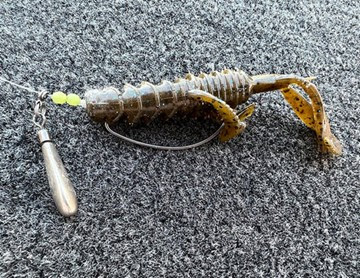
Although it owes its origin to Japanese counterparts, this rig already is finding favor among some anglers in America. One such angler is Bassmaster Elite Series pro Taku Ito, a pro who has quickly gained a large fan base, given his infectious personality and unique angling methods.
Ito has found plenty of success on the water, with seven Top 10 finishes, including a win on the St. Lawrence River, New York, in less than three full seasons on the Elite Series trail. During his short stint as a professional bass angler in America, Ito has opened some eyes with his Japanese techniques, including the free rig.
A hybrid, this rig shares some aspects of the popular Texas and Carolina rigs. It uses a weight with a hole at the top through which anglers thread their line, tie their hook, and then rig their soft-plastic bait. As the rig is cast, the weight falls first, and the soft plastic falls slowly behind it in a free-flowing and unpredictable way. As Ito says, this falling action is what makes it so deadly.
While similar to the Texas rig, the free rig is not the same.
"The Texas rig is much better for heavy cover, but the free rig is the best for suspended fish," explained Ito. "It started getting popular in Japan about five years ago on Lake Biwa, which has a lot of grass like Lake Guntersville in Alabama. The bass would suspend over the grass and were hard to catch until they started using the free rig."
As noted by Ito, the free rig is a perfect solution to fool finicky bass all four seasons.
"It shines the best, however, around grass, brush piles, and when bass suspend under docks," he said. "Most of the time, it's done between 5 and 25 feet of water. Any shallower," he continued, "and the bass don't suspend as much, and the bait falls too fast. Fifteen feet is the average depth I use it in, but only if the water is warm. If the water is cold, the bass mostly rest on the bottom and don't suspend.
"Letting the free rig fall on a slack line is vital," he said, "because as the weight falls first, you want the plastic to free-fall behind it. The fish usually bite as the bait falls. You will see your line swimming away. I let the bait hit bottom, shake it a few times, and then make another cast."
When fishing the free rig, Ito prefers a setup similar to what most anglers use for jigs and Texas-rigged plastics: a 7-foot to 7-foot 3-inch heavy baitcast rod, paired with a Shimano Metanium XG reel. For line, he uses 17-to-25-pound Seaguar Tatsu fluorocarbon. His favorite is 20-pound, but he'll go heavier on a lake with big fish and lots of trees...like Lake Fork in Texas. It the fish are smaller and/or the lake has less cover, he will use 17-pound but nothing less.
Ito prefers using heavy lines to gain a slower fall from the thicker diameter.
"Lighter line makes the bait fall too quickly," he shared. "You want it to stay in the water column and sink slower, so you can suspend the bait longer."
While many Japanese imports are finesse techniques with downsized baits, Ito prefers large soft-plastic baits with curly tails or plenty of appendages, which helps add time for the bait to fall and attract fish.
"I like baits such as the Zoom Ol' Monster 10-inch worm with a big curly tail, or a big creature bait with a lot of appendages to slow it down," he said. "You want the bait to grab water and fall slowly. Baits like a Senko or fluke fall too fast, since they have straight tails. I also don't like anything less than 4 inches long because they likewise fall too fast."
A simple lead bass-casting sinker will work for the technique, as it has a large opening for the line to flow through and has the perfect teardrop shape for the best fall, but Ito uses free-rig specific weights from Japan. He prefers the Fuji Rig Suberu that's made of tungsten, with a line guide that allows for smooth line movement.
"Normally, I like 1/4-ounce but will use 3/16-ounce for shallower water and 3/8-ounce for deeper brush," he said.
Ito also will use a bobber stopper, adding two of the Ryugi Rubber Stoppers just above his hook. "Without those, the weight can get stuck to the knot sometimes," he added.
Having already proved its worth in Japan, the free rig just might be the next big thing in American bass fishing, too. The rig is simple and gives anglers yet another effective way to rig soft-plastic baits for enticing otherwise stubborn bass to bite.
Sunday, March 26, 2023
2023 Tournament Season Off and Running

Wouldn't you know that, on our very first event of the new season, the local weather forecasters would blow their predictions in grand style. Nowhere had I seen the first call for rain in our area today, yet the trip Wayne and I had to make back to West Neck from Milldam this afternoon was anything but dry. More precisely, it was painful. The raindrops smacking us in the face were smarting.
The unpredicted rain, however, didn't cause any of the 21 anglers in 12 boats to give up our pursuit of those green fish. We stayed at it until weigh-in time arrived, and all but two of the boats weighed five-fish limits.
Those anglers who finished in the winners' circle at day's end included the following:


Here is the finishing order for the remainder of the field:
* The husband-wife team of Andy and Diana Morath, with 12.44 pounds and no kicker.
* Eddie Sapp, with 11.87 pounds and no kicker.
* The team of Dave Anderson and Gary Coderre, with 9.84 pounds and no kicker.
* James Calhoun, with 9.41 pounds and no kicker.
* The team of Rob Peppers and Don Carter, with 9.01 pounds and no kicker.
* The team of Fisher Bryan and Gabe Himmelwright, with 7.71 pounds and a 4.10 kicker.
* The team of Wayne Hayes and Ken Testorff, with 7.38 pounds after a 0.25 dead-fish penalty and no kicker.
* The team of Craig Jones and Rob Chatham and the uncle-nephew team of Robert and Ryan Land didn't weigh any fish.
Congratulations to all the winners and sincere thanks to all those who joined us today.

Two weeks later, on Saturday, April 29, the second event of the 2023 Dewey Mullins Memorial Series will be held.
Be watching for my emails in coming days with details about both of these tournaments. As usual, if you have any questions, you can reach Wayne at 757-478-3387.

Current Overall Statistics

Click anywhere on this chart for an enlargement.
Friday, March 24, 2023
53rd Edition of Biggest Bass Tournament on Earth Is Underway

And the Winner Is:
Jeff Gustafson (42 pounds, 7 ounces)
Top 10 After Day 2
Jeff Gustafson (35 pounds, 11 ounces)
2. John Cox (29 pounds, 15 ounces)
3. Bryan Schmitt (29 pounds, 13 ounces)
4. Drew Benton (28 pounds, 6 ounces)
5. Scott Canterbury (28 pounds, 0 ounces)
6. Brandon Lester (27 pounds, 9 ounces)
7. Cory Johnston (26 pounds, 9 ounces)
8. Jay Przekurat (25 pounds, 6 ounces)
9. Austin Felix (23 pounds, 10 ounces)
10. Jason Christie (23 pounds, 3 ounces)
Top 10 After Day 1
1. Jeff Gustafson (18 pounds, 8 ounces)
2. Brandon Lester (17 pounds, 7 ounces)
3. Bryan Schmitt (16 pounds, 1 ounce)
4. John Cox (14 pounds, 4 ounces)
5. Cory Johnston (14 pounds, 2 ounces)
6. Jay Przekurat (14 pounds, 0 ounces)
7. Chris Johnston (13 pounds, 12 ounces)
8. Drew Benton (13 pounds, 5 ounces)
9. Scott Canterbury (12 pounds, 13 ounces)
10. Jacob Powroznik (12 pounds, 9 ounces)
As reported this morning by Shaye Baker, the 2023 Academy Sports + Outdoors Bassmaster Classic, presented by Toyota, has begun on the Tennessee River, and as usual, plenty of fans were on hand to watch things shift into motion.
The weather in Tennessee this morning was as pretty as a fisherman could ask for to start the Classic. Air temps were in the mid-60s already, with a predicted high in the upper 70s. Rain came down heavy during practice at times, and more precipitation is predicted for Day 2.
A front is supposed to move through the area, with an 80 percent chance of rain, a high of 75 degrees, and temps dropping a bit...into the upper 40s tomorrow night. However, the highs are predicted to bounce back on Championship Sunday, perhaps reaching the mid-70s.
According to this morning's reporting, three pounders are solid gold on this fishery. A 15-pound bag equates to a strong bag, and an angler really shows out with 18 pounds.
Here's where a win, or even just a good, strong finish can do more for an angler's career than any other thing.
Thursday, March 23, 2023
It Was a Day on the Water for 5 Amigos

We made our plans a few days ago and then executed them this morning. Skip in his boat, Craig and Rob in the latter's boat, and Wayne and me in his boat were going to show up at West Neck this morning and get in some fishing time.

The picture here is Skip's first fish of the day, and I know for a fact that he boated at least one more before the end of the day, because I saw him swing it over the side. Came off one of his favorite trees in the upper stretches of West Neck Creek.
He just had told Wayne and me it's one of his favorite trees, when I turned around and saw him chalk up yet another bass from it. Also heard him chuckle a bit as he swung it aboard.

Because they were interested in trying to preserve their productive stretch of water for a revisit during this Sunday's tournament, both were trying just to feel the fish but then allow it to go free without ever setting the hook. As it turned out, they were only partly successful in that effort. A few of the bass were just too eager.

We fought the strong winds for a spell but soon grew tired of the conditions and decided to go looking for some cover. We first checked out a couple of new spots to us down south on the North Landing, without finding anything, and eventually made our way back to West Neck.
It wasn't until we got above the bridge, however, before we started finding any catchable fish. We ended the day with a total of four bass, none of which was anything to write home about. Only a couple of them would have cleared the 12-inch tournament minimum length.
Whether today's excursion on the water will lead to any success Sunday remains to be seen. At least we got out and had a look around for some ideas to help us form some kind of battle plan for the tournament.
Wednesday, March 22, 2023
A Saying That May Hold Some Truth

In reality, there's nothing wrong, generally speaking, with an angler having all the basic tackle and extra things he or she needs/wants, as long as it doesn't lead to their having to take out a second mortgage on their home to pay for everything.
One thing we all can do is learn to become "bargain conscious." Just as there are certain seasons of the year when bass are easier to catch, there are times of the year when expensive tackle can be purchased at bargain-basement prices. Stores routinely clear their shelves of old inventory to make room for all the new stuff, including fishing tackle. It's nothing unusual to see some prices reduced by more than half during seasonal clearances.
Conventional wisdom holds that you get what you pay for. And since a fisherman's line is the most vital link between him and his quarry, it then behooves him/her to choose good line. While inexpensive monofilament line may fill some of your needs, you will be better served with fluorocarbon and braid for other occasions. Once again, you may find bulk spools of all these lines in the spring sales offered by many retailers.
Some of the most dramatic cost increases in recent years have been in fishing lures, with prices running $30 and, in some cases, considerably more. One way to reduce these expenditures is by finding outlets that deal in knockoff models and painting them yourself or obtaining the services of a custom painter.
And if you happen to be a live-bait fisherman, you always have the option of gathering your own bait at no expense whatsoever to yourself.
By being observant and choosing wisely, an angler should be able to save enough cash to put gas in his vehicle and drive to that special spot a little farther away, where the big ones are just waiting.
Tuesday, March 21, 2023
Crazy Stuff You Don't Often Hear About
During the first round of an old CITGO Bassmaster Classic in Pittsburgh, Terry Scroggins was surprised by a 13-ounce smallmouth that suddenly leaped into his Triton/Mercury rig. To the Florida pro, it must have seemed like manna from heaven in a tournament where keeper-sized bass were, according to one writer, "as scarce as Paris Hilton's brain cells." Alas, a chagrined Scroggins simply grabbed the illegally caught fish and tossed it overboard, no doubt muttering something about being teased by the finny stowaway.
That scenario was the motivation for some research into other weird ways Bassmaster pros have boated bass over the years, along with the strange circumstances that were involved. Spend enough time on the water, and strange catches are bound to occur, as revealed in the following examples.

Ambitious Bass. The fishing was so tough on Georgia's Lake Russell in a past BASS event that the country's top tournament pros were highly appreciative of any and all bass that would cooperate, even the smallest legal fish. That included Kevin Wirth's 12-inch, 12-ounce largemouth, which ranked as the smallest specimen of the week.
"That fish hit a 12-inch worm," said the Kentucky angler. "These fish are nuts. That's why we're not catching more of them."
Tug-of-War Bass. Pete Thliveros chuckled when he remembered a crazy bass that appeared during an outing with friends on the St. John's River.
"A couple of buddies in two different boats were fishing one little point," he said. "We were close enough together that we were throwing at each other and goofing off. I made a cast, and one of my buddies in the other boat made a cast right on top of where I had thrown. He was laughing when I felt a fish and set the hook. He jerked at the same time, and the fish came up between the two boats. It had two worms in its mouth. I pulled a little harder, and it came off his hook, allowing me to land the 13-incher."
Amateur Lesson. Randy Howell recalled a time when he didn't feel much like the pro in charge of his boat.
"I was fishing a Tour event on Neely Henry Lake, and my partner was using one of those Yankee-rig worm things with three hooks in it," noted the Alabama pro. "He had caught a couple behind me, and I asked to borrow one. I tied it on and caught a 3-pounder right before we came in. That's probably the weirdest bait I've ever caught one on."
Bass Traffic. In the final round of his wire-to-wire domination of the 2002 Classic on Alabama's Lay Lake, Jay Yelas somehow caught a 6-pounder in the wake of an obnoxious boater who purposely ran over his spot.
"This guy in a pontoon boat ran between me and the bank, and he was only about 10 feet from the shoreline," said Yelas. "I don't know what the deal was with that guy. After he did that, I said 'It'll take an act of God for me to catch one there now.' So I certainly need to thank God for that 6-4."
Largemouth Assault. Little-known Florida pro Greg Brightbill took big-bass honors in a Georgia Invitational with a Lake Lanier trophy largemouth weighing 8 pounds 6 ounces. Its sheer size was impressive enough, when you consider that Lanier is renowned for its spotted-bass population. But the way in which Brightbill lured and landed the fish made this saga seem even more incredible.
"I flipped a Berkley Power Worm up against this dock, and I felt a little twitch, so I set the hook on a little spot of about 9 inches," he recalled. "I had started reeling it in when I saw a big ol' bass coming out from under the dock, and he just sucked that little fish in and ate it. I set the hook again, and as I was fighting the big fish, he spit out the spot, which was about 11 inches up the line by the time I landed them both."
Then-assistant tournament director Trip Weldon ruled that this inadvertent bit of live-bait fishing was perfectly legal. If only the spotted bass had been 12 inches long, Brightbill would have weighed in perhaps the most unusual double in BASS history.
Shared Fish. North Carolina pro Dustin Wilks once caught a 2.5-pound Lake St. Clair smallmouth that he shared temporarily with an amateur partner.
Said Wilks, "I laid my rod down and tried to net my partner's fish, but it was hooked in the belly and got off. When I picked my rod back up, I had a fish on it. The fish had a grub snagged in its side, which turned out to be the same fish my partner just had lost. It didn't fight very much because he had worn it down already."
Tripleheader.
During a Tour event on Arkansas' Lake Hamilton, top western pro John Murray caught and landed three bass on the same cast. One was hooked on a Frontrunner teaser, while the other two nailed his topwater bait.
Chinese Rig. Arizona pro Brett Hite once caught a bass on what is called the Chinese rig.
"It's like a drop shot," he said. "Where you normally would tie the weight for a drop shot, though, you attach a Carolina rig weight. Tie a swivel and then tie another leader with a lizard or something behind it."
Fly Rod Surprise. While fishing crystal-clear spring waters with a fly rod and popping bug, Florida pro Shaw Grigsby hooked a little guy, maybe 10 inches long. As it jumped out of the water, he saw a big one right behind it.
"All of a sudden, my little fish started feeling heavier and heavier. Turns out the big one had eaten the little one and gotten hooked, and I landed the 4-pounder. There was no sign of the little one. That was really wild."
Hand-y Bass. North Carolina's David Dudley had an interesting encounter en route to winning a BASS tournament on the James River. It began when his rod and reel became separated on a hookset.
"I stuck the rod between my legs and started hand-lining the fish in," he recalled. "Just about the time I was going to flip him in the boat, the fish came off. So I was sitting there fooling around when that bass came back and grabbed my lure again. I saw my line taking off, so I set the hook by hand, then hand-lined him in. It was one of my biggest fish."
Sunday, March 19, 2023
Fishing Is an Humbling Sport To Start With...

Throw in a spring cold front...even though spring doesn't officially start for two more days...and you have the makings of some tough fishing. Just ask those anglers who showed up Saturday at the Pasquotank River for the season-opener of the Tidewater Division, NC CATT Trail Tournaments.
As anyone who has fished on the heels of a spring cold front knows, bass usually get downright finicky or stubborn after one of these weather events occurs. It's not an exaggeration to say that you can put a bait square on their nose at such times, and they won't even think of biting.
Wayne Hayes didn't waste any words Saturday afternoon when he phoned, telling me about how miserable a day he and his partner, Andy Morath, had had. As I also understand it, the same was true of the team composed of Bob Clarkson and Mark Ingram, as well as a large swath of the other competitors. Simply put, when Saturday morning's cold front passed through, it choked the bite down to parade rest.
The only hope anyone in the field ever had, as described in the tournament director's comments, was to have scored big in the first hour or so of the competition...before the front passed through. That's exactly what at least the top three teams did and subsequently finished in double-digit figures.
There's nothing new about Mother Nature playing a dirty trick on you after a short warming period and then kicking you and your fishing patterns in the teeth. Walker Smith of Wired2Fish knows the drill, too. A few years ago, though, he sat down and generated a list of all the things he had to do to keep catching bass during these tough conditions. Following is a digest of things he learned that may help you the next time a front blows through and cools down the bite in your area, as well.

"The slower and more deliberate fall gives these slow-moving bass extra time to detect and bite your Texas rig. In these conditions, bass don't necessarily want something fast-moving and obnoxious. The more natural you can get your presentation, the better off you'll be.

"This concept, although fairly simple, finally clicked for me. I could fish miles of bank with very few bites. But when I started scanning around on my LivScope unit, I noticed several bass sitting off the first depth change from the bank. I was targeting 3 to 6 feet of water, and the bass actually were sitting behind me in 10 feet of water. They had eaten their fill during the morning shad spawn and just slid out to deeper water to hang out for the rest of the day...not unlike the dude who pigs out at a Thanksgiving feast, then has to undo his belt buckle and spread out on the sofa all afternoon.
"I chose to cast something very small and subtle to 'em, so I rigged up a small grub on a spinning rod with 8-pound test line. Sure enough, I caught three of the four bass I saw on my LiveScope. For the rest of the afternoon, I made a conscious effort to target that first depth change off the bank, and I turned a poor day of fishing into a surprisingly productive one.
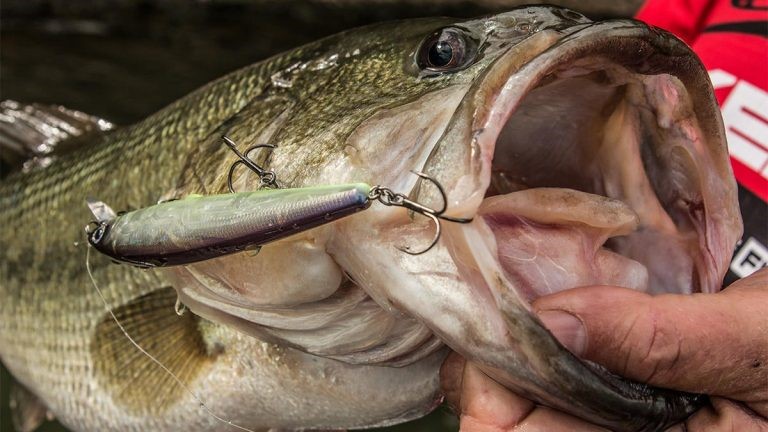
"Once a spring cold front rolls through, in addition to the high barometric pressure, you're also left with high winds. It's been so bad here lately that I've had to leave the big water a few times and head up rivers to get away from the huge swells.
"You can use this wind to your advantage, though. It will position both baitfish and bass on windblown points and seawalls throughout the lake, and there is no better lure for windy conditions than a jerkbait. The waves and ripples created by the wind distort the profile of the jerkbait just enough to hide any unnatural characteristics, such as hooks and split rings, which makes it much easier to fool bass.
"Even if you're not crazy about jerkbaits, try it during the next cold front. I've had nasty days lately when I've caught upwards of 30 bass in just a few hours. Is it because I'm that good? Heck no. Absolutely not. It's because a jerkbait flat-out catches 'em during cold fronts.

"There's a reason those fish are there. Whether it's the presence of bait, bottom composition, or vegetation, it all depends. But again, they're there for a reason, and in cold-front conditions, their feeding windows get incredibly small. So revisiting a productive spot several times increases the likelihood of your pulling up while they happen to be feeding, or at least, that's my opinion.
"So try these tips on your next trip. If you run across a little bunch of 'em, come back in an hour or two. Don't peg your weight. Throw a jerkbait. Back off the bank a little bit. I'm willing to bet if you try these things, you won't be so hesitant to go fishing during that next cold front."
When Stuff Off the Shelf Don't Work, Whaddaya Do?
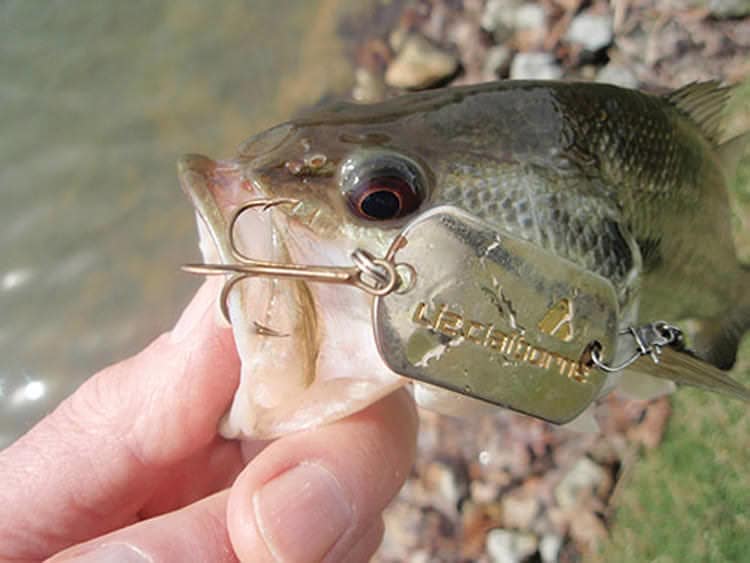
When none of the tried and true are working, whaddaya do? Throw your hands in the air and say, "I quit," or knuckle down and do what a fella I read about online today does: Come up with a homemade lure or two of your own...something none of the fish likely have seen before.
This guy very well may be a one-of-a-kind. After all, how many people do you know who owns a Liz Claiborne lure?
It seems that several years ago, the guy's wife purchased a new purse with a 2-by-2-inch brass "Liz" insignia that was fastened to it by a key chain. Upon seeing that insignia, his devious mind immediately thought: fishing lure! Since it already had one hole in it, 'twas an easy matter to drill another and attach a split ring and a No. 6 treble hook. Voila! A new lure was born.
"Does it work?" you may be asking. How about this: Check out the accompanying photo carefully and decide for yourself.
Like a lot of men, this guy was one to never throw away anything. He subsequently spied the handle of an old silver spoon gathering dust on his workbench. Once again, a light bulb went off in his head, and another lure soon was born.
A friend used a drill press to poke two small holes in the very hard metal, then a split ring was attached, and a No. 6 Daiichi bleeding-bait hook was added. Why red? There are two prevailing schools of thought. The first is that red duplicates the gill flash of a wounded or fleeing baitfish, and this in turn provokes an aggressive response from predatory fish. The second is that red disappears in the water, and that since the fish can't see it, the hooks don't spook them away from the lure.
This do-it-yourselfer believes the first theory. He thinks the fish can see the hooks, and the red color provokes them into striking. As pro walleye angler Mark Martin once stated, "All I know is that I have cashed a lot more checks since I began putting red Daiichi hooks on my Rapalas."
The DIY guy also decided to add red hooks to his "Ol' Liz" lure the next time he used it. At the same time, he further came up with a way to customize an old Road Runner lure that he found laying on his workbench. For the past 10 years or so, he had had great success catching bass on bubblegum pink artificial worms. So he snipped off about four-and-a-half inches of an old, chewed-up pink worm, attached it to the hook of a 1/8-ounce red-headed Road Runner and set forth to try his luck.
With two small ponds located within easy walking distance of his house, which the DIYer likes to think of as his "laboratories," he walked over one early, chilly morning and put his wacky new idea to the test.
Within a very short period, he had landed eight largemouth that literally had destroyed his new lure...so much so that he had to bite off about the first half-inch of the worm and reattach it. Their zeal told him that they liked the look, action, smell, and whatever else of the lure and wanted to eat it, rather than just chase it out of the area.
If any of you other DIYers out there find these ideas appealing, why not try coming up with some homemade lures of your own? Let your imagination be your guide and create something unique. Whatever you do, don't forget to take some pictures as a reminder of your creative talent.
Subscribe to:
Posts (Atom)