Saturday, August 19, 2017

Another Blistering Day on the Water


That fact, however, didn't deter 10 anglers in six boats from testing their skills against the bass today. They collectively weighed in a total of 23 fish, with a total weight of 45.43 lbs. and an average weight of 1.97 lbs.

Standing tall in the winners' circle at day's end were the following:


(From left) Al Napier and Wayne Hayes claimed 1st place with a five-fish limit that weighed 12.48 lbs. Their big fish weighed 3.11 lbs.


(From left) Gary Coderre and Chris Fretard walked away with 2nd place. They had four fish with a total weight of 9.38 lbs. Their big fish was the day's lunker prize at 4 lbs. even.


(From left) Bobby Moore and Duane Kessel captured the mystery-weight award. Their limit tipped the scales at 7.25 lbs., which was closest to the drawn weight of 4.90 lbs.


Here is how the other competitors finished the day:

     * Randy Conkle and Bob Glass caught a limit, with a total weight of 9.03 lbs. Their big fish weighed 2.21 lbs.
     * Jim Wilder brought four fish to the scales, for a total weight (after a 0.50 penalty for two dead fish) of 7.29 lbs. His big fish weighed 3.06 lbs. Unfortunately, the scales already had closed when Jim found a fish he had dropped en route to the weigh-in site. Accordingly, that fish could not be counted.
     * Once again, yours truly did not weigh a fish. My day was limited to four hours due to the fact I was forced to operate with only one of two trolling-motor batteries. It looks as though one bank of my onboard charger may have died.

One more angler became eligible to fish in our season-ending two-day Classic as the result of his participation in today's contest. That brings the total to 15, with four more qualifying tournaments still remaining.

Congrats to all the winners and thanks to everyone who showed up to participate. For planning purposes, our next scheduled event is Saturday, Sept. 9, from safe light to about 2:30 p.m. Hope you can join us.


While frustrated that yet another day came and went without my being able to complete it, I have to admit my frustration was somewhat tempered by the fact it already was pretty miserable at 10 o'clock when I had to quit and head for the dock. I used the rest of the fishing day to clean up my boat, put it away in the storage shed, and sit around sipping on a couple of cold sodas.

When 2 o'clock rolled around, and the other anglers were heading up the channel for weigh-in, I was ready for them, and once that was completed, I was on the road home for a visit with one of my granddaughters, her husband, son and daughter who were passing through my neck of the woods on the way back home from a wedding they had attended. It was a short but most pleasant get-together, and I enjoyed every minute of it. Fishing is fun, but family reunions are even more fun.


Angler of the Year Race Continues


(From left) Al Napier/111.84 lbs., Bob Glass & Randy Conkle/109.78 lbs., Bobby Moore/108.51 lbs., Duane Kessel/106.14 lbs., Rob Peppers/100.86 lbs.

Monday, August 14, 2017

For the Week Ending Sunday, Aug. 20, 2017


Monday, Aug. 14 (from Ron)...Weather didn't look very good, but I rolled the dice. Launched on Milldam from Blackwater Road at about 5 p.m. and caught two dink bass and three dink white perch before the sky darkened and the distant thunder drove me away. Still good to be out.

Tuesday, Aug. 15 (from Ron)...Launched at the drawbridge on upper North Landing to stay close to my car with a pending storm. Fished for about an hour and caught two stripers at 16 and 17 inches, respectively, along with a dink bass, a 2-0, and nothing else. The sky darkened, and I got out of there just before it got ugly. Stripers were hitting a crankbait, and the bass hit a Pop-R. (FYI: Ron nailed it with the term "ugly." Wayne and I were working on my boat at West Neck when "ugly" hit, including some loud thunder and a downpour that lasted at least 30 solid minutes.)

Wednesday, Aug. 16 (from Ron)...It's always a good trip when I get a bowfin! Launched Milldam about 5 p.m. and fished 'till dark. Had a few hits and misses until I tied on a Zoom Fluke, which seemed to be what they wanted. Managed four dink bass, a 1-9 and a 2-7, all of which hit the fluke along grass edges. A beetlespin found three dink white perch but nothing for the stringer. As the sun was setting, tied on a Whopper Plopper and found a really nice bowfin at 6-1. Gave a great fight. Very chubby and healthy bowfin. Also missed a few on the WP--maybe gar. The bowfin was a struggle. The WP treble was between upper and lower lip, so I couldn't get the lip grip on him. Had to grab him with a towel as he thrashed around. A tussle to say the least. Nice to be out late without thunderstorms.

Thursday, Aug. 17 (from Jim)...I fished south to start, using a WP, Pop ShadZ, and small swimbait. Had a bump on the first two baits but no hookups. Came back to the bridge and decided to throw a crankbait and they were on it! Caught a 1.3 and a 13 oz. off one log. Eased above the bridge and caught a 1.8, 1.4 and a genuine dink. Came back to the bridge and caught four tiny crappie. Called it quits about 3:30. With no wind this morning, it was darned muggy. When the wind finally came up, the fish got active. Water temp was 84 degrees at launch and 88 when I pulled out. The fish were on wood--mainly logs, rather than stumps. Water color was super dark and clear.

Thursday, Aug. 17 (from Ron)...The water was a bit high for the bridge limbo (2.8), but I managed to squeeze under and fished Milldam from 5 p.m. 'till dark. Caught several white perch on beetlespin and Whopper Plopper but only one keeper. Seems the bigger ones perhaps have migrated. Also lost one keeper-size crappie yak side, so there will be no tacos. Caught a dink bass and a 1-7--one hit the WP, the other a Fluke. Caught a bowfin, as well. Didn't think they came in extra small size, but this one did--I'm guessing it only would have gone 1.5.

This week (from Charlie)...Due to weather and other commitments, I only made it out once. After last week's success with hollow-bodied frogs, I went looking for grass again. Grass was not on the menu this time, though. Went to plan B, which was crankbaits in grass-free holes. The water was 84° and on the murky side, because the stiff south wind was pushing the water in from the bay, and the current was running strong, stirring thinks up. Not a lot of fish this week but a couple of good ones. I did get a 1-8 on a frog in the grass, but it took three hours. The crankbait event lasted one hour and produced a 2-4 on a Yo-zuri 3DB Wakebait, and a 4-6 on a Yo-zuri 3DS shallow crankbait. The heat and humidity drove me off the water by eleven, but a good haul nevertheless. Maybe next week will have better conditions.

Friday, Aug. 18 (from Ron)...It was a long trip from North Landing drawbridge to Haynes Creek. In short, the juice was not worth the squeeze. Enjoyed being out after the sun hit the treetops and things cooled down a bit. The trip south was dreadful, with all the heat and humidity. Ended up with only three dinks and a 2-2. They were hitting Zoom Flukes and nothing else. Oh well... .

Saturday, Aug. 19 (from Ron)...Fished Back Bay this morning. Very murky and not the best bite, but found four dink bass, as well as a 1-2 and two 1-3s. Had luck with Whopper Plopper when I could throw it, as well as a swimbait. The swimbait is new for me and am still trying to figure it out. Had some company out there, too, as you can see in the accompanying photo.

Sunday, Aug. 20 (from Charlie)...Another great day. Got 25 this morning with the top 5 including a 1-4, two 1-8s, 2-0, and a 4-0, for a total of 10 lbs. 4 ozs. Can’t believe my luck lately. There were five other kayaks in my first hole, so I headed south to find some new ground. Glad they chased me out of the cove. Here’s the 4-0, which I took on a SwimSenko fished over the grass.

Sunday, Aug. 20 (from Ron)...Launched from Munden Pt. Park and made my way to Snake Creek south. Caught nine dinks, plus a 2-7. They all went for SwimSenkos, and now I have none left. They are not very durable, and they're too costly. Wish Z-Man made something similar. Water was very clear, and the best bite was from 0800 to 0900 near the entrance from North Landing. The further I ventured in, the worse the bite got. Grass-covered feeder creeks were where most of the bites occurred. Lost two bowfin and caught three crappie. A friend I was with caught a whole stringer full of crappie. Didn't see any snakes today. Trip back across North Landing was like a shooting zone, what with all the boats and jet skiers...ugh!

Sunday, Aug. 20 (from Ray)...My son, Barry, and I fished Pocaty and part of West Neck today. Ended up with 13 bass, a bowfin (maybe 4 pounds), and a couple perch. The two largest bass weighed 1.4 and 2.4 pounds, and the rest were dinks. The lure that worked best was a weightless swimming Dinger, fished by twitching it slowly on the bottom. The water was fairly clear and 83 degrees. The wind was friendly today. The traffic was very heavy on Pocaty, with kayaks and all kinds of boats.

Sunday, August 13, 2017

Makin' 'Em Bite When They Don't Want To


The fish just aren't biting. A cold front has turned 'em off. It's too windy (or not windy enough). It's too hot (or cold). There's too much boat traffic. I don't have the right lure. I'm fishing the wrong place.

Sound familiar? I'd venture to say we've probably all heard these excuses and/or maybe uttered a few of them ourselves at one time or another. The fact is that everyone, even experienced anglers, have occasions when they don't do very well.

As a tourney director, I distinctly remember a couple of those occasions this year--days when the usual "heavy hitters" didn't fare so well. Each time, though, I witnessed one or more other anglers who managed to find a bite that produced a nice bag of fish.

So, how do you make stubborn bass bite? It starts with making mental adjustments. You fight off a defeatist attitude. When you're not getting bitten in an area where you've caught fish recently, step back and try to figure out why the bites aren't happening. If you think the fish are pressured, look for a different area, but remember this: The fish don't usually move far, so resist the temptation to start running all over the place. And if the weather is an issue, simply slow down and fish more methodically.

Another suggestion is to fish heavy cover, which can include everything like thick vegetation, brush tops, gnarly stumps, and logjams. According to the pros, brutal conditions will make "sulking fish pull into the thickest cover available, and you have to go in after them." Forget the obvious targets. Instead, concentrate on the high-percentage places--those that are hardest to reach but are the most likely to hold fish. Bass burrowed in heavy cover feel more secure and are vulnerable to baits that drop into their safety zone--baits like soft plastics, especially scented ones.

Be thorough and slow down. Patience is a virtue when bass don't want to bite. A smart angler resists the urge to fish faster through potential areas in an effort to cover more water. Instead, he lets the bait soak longer in the same spot. In other words, make the most of each cast with multiple presentations from different angles. You want to cover every inch.

Whether you have to deadstick the bait, shake it, or maybe do a combination of the two, the onus is on you to entice the strikes. If you're fishing fast movers like spinnerbaits or crankbaits, use the bottom or cover to deflect the lures and create erratic movement that can trigger reactionary strikes.

Also don't hesitate to downsize your lures. Smaller lures are apt to produce more bites from lesser quality fish, but on tough days, smaller fish are better than no fish at all.

And finally, rotate locations. When the water temps reach the upper 80s and hotter, fish become less active because it burns up their metabolism. However, they still feed--just for shorter periods. At times like this, pros often will rotate their fishing spots, keying only on those where they know the fish live. Under these conditions, you don't have to worry about slowing down or scaling back your lure size because, as one pro explained, "they'll eat anything when they feed."

If you accept the conditions, stay confident, and fish with patience, you'll catch fish, insist the pros. "The secret to being a good angler," according to old-timer Denny Brauer (right), "isn't knowing how to catch fish when they're biting. It's being able to catch them when they're not."

Wednesday, August 9, 2017

For the Week Ending Sunday, Aug. 13, 2017


Wednesday, Aug. 9 (from Ken)...After Saturday's skunk, I felt a need to get back out there and try something different than what I fished then. Turns out I managed to catch a few fish, including a couple of dinks, a 1-0, 1-2 and a 1-6. Two of the bass went for a small Senko. The other three fell for a small crankbait. Everything came out of West Neck. Unfortunately, the day ended on a sour note. I've been having a trolling-motor problem about the last four or five trips, and it all came to a head today. Something in the unit appears to be binding, cause my operating speed has been growing less each trip. Called my mechanic at the end of the day, and he came out to the marina, removed my trolling motor, and tucked it in the back of my van for transport to Tom in Suffolk in the morning. Got my fingers crossed I'll be back in business sometime next week.

Wednesday, Aug. 9 (from Charlie)...Found seven dink bass and one at 3-0, plus a 2-12 bowfin to end the day. Tried mostly crankbaits. Had a few taps but the majority wanted a swimbait. Most dinks went for a small beetlespin. Big bass hit the swimbait with no weight. When I got to my favorite spot first thing in the morning, a bass boat was sitting on the hole and stayed there for an hour. When he passed me on the way out, I went back and got the big bass. A pleasant day for a change.

Thursday, Aug. 10 (from Ray)...Fished the lower and upper West Neck Creek today. Thought it would be a good day but only caught three bass (a 1.10 and two dinks), along with four bream. Had several more strikes on topwater but couldn't hook 'em. The lures that worked were the Whopper Plopper and KVD 1.0 crankbait. Water temperature was 76/78, and it was fairly clear and at a good level. The grass seems to be increasing at a high rate.

Friday, Aug. 11 (from Charlie)...Another killer day! Can't believe I've had such good luck the last two weeks. I was out early to try and miss the rain. The water was in the upper 70s, and it was clear in the grass beds. Calm winds and an overcast sky made for some really active fish. The bite was steady all morning, and if it hadn't been for a doctor's appointment, I'd have stayed a lot longer--rain or not. It was that good. I'm always surprised that the fish prefer one bait over everything else you throw, but while swimbaits were the ticket on Wednesday, they wouldn't touch 'em today. I still got a few on alternate baits, but the hollow-bodied frog was the killer this morning. Got 16 with it, but also picked up 8 on the Whopper Plopper. Missed a lot of strikes on the WP, and the ones I did get were hooked everywhere but in the mouth. Meanwhile, the frog almost always was completely down the throat after some tremendous explosive strikes. Today's overall totals were one white perch and 24 bass, with the best five going 1-10, 2-0, 2-4, 3-8, and 3-9, for a grand total of 12-11. It just doesn't get much better than today.

Saturday, Aug. 12 (from Ron)...With the spotty thunderstorms, decided to launch at the drawbridge on North Landing. Stayed close to cover and the culvert leading to upper North Landing. Stripers were biting well, and I caught four. Also lost two fish on break offs that may have been a gar. Had one nice keeper striper that went just over 20 inches and weighed in at 2-14. Also caught a dink bass. All bites fell to a small crankbait running about 3.5 feet deep. Tried Zoom Flukes and Whopper Plopper to no avail. Good to be back on the water.
Looked like a big cell of nastiness to the west, so launched Munden Point and stayed close to launch till about 0900.  The cell spilt north and south so headed across North Landing and into a creek south of Snake Creek.  Very poor and intermittent bite.  

Sunday, Aug. 13 (from Ron)...Caught several panfish, including three crappie to 11 inches, on the beetlespin, as well as a 9-inch yellow perch, but oddly no white perch. Tried everything in the arsenal. Water was high but flowing out, so shifted to plastics and grass-choked feeder creeks. Threw a SwimSenko into a feeder creek and had a violent attack. While reeling the fish, I thought it was a small bass or panfish until he got close to the yak, but it then took off and made my drag scream. My initial thought was a pesky gar, but it turned out to be a nice big ol' bowfin. Made my day at 24 inches and 5 lb 8 ozs. Managed a few dinks and what I think was a "sub dink" and called it a day.

Monday, August 7, 2017

Another Fishing Method on the Local Scene Stirs Childhood Memories


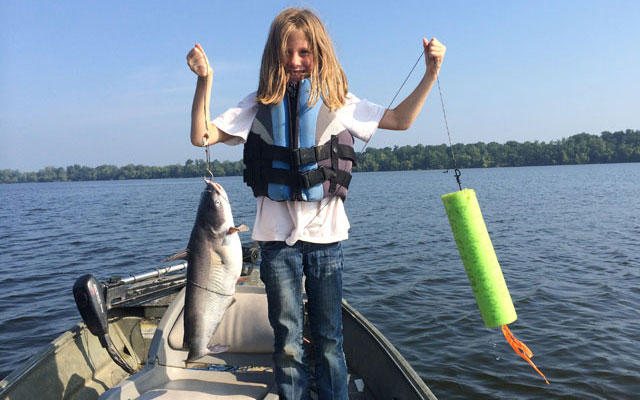
I was fishing the West Neck Creek shoreline during our tourney two days ago when what should appear before me but a couple of boys in a johnboat running their jug-fishing lines. My immediate thought was that I just had happened upon a couple of young fellas who might be breaking the law.

There's a good reason why I had that thought. As a young lad growing up in my hometown of Oswego, KS, I remember one summer in the 1950s, when my dad's Uncle C. came to town from Kansas City for a visit. As usual, he wanted Pop to take him fishing, but not with rod and reel.

No, sir. Uncle C. wanted Pop to take him jug fishing in the Neosho River. And he had come fully prepared for the occasion. His car was loaded with 5-gallon glass jugs. There was just one problem: At that time and to this day, too, I think, Kansas has a thing about jug fishing. In short, it's illegal--a fact I'm not sure Dad ever divulged to Mom, because he had to have known how she would react to that kind of news.

Nevertheless, Pop and Uncle C. readied the bottles and, at the agreed upon time, set out for a secluded stretch of the river. I had been all over Dad for a couple of days to take my brother and me along, and in due time, he had caved, so I was all set to get a lesson about a new kind of fishing (new to me, that is).

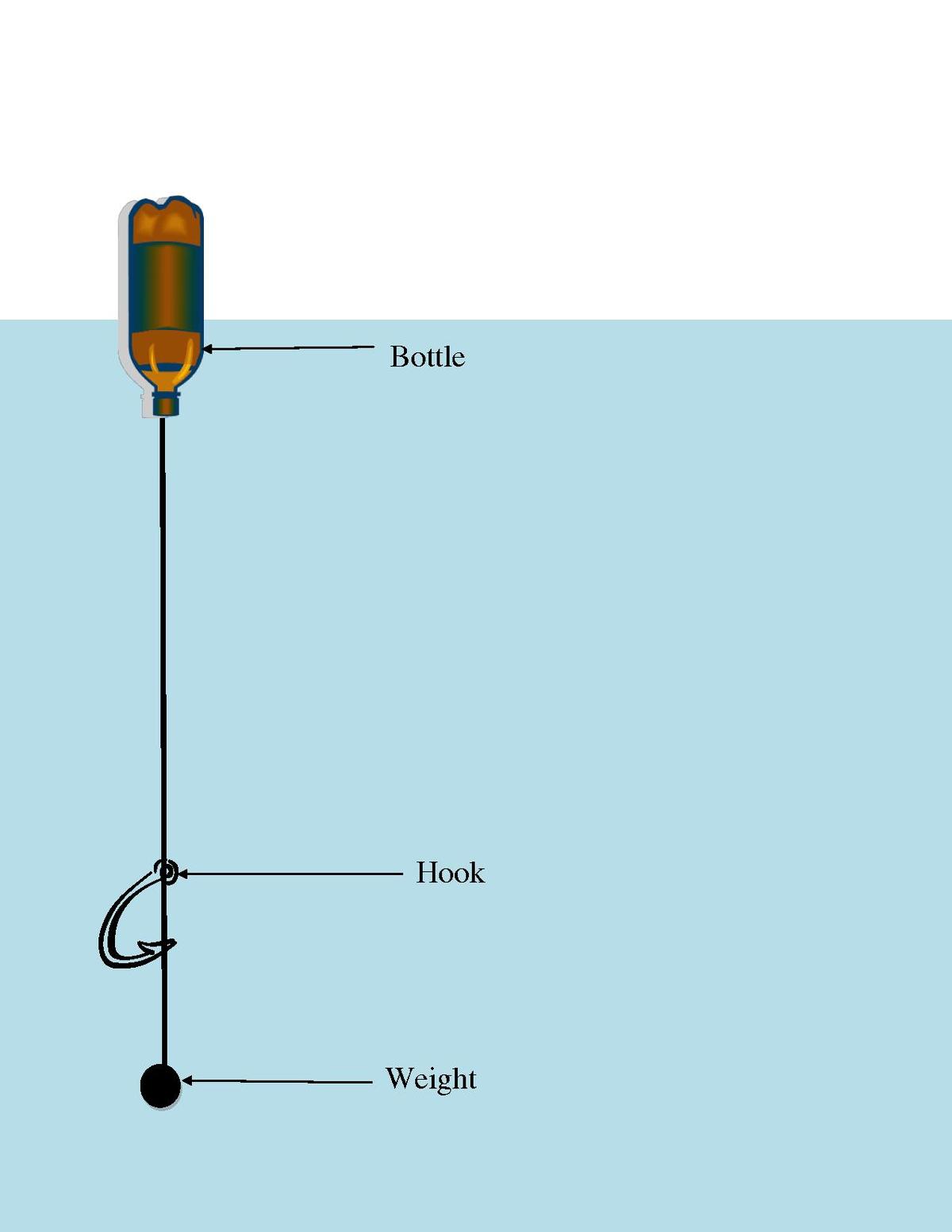
In its simplest form, jug fishing is an unlimited class-tackle method of fishing that uses lines suspended from floating jugs to catch fish in lakes or rivers. Often, a large number of jugs are used. In many states, a fisherman can use up to 20 jugs. Big catfish often are the sought-after species.

I can't begin to tell you how much I enjoyed seeing what happened to those floating bottles when a big catfish would grab the bait attached to one of them. It then was up to Dad and Uncle C. to go chase down their prize in Dad's rowboat. Suffice it to say the day was a total success...without, I might add, any visits from John Law.

From that day until this past Saturday, I hadn't seen any more jug fishing, so you can imagine my surprise when I came around a blind corner in West Neck Creek and saw all those floating jugs. That element of surprise, however, quickly was replaced by questions about the legality of what I was witnessing. For that reason, I contacted Chad Boyce, a fish biologist with the Virginia Department of Game and Inland Fisheries, and got answers to my questions.

It turns out that jug fishing is a legal means of taking catfish and other nongame fish in Virginia. According to Chad, "Each float is required to be marked with the owner's name and fishing-license number (I think). I believe each fisherman is allowed to use 20 noodles (another name for jug lines) at a time, and they must stay within sight of the floats while fishing them," he said.

Chad provided the following language from the official regulations:

"Trot lines, jug lines, or set poles (limb lines) may be used to take nongame fish and turtles, provided they are not baited with live bait (worms are permissible), except on designated stocked trout waters, Department-owned lakes, and within 600 feet of any dam. Live bait, other than game fish, may be used on trot lines to take catfish in Carroll, Dickenson, Giles, Grayson, Montgomery, Pulaski, and Wythe Counties, and in the Clinch River in Russell, Scott and Wise Counties. (See page 13 for South Holston Reservoir.) Any person setting or possessing the above equipment shall have it clearly marked by permanent means with his or her name, address, and telephone number, and is required to check all lines and remove all fish and animals caught each day. Remove all trot lines, jug lines, or set poles from public waters when not in use. Additional requirements for jug lines: Defined as a single hook, including one treble hook and line attached to a float. Jug line/noodle sets on public waters shall be restricted to 20 per angler and must be attended (within sight) by anglers at all times. Also, in addition to being labeled with the angler's name, address, and telephone number, jugs/noodles shall be labeled with a reflective marker that encircles the jugs/noodles to allow for visibility at night."

I'm not advocating that anyone take up jug fishing. Rather, I'm just making everyone aware to be on the lookout for jugs now, as well as crab pots, on the North Landing and its tributaries. This is the first time in my 40 years of local bass fishing that I've ever seen anyone using this method. I suggest that it's anyone's guess how long it will last, or if it perhaps will catch on the way kayak fishing has in recent years. Bottom line: The waterways could have just gotten a little more crowded...for the long haul...or not.

Sunday, August 6, 2017

Summer Isn't the Only Thing Getting Hot...


So is the five-way race for Angler of the Year in the 2017 Dewey Mullins Memorial Bass Tourney Series. Less than three points separate these competitors.

Here is how the race stacks up at the moment:


Leading the charge is Bobby Moore, who has weighed an accumulative total of 101.26 lbs. of bass to date.


The first runner-up is Rob Peppers, whose accumulative total to date is 100.86 lbs.


In the next runner-up position is the team of (from left) Bob Glass and Randy Conkle, both with an accumulative total of 100.75 lbs. to date.


And then comes Al Napier, who has accumulated a total of 99.36 lbs. to date.


Finally, we have Duane Kessel, who is Bobby Moore's partner most of the time. One instance when they didn't fish as a team accounts for why Duane's current accumulative total is 98.89 lbs.


A couple other competitors these fellas have to watch are Chris Fretard and Don Carter, with 81.04 lbs. and 79.57 lbs., respectively.

All of these anglers are veterans of the Dewey Mullins Memorial Bass Tourney Series and current Classic qualifiers. This year marks the first time since I introduced the Angler of the Year Award to the series that there has been this kind of competition, and I'm enjoying every minute of it. I wish all the competitors the best of luck.

Saturday, August 5, 2017

In Just 2 More Months, Another Season Will Be in the Record Books


For the moment, though, everyone is just taking it one tournament at a time. A total of 19 anglers in 12 boats showed up for today's contest. Their combined efforts resulted in a total of 44 bass coming to the scales for a total weight of 84.2 lbs. and an average weight of 1.91 lbs. per fish.

Those standing in the winners' circle at day's end included the following:


In first place was the team of Duane Kessel (left) and Bobby Moore (not pictured), with a five-fish limit weighing 15.09 lbs. They had a couple of nice fish, including a 4.61 (caught by Duane) and a 4.75 (caught by Bobby), the latter of which took the day's lunker honors.


In second place was the team of (from left) Bob Glass and Randy Conkle, with a five-fish limit that tipped the scales at 14.45 lbs. Their big bass checked in at 3.8 lbs.


Finishing in third place was Chris Fretard, who had a five-fish limit weighing 9.57 lbs. (after a one-dead-fish penalty of 0.25). He didn't weigh a big fish.


Today's mystery-weight winner was Skip Schaible. He had three fish that weighed 3.69 lbs., which was closest to the 4.85-lb. tab that was drawn. He didn't have a big fish.


Here is how everyone else stood in the final tally:

     * The team of Rob Peppers and Don Carter, five bass, 9.51 lbs. total weight, 4.02-lb. big bass.
     * The team of Andy Morath and Diana Mendez, five bass, 7.60 lbs. total weight, 2.75-lb. big bass.
     * The team of Gary Coderre and Lenny Hall, five bass, 7.42 lbs. total weight, 2.89-lb. big bass.
     * The team of Wayne Hayes and Al Napier, five bass, 7.31 lbs. total weight, no big bass.
     * Jim Wilder, four bass, 6.59 lbs. total weight (after a one-dead-fish penalty of 0.25), 2.59-lb. big bass.
     * The team of Rusty Girard and Samantha Tawan, two bass, 2.97 lbs. total weight (after a two-fish penalty for weighing a short fish), no big bass.
     * Steve Bailey and Ken Testorff did not weigh any fish.

Three more anglers joined the ranks of those qualified to fish our two-day season-ending Classic. These additions bring our current total to 14 competitors.

Congratulations to all of the winners, and thanks to everyone who came out to participate. For planning purposes, our next scheduled event is Saturday, Aug. 19, from safe light to approximately 2 p.m. I hope you can join us.


During the weigh-in today, I learned that about three fellas' boats had some issues with the outboards. One motor locked up early this morning, another was having oil-alarm problems, and yet another was experiencing an overheat alarm. Could it have been related to the weather conditions? Who knows?

I talked briefly with the fella with the overheat alarm and advised him to remove the thermostats from his motor. I've done that with my last two Yamahas (which he also has) and never, to this point in time, have had a repeat event. I have to allow a little extra warm-up time during the colder months, but that's the only difference.

Of those anglers I talked to during weigh-in, the vast majority indicated their productive baits today were soft plastics. I threw some of those baits, too, along with a wide assortment of topwaters, a spinnerbait, some wakebaits, and a crankbait--all to no avail. The best I could do was to get about four blowups on different topwaters. So, for the fourth time since this past January, I had my butt handed to me in the form of a skunk. But, in a manner of speaking, I spread my wealth around: I wasted the first four hours in Milldam and finished up wasting the last four hours in West Neck. If nothing else, I believe in equal opportunity.

Wednesday, August 2, 2017

For the Week Ending Sunday, Aug. 6, 2017


Wednesday, Aug. 2 (from Ken)...It was a day of 5s. Three of us went out of West Neck today, and each of us caught a total of five bass. Said my friend, Gary, "I probably would have won mystery weight with my five if there had been a tournament." Skip told me his biggest was a tad over 2 lbs., but the other four were dinks. My five included two dinks, plus a 1-10, 2-3, and 2-13. Caught all of my fish on a wakebait before 1 o'clock. After that, the bite seemed to die completely. I continued mixing the wakebait with a worm and a crankbait but couldn't muster a single strike. I boated all my fish in West Neck, having fished both sides of the bridge. With a tournament scheduled for this coming Saturday, I have no plans for another practice day this week.

Wednesday, Aug. 2 (from Skip)...Just received Skip's report for Wednesday, along with some photos of his fish and boat umbrella. That's right, folks, my friend likes the shade and plenty of it, when he's out there on the water this time of year. All you have to do to find Skip anytime between July and August is to look for that familiar blue and white umbrella. It stands out like a beacon, especially on a bright day. In any event, as I mentioned in my earlier post, he caught a total of five bass, his biggest a 2.1-pounder.

Thursday, Aug. 3 (from Ray)...Fished the upper and lower West Neck today. Caught three dinks and lost two others on topwater baits. Still don't understand how a fish can throw a lure with two treble hooks. Also caught a half-dozen perch and bluegill, which were small. Water temperature was 81/84 and fairly clear. Yum Dinger, spinnerbait and crankbaits were the lures of the day. Spoke to another fisherman, and he said the size of his catch also was small.

Friday, Aug. 4 (from Ron)...Returned today and headed out to Old Pungo Ferry Road. Forgot that a Friday evening would see too many boats and people. Headed to Spitzle Creek for some solitude, which I found, but not many bass. Only found two dinks and a 2-4. Lost more than I landed. Whopper Plopper and Zoom Fluke were working for me. Good to be back on the water.

Saturday, Aug. 5 (from Ron)...Tried Back Bay this morning. Launch was OK, but then about 8 a.m., the wind got bad. The water was super murky, and the bite was nonexistent.  Alex caught two dinks, and I managed a 1-7 right about 10 a.m., when we called it quits.

Tuesday, August 1, 2017

Some Bad News for Tenants of West Neck Marina


I hate to be the bearer of bad news, but late this afternoon, I learned that the fire marshal had inspected the West Neck Marina premises today. One of the things he did while on the scene was to go around disconnecting all drop cords he saw. According to Steve, he was told by the fire marshal that he will have to upgrade West Neck with all marine-grade wiring. At the moment, there's no way of knowing how long this project will take. However, if you are a tenant and have been powering battery chargers and/or any other equipment with drop cords, be advised you undoubtedly now are without power.

Saturday, July 29, 2017

Beware Those "Next Big Thing" Promises


Consider, for example, this ad, which accompanied a 1977 Popular Science article. The actual opening statement in that article read as follows: "Fiberglass, the core of modern hull construction, is now obsolescent."

As noted by Bryan in a Feb. 15, 2013, Bass Fishing Archives piece, "That's a pretty bold statement, surely made mostly to grab the readers' attention"--and I agree wholeheartedly. All writers usually learn that lesson early on...or spend a lot of time looking for new jobs.

In the case of the Popular Science article, it was promising that Kevlar, with its "some 25 percent lighter, 50 percent stronger, and 50 percent stiffer" qualities was going to make fiberglass a thing of the past. DuPont's invention then was recognized as the strongest synthetic fiber in the world.

"Yet, nearly 30 years after this article made print," continued Bryan, "fiberglass still seems to be alive and well in the boat-manufacturing world. Still, back in the late 1970s and early 1980s, Kevlar boat hulls (like the one on this 1978 HydraSports) were 'all the rage.' The promise of indestructible hulls had the bass boatin' world abuzz."

So, what went wrong?

As Bryan explained, "On the surface, it seemed like a great idea. Lighter weight meant better fuel efficiency and easier towing, a big deal back in those days of double-digit inflation and gas embargoes. Where ramming a stump or other solid object would puncture a hole in the hull of a fiberglass boat, it only would dent a Kevlar-built hull--and, in some cases, could be popped back out.

"Remember that ad where the bulldozer was running over the hull of a HydraSports boat? At one point, according to some accounts, HydraSports was building 93 percent of their boats with the stuff."

There were several problems, though:

     * Kevlar was more difficult to work than fiberglass.

     * It was trickier to prepare for lamination.

     * While it had great tensile strength, it was relatively weak in compression. And, as one expert remarked, "It is one bad mutha when it comes time to repair it." He explained you need special shears/blades, an understanding of the fabric and its madness, and a bit of masochism to boot. His advice was, "Save your money, your repair-bill hassles, and get on with it, using fiberglass. If your boat is going to be subjected to some measure of hard-lick abuse, add more glass to that area and get back on the water."

     * Finally, it was a pretty costly material, adding between $300 and $500 per boat built with the stuff (doesn't actually sound like much). Kevlar woven roving costs $14 per yard versus $1 for fiberglass.

While HydraSports was the first manufacturer to introduce the bass-fishing world to the Kevlar 49 aramid fiber in 1976, Skeeter soon joined in the venture, with the introduction of their 1977 Wrangler 16-foot model (pictured in the ad at the start of this article and at right).

In the interest of leaving y'all laughing--or smiling, at least--I dug around the Internet until I came across an angler who had posed a couple of questions in 2000 to his fellow forum members about an old Skeeter Wrangler (his first boat) he just had bought and restored. He began by explaining that, while the boat was rated for a 175-hp outboard, he had installed a rebuilt 225 Merc. The first problem, as he described it, was, "I'm only getting about 79-82 mph. I figured I'd see near 90. Should I try raising the motor?" he asked.

Then he noted that "the boat also seems to slide in the corners" and asked what he could do for that, as well.

The first response he got was as follows: "Hope you've got a good kill switch, life jacket, and a Kevlar suit with reinforced crotch, 'cause God forbid that you should flip that thing! Have you any idea what the force of water at 90 mph will do to the weakest spot if you go in feet first? Can you say 'sphincter blowout'? Good luck."

Said Bryan in closing his Bass Fishing Archives piece, "I still see where Kevlar is being used in some hulls of modern-day bass boats, usually in the more custom-built lines. Again, it seems like a case of great science, but just not at the right time."

Friday, July 28, 2017

Inflatable Life Jackets: Some Like 'Em, Some Don't


A friend of mine got a bit of a surprise Wednesday morning when he went out to West Neck Marina and climbed in his boat to go fishing. As he started to put on his life vest, he noticed it was completely open.

"It had inflated (I'm assuming) in the boat," he said. "I checked the bobbin, and it was red. I then checked the date, and it was 06. I have to wonder how many people, like me, don't check them regularly."

Then, as luck would have it, when I opened Jay Kumar's latest electronic issue of BassBlaster last evening, what should I find but an article entitled "Inflatable PFD doesn't open...again." I knew this coincidence warranted a blog post.

Kumar began his BassBlaster piece with a question: "Remember in March 2015, when two guys were ejected from their boat (on Lewis Smith Lake Alabama) and their inflatable PFDs (one a couple-years-old Stearns SoSpenders, and the other a new Mustang) didn't open?"

In that case, angler John Cox (see right) and his marshal, Bryan New, were thrown from the FLW-issued Ranger driven by Cox. He was moving to another pocket in the mid-section of the lake to do some sight-fishing, traveling about 45 or 50 mph, when the boat suddenly cut hard left.

Both Cox and New were launched into Smith Lake's 52-degree water, but their inflatable PFDs did not deploy. As a result, they quickly dropped to the bottom in approximately 10 feet of water because both were wearing foul-weather bibs and extra layers of clothing. This gear, according to Cox, may have saved both of them from suffering additional and possibly more severe injuries.

Cox ended up with a gash on his head that required staples, as well as a possible concussion. New, who already was nursing an unrelated collarbone injury, suffered a bump on his forehead.

Continuing his BassBlaster piece, Kumar cited the July 10, 2017, incident which occurred on Lake Michigan, involving Munster, IN, anglers Bobby Bergen and Ian Boston (see left).

"As he (Bergen) zoomed into the mouth of the shipping channel," wrote Kumar, "the bottom of his boat struck a large pipe protruding inches above the water off an underwater break wall. The heavy pipe shredded the fiberglass hull of Bergen's 21-foot Ranger boat on impact and ejected both men into the lake.

"Both anglers were jettisoned across the front deck, over the bow, and into 30 feet of water. 'It happened so fast neither of us had time to react,' said Bergen, who was knocked temporarily unconscious when his face slammed into the console on his way out of the boat.

"Fortunately for both men, the boat turned sharply away as they were tossed over the nose, and neither man was struck by the propeller. The boat came to rest against channel rocks.

"Bergen had the outboard 'kill' switch attached to his life vest but had forgotten to attach it to the throttle connector. Otherwise, the engine would have shut off as he was thrown from the cockpit. Because he uses a foot throttle, the boat did slow to idle speed when his foot came off the gas.

"Both anglers were wearing life jackets. Boston had a traditional foam-filled jacket that covers the back and chest; Bergen was wearing a harness-style vest designed to inflate when submerged...but it didn't."

As Bergen subsequently related, "I just bought it a few weeks ago, and even had the Coast Guard inspect it before I used it. I'll never wear one of those inflatables again."

Kumar added that he hasn't used or carried any inflatables since the earlier FLW incident. "A PFD has to work when you need it to...period!" he explained. "Not saying all inflatable PFDs are bad--just for me, it's a confidence deal."

Another angler who quit wearing inflatable life jackets, as noted by Kumar, is Scott Rook. The last time the Elite Series came to Lake Champlain in 2007, Rook was wearing an inflatable while fighting 5-foot waves to get back to the weigh-in site.

Said the Elite Series pro, "I thought, if I go down here, it's 400 feet deep and 2-3 miles to the bank. If that life jacket fails to inflate, I can't swim that far in these waves. It was as scared as I've ever been."

If you're one of those who like inflatable life jackets, here is some do-it-yourself owner-maintenance advice from Tom Burden, senior technical editor at West Marine, you should consider:

Checking out your brand new vest. We recommend that the first thing you do with a new vest is to unfold and inflate it, using the oral inflation tube, to be sure it has no leaks in the bladder and is safe to wear. Leave it inflated overnight. If it still is holding air the next day, deflate it, refold it, and use it with confidence. If the new vest won't hold air, return it for replacement.

Regular inspections when you put on the PFD. Check the exterior for abrasions, loose thread, or other signs of wear. Make a habit of checking the service indicator that is visible inside the clear plastic window to make sure the status is green, which means your PFD is armed and ready to inflate. Red means the vest only can be manually inflated and needs service.

Detailed inspection. At least once a year, at the beginning of the boating season, inflate the PFD and go over the CO2 cylinder, the bobbin, and any other of the various pins or parts that make it work. Perform this inspection every two or three months if you wear your vest regularly, or if your boating location is hot and humid, since the inflation mechanism may be subject to corrosion.

This time, unfold the vest and carefully remove the CO2 cylinder and the bobbin. Check the bottom of the cylinder and make sure it has not been punctured or discharged, and that it does not show any sort of damage. Check the date that is stamped on the bobbin (note that some vests, like the Mustang models with the Hammar hydrostatic inflators, have the expiration date printed on the exterior of the inflator). If the bobbin is more than three years old, get a new one, regardless of how intact it appears. Bobbins have to dissolve like an aspirin pill when they come in contact with water, which is how the device activates itself, so don't mess around with out-of-date equipment.

If your vest has a safety harness, check the stitching, inspect the D-ring that clips to your tether, and be sure the whistle is still present (as well as an operational strobe light, if you've installed one). Be sure the bladder is intact, without tears or holes, and the oral inflating tube and reflective tape are in good shape.

Most vests have "care instructions" sewn inside the fabric cover that will cover all of these points in detail and, especially important, will provide the part number for the rearming kit you may need to purchase that will contain the cylinder, bobbin, and other replacement parts. Cylinders come in a variety of sizes, diameters, and thread patterns specific to each model of the jacket. Some vests also need pins or "pills" to activate. Always use the exact model of rearming kit intended for your specific model of vest.

Inflate the vest, as before, with the oral inflation tube. Leave it inflated for at least 16 hours. Consider giving the vest a quick wash in warm soapy water, followed by a rinse with fresh water, especially if you're a saltwater boater, since salt is just as gritty and corrosive to life vests as to other boating gear. You also can perform the leak test by submerging your vest in a bathtub or sink, and check it for pinhole leaks.

When you've finished, hang the vest up to dry in a well-ventilated location that's out of direct sunlight. After it dries, deflate it, using the small tool attached to the oral inflation tube, carefully squeezing out all the air so the device will fold compactly enough to fit back into its cover. Then rearm your PFD with the bobbin and CO2 cylinder (both of which have not yet reached their expiration dates) and repack the vest according to the manufacturer's instructions.

Now, with the service indicator showing green, you can wear your life vest with confidence. The point of inflatable life vests, and what makes them worth these extra maintenance chores, is their comfort, light weight, and ease of use. The best life vest, after all, is the one you will wear whenever you're on the water.