That was the bottom line in Ron's latest email I received. He was describing the fact his son, Alex, invariably leaves him playing "second fiddle" during their fishing trips.
In this instance, Ron described events during a two-week trip home in October 2013, from his year-and-a-half contractor job in Afghanistan, where he was training Afghans in IED defeat. "I had to look the part," he said, in explaining his heavy beard in the accompanying photo, which depicts him holding a 46-inch red drum he caught during the trip home.
The father and son team were fishing from Sandbridge Pier. According to Ron, "All the regulars had left"--no surprise, since there was no bite and the conditions were poor. "With my time home running out, though," he continued, "we stayed put."
Suddenly, there was a telltale drag scream coming from the rod belonging to Alex. He grabbed it and set the hook. Meanwhile, a lady with what appeared to be a high-end camera started clicking away and didn't stop until Ron and Alex had netted, measured and released the fish some 10 or 15 minutes later.
Ron later was talking to the woman and learned that she and her husband were visiting the area from Richmond. He gave her his email address so she could send them the pictures.
Ultimately, however, this couple shared their story with Tee Clarkson, a friend of theirs who writes for the Richmond Times-Dispatch. Clarkson followed up by contacting Ron, saying he wanted to do a write-up for the newspaper. Here's the link to that story: http://www.richmond.com/outdoors/article_6797d18f-ea8e-5590-8a1d-b60eda735654.html.
It was the last day of Ron's time at home when Alex once again showed his dad how to catch the big one (see photo above). Said Ron, "His fish (also a red drum) was at least 10 lbs. heavier."
Tuesday, November 10, 2015
Sunday, November 8, 2015
Bass Breaks More Than a Boy's Rod
It also broke his heart. You see, the bass in question was big--and, believe me, this boy, Alex, knows "big," because he's already boated one that weighed 6-3 (the one he's holding in this photo), as well as one better than 4 and another better than 5.
The setting for this broken-rod episode was the first cove on the left after the West Neck Creek Bridge this past Friday evening. The water was high, and the bite was low. The only thing working was spinnerbaits. Ron and his son were fishing out of their kayaks when the boy suddenly hooked what he described as "his largest bass ever."
"It took a last dive, and when my son's pole (a Berkley baitcasting rod) hit the side of the kayak, it broke," said Ron. "Lost the fish. Poor kid was heartbroken, and I'm out $80."
Ron (pictured here with a 4-3 "personal best" bass that he caught July 16, 2015) and his teenage son have had their kayaks since last fall and love to fish, as evidenced by the fact they routinely wet a line on an average of 5 or 6 days a week.
As Ron explained, "Last fall, we tore up the inlets, chasing specks and puppy drum. This past summer, then, was freshwater intensive. Alex frequently nips over to Courthouse Estates retention ponds after school, too, where he seems to have good luck.
"We're still novices, just trying to figure it all out," added Ron. However, very few novices can claim the kind of success this dad and son have had. Young Alex, for example, already has scored multiple citations, starting with one for a 22-inch bass he caught in Blackwater Creek.
In describing that occasion, Ron said, "I was having a good day, with a small bass and a bowfin. Alex, meanwhile, was looking at a skunk. Then about 1200, while throwing a jig and pig to the base of a cypress tree, on our way back to Blackwater Trading Post, he landed the ugliest bass ever."
It was during a trip to Tecumseh a few months ago that Alex caught a 28-inch citation chain pickerel (the one in this photo). On the very next cast after getting that fish unhooked, he caught a 25-inch citation pickerel--"and here I have yet to break the 24-inch mark on a pickerel," noted Ron, adding, "I had one yesterday that was 23.5 inches."
And the citations don't end there, either. It seems that Alex also has picked up a few red drum citations while fishing from Sandbridge Pier, the same place where he landed two cobia on an otherwise uneventful morning. One of those fish measured 50 inches but fell shy of a citation by 5 lbs. Said Ron, "My biggest cobia wasn't even a keeper!"
This past summer found Ron and Alex getting a case of gar and bowfin fever. They landed some nice ones but want to figure out how to target the big boys. Alex, meanwhile, has acquired a taste for crappie, "so we're now trying to figure them out, as well," Ron added.
Thus far, the upper North Landing has been good to Ron and Alex. When launching from West Neck, though, they haven't done so well.
Ron sums up the situation this way: "We wouldn't have had as much success if not for following Charlie's blog. We try all the places he posts about, as well as the methods he uses. We would be lost without his guidance, and I am grateful for it."
There couldn't be a more fitting tribute for a guy whom I'm privileged to know and happy to call "friend."
Saturday, November 7, 2015
A Word to the Wise Shopper
Over the years, especially the last 5 to 10, I've bought a considerable amount of fishing tackle. Lures have comprised many of those purchases, and in most cases, I didn't seal the deal until I had compared prices among two or three different retail outlets.
The few times I failed to do comparisons can be attributed to one or both of a couple of factors. I either was in a hurry for the baits, or I knew for a fact the advertised price was right.
That background brings me to the point this past Wednesday when I ordered some baits from Tackle Warehouse (TW). I didn't do a comparison because I knew their price--$8.99 each--was reasonable. How did I know? Because of my previous dealings with TW. They just don't jerk around their customers. If anything, they bend over backward to ensure their customers are happy.
Today, however, while I was doing some unrelated research on the Internet, I stopped at the Oceans East 2 website, whereupon I checked their price for the same lures I ordered Wednesday from TW. It turns out they ask $19.95 each, which, for lack of a better way of putting it, simply amounts to nothing short of highway robbery. Consider, too, that the identical lures at Bass Pro Shops retail for $9.99 each.
The fact that Oceans East 2 inflates many of their prices is common knowledge among locals. However, the markups don't always mirror what I found today, or they never would have received the small amount of business I've given them to date.
Don't get me wrong. I have, on a few occasions, paid more than $20 for a lure, but everyone's asking price at the time was in the same ballpark.
My intent here is just to serve notice to fellow local anglers that you need to weigh the prices at Oceans East 2 against at least one other outlet before completing a purchase there. Otherwise, you may lose your proverbial shirt.
Friday, November 6, 2015
Just a Thought--Take It or Leave It
Don't know how boatowners in general feel, but I, personally, really hate dragging any more grit and grime into my bass boat than absolutely necessary. The last thing I want to see when turning around and looking where I first stepped onto the boat is a footprint across my carpet. That's why I always slosh water around the soles of my shoes at the ramp before climbing aboard at the start of any given day's fishing trip.
Sure, maybe I look like a little kid playing in the water by following such a regimen, but at least I avoid having some of that ground-in stuff throughout all the carpeting like I see in other folks' boats.
What are you supposed to do, though, at the end of the day, after you've climbed off the boat, then suddenly find that you have to reembark? That's been happening to me a lot since I got this other Skeeter last December.
You see, I usually keep all my tackle for each trip on this boat in the forward, center storage compartment--a luxury I didn't have with the SX-170. When I remember, I will remove all my gear from that compartment before getting off the boat, but more times than not, I forget.
Until now, I've been addressing this problem by removing my shoes and going back aboard in my sock feet. Then, the other day, during a rare moment of clarity, I remembered that most home repairmen and service folks today wear either disposable or reusable shoe guards when they're in your house.
As my wife was heading to Walmart the other evening, I asked her to look and see if they had any of those shoe guards, and sure 'nuff, they did. So now those days of having to remove my shoes before reembarking are long gone.
Don't get me wrong. I know a certain amount of debris still will collect in the boat, so I'll still have to run a shop vac from time to time, but maybe not quite as often.
And if you're interested in knowing how to do a "thorough cleaning" of your boat carpet, here's the link to a website that provides all the details: http://www.flwfishing.com/tips/2013-12-02-boat-care-101-simple-do-it-yourself-carpet-cleaning.
Or, perhaps you'd rather pay someone else to do the dirty work for you. I know for a fact that Stanley Steemer is more than happy to oblige. For a free quote, call 1-800-STEEMER/1-800-783-3637.
Thursday, November 5, 2015
Finally--A Day on the Water
Back in 1947, Tex Williams recorded a chart-topper entitled "Smoke! Smoke! Smoke! (That Cigarette)." Some of the lyrics to that Western swing novelty tune are as follows:
My fishin' buddy, Jim Bauer, doesn't smoke, but he does fish, and I'm here to tell you that he has been going through a form of withdrawal akin to a man who hasn't been able to wet a line for a good spell now. In his case, Oct. 17th marks the last time he was on the water. His symptoms have gotten so bad it's rumored that he's been begging mutual friend, Skip Schaible, to give him some of his "fishing pills" (see accompanying photo of the bottle).
OK, so maybe that was a feeble attempt to instill a little humor into this piece, but after all, laughter is the best medicine, no matter what ails you.
To get back to reality, I'm happy to report that Jim finally made it onto the water today--without taking any pills or ever reaching the point where he was choking anyone. How do I know this? Because I received an email from him this evening, with a fishing report included.
He hit the water about 10 o'clock this morning, when the water temp read 67 degrees. It had bumped up to 69 when he came off the water about 2:30.
In those 4.5 hours, Jim caught two fish: a largemouth (pictured right) that weighed a pound even and a striper that weighed 1-11. He found the largemouth below the bridge with a wakebait. Said Jim, "He smacked it when it hit the water and went tail-walking and jumping just like a big 'un." The striper, meanwhile, hit a Thin N crankbait above the bridge.
It turns out Jim had lots of company today, mostly in the form of water skiers. Can't say I'm surprised at that, given the warmer temperatures we've been having around here. He also ran across Bob Glass today, as well as Ray Scott and a couple of live-bait fishermen he didn't recognize. Ray told Jim he had caught some panfish.
Here's the striper Jim boated today.
Smoke, smoke, smoke that cigarette
Puff, puff, puff, and if you smoke yourself to death
Tell St. Peter at the Golden Gate
That you hate to make him wait
But you just gotta have another cigarette.
My fishin' buddy, Jim Bauer, doesn't smoke, but he does fish, and I'm here to tell you that he has been going through a form of withdrawal akin to a man who hasn't been able to wet a line for a good spell now. In his case, Oct. 17th marks the last time he was on the water. His symptoms have gotten so bad it's rumored that he's been begging mutual friend, Skip Schaible, to give him some of his "fishing pills" (see accompanying photo of the bottle).
OK, so maybe that was a feeble attempt to instill a little humor into this piece, but after all, laughter is the best medicine, no matter what ails you.
To get back to reality, I'm happy to report that Jim finally made it onto the water today--without taking any pills or ever reaching the point where he was choking anyone. How do I know this? Because I received an email from him this evening, with a fishing report included.
He hit the water about 10 o'clock this morning, when the water temp read 67 degrees. It had bumped up to 69 when he came off the water about 2:30.
In those 4.5 hours, Jim caught two fish: a largemouth (pictured right) that weighed a pound even and a striper that weighed 1-11. He found the largemouth below the bridge with a wakebait. Said Jim, "He smacked it when it hit the water and went tail-walking and jumping just like a big 'un." The striper, meanwhile, hit a Thin N crankbait above the bridge.
It turns out Jim had lots of company today, mostly in the form of water skiers. Can't say I'm surprised at that, given the warmer temperatures we've been having around here. He also ran across Bob Glass today, as well as Ray Scott and a couple of live-bait fishermen he didn't recognize. Ray told Jim he had caught some panfish.
It would seem that today's trip to West Neck may be signaling that Jim would like to have a little more of the same. As he noted in this evening's email, "Might try it again tomorrow." So, I'll keep watching to see if another fishing report shows up in my email then. He said the report very well may come from Scope, where he'll be attending an Admirals hockey game. As a season ticket-holder, he never misses one of those.Here's the striper Jim boated today.
Wednesday, November 4, 2015
We Both Were Throwing Wakebaits, But...
With vastly different results. He was catching bass after bass, while I was scratching out one here and one there. The "he" in this scenario is none other than my kayaker buddy, Charlie.
What can I say but that it's almost like his hands have magic in them when he's holding a fishing rod. I'm here to tell you that, anytime you're in the mood to have one of the nicest guys I've ever known put on a bass-fishing clinic from the backseat of your boat, just give Charlie a call. You won't regret doing so--that much I promise you.
I met Charlie at the West Neck ramp about 7:30 this morning, and we were fishing about 15 minutes later. Fortunately, both of us made sure we had our rain gear in the boat. Off and on for a good spell this morning, we encountered light showers. They were light enough that all we ever needed were the tops. Just to be on the safe side, both of us left the tops on throughout the day, but they both were bone-dry when we returned to the launch ramp around 2:30 this afternoon.
With that explanation out of the way, let me just say that Charlie--to put it very bluntly--kicked my butt all day long. He masterfully put 13 bass in the boat, with the biggest being the 2-2 he's holding in the accompanying photo. Nearly all his other fish, if we had taken time to weigh them, would have run around 1.0 or 1.5 pounds. Besides all the bass, he also caught three or four white perch, as well as one yellow perch.
That remark, of course, referred to our head-to-head challenge we had a year or two ago, in which Charlie crushed me with his day's totals, while I waited until the 11th hour to boat the biggest fish of the day. As I said in an earlier post, though, there was no "competition" involved in today's trip, so we just had a good chuckle in seeing the results turn out so similar to what happened on that earlier occasion.
And just for the record, let it reflect that once again, as on that same earlier occasion, I came home and promptly placed an order for the same bait Charlie used to beat me into submission today. Of course, if his success indeed is, in any way, tied to some kind of magic he possesses in his hands, I don't think I need to tell you that my efforts undoubtedly will prove to have been in vain. Nevertheless, I shall give it the old college try.
Monday, November 2, 2015
Just When I Thought I Had Seen and Heard Everything
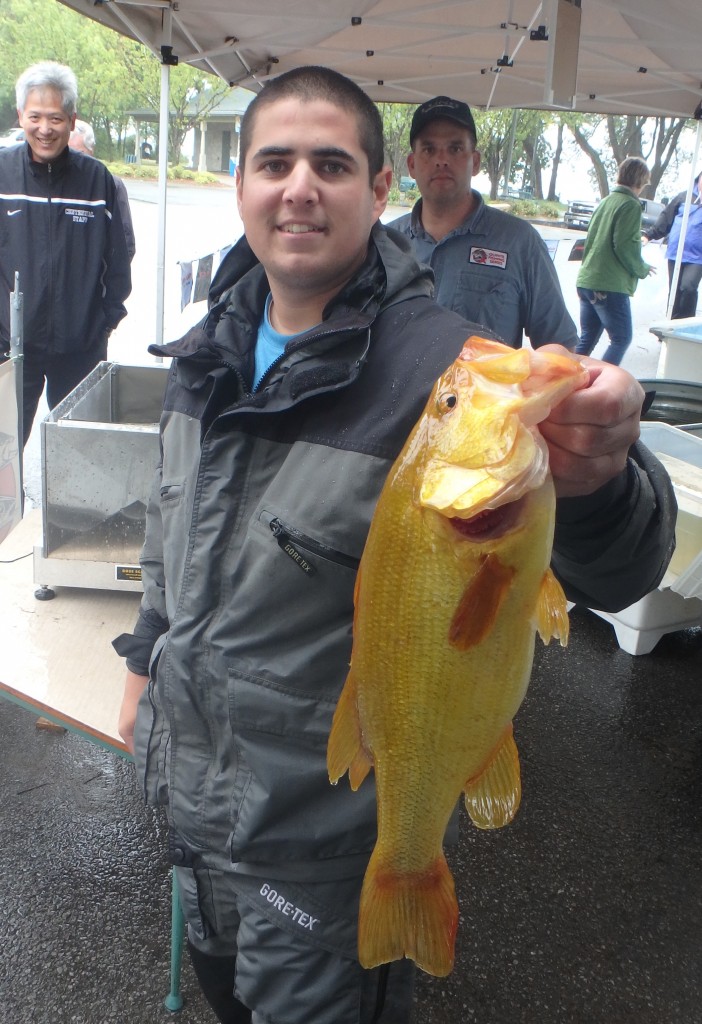
I've heard of the golden rule...a golden moment...the golden age...and even the golden hour. I've also heard that "silence is golden," I've crossed--both over and under--the Golden Gate Bridge a few times, and I've heard the story about "the goose that laid the golden egg." But never, until today, had I heard (or seen) anything about a golden bass like you see here.
My newfound discovery occurred while I was digging around the Internet, looking for material of any kind I might be able to turn into another blog post.
So what causes this rare condition, known as "xanthism"? As explained by Dr. Robert Montgomerie, a biology professor at Queen's University in Kingston, Ontario, "Normal fish scales on bass receive incoming white light, and molecular structures convert that light to blue or yellow, which makes the fish look green. In the yellow bass, it is likely that some spontaneous mutation occurs that prevents the scales from making the proper molecular structures to convert white light to blue.
"Without those structures, the fish looks gold, rather than green. It's not that the bass has gained a yellow pigment, but rather, it has lost the ability to produce the blue colors that make its scales green," he concluded.
What are your chances of seeing one of these rare golden beauties? Evidently, not very good. For instance, workers at the Florida Wildlife Conservation Commission (FWC) reported that, after sampling more than 255,000 largemouth bass from 175 different bodies of water in a 10-year period, they've yet to see one example of this genetic phenomenon.
And Gene Gilliland, B.A.S.S. conservation director and long-time fisheries biologist in Oklahoma, was quoted as saying, "In thousands of hours of electrofishing, I never saw one (of these fish) in the wild. You shouldn't expect to see one, either."
The only problem, though, is that there have been several reports of these unusual catches this year--everywhere from California to Florida, to Kentucky, to Nebraska, and even to Canada, where the photo at right (http://www.quintefishing.com/qfs.htm) was taken during a Quinte Fishing Series bass tournament.
Angler Markus Bardy made the rare catch near Belleville, in the Bay of Quinte on Lake Ontario, while fishing with his partner, Casey Kimmerly, according to tournament weighmaster Brad Pound. This golden largemouth weighed 3 lbs. and helped the duo win the tournament with a total of 35.94 lbs.
Nevertheless, experts collectively chalk all these sightings up to "nothing more than a remarkable coincidence." Their contention is that if you spend time in the outdoors, on the water, in the field, or in the woods, you have to marvel at the variety you can experience in nature.
"Sure, there are patterns, tendencies, habits, and cycles," they say, "but if you spend anytime at all 'out there,' you will encounter something from time to time that you never have seen or experienced before. And that is one thing that keeps us coming back, again and again."
I can't argue with that logic.
Sunday, November 1, 2015
Bet He Didn't Have Much Company Today
Heard from my friend, "Doc" Murdock, this afternoon, telling me that he had been out to West Neck today and found a few fish. It appears his outing mirrored the one I had just this past Thursday.
His catch today weighed in at 1.2 (the fish at right, I think), 1.0 and 0.14. The baits used were a crankbait and a swimjig. "Doc" told me he also lost a couple fish today.
Also had an email from my kayaker buddy last evening. It seems Charlie would like a break from all the paddling he's been doing here lately. He asked if it would be OK for him to hold down the backseat on my Skeeter for a future trip.
I plan to take a look at the weather forecast for this next week and see if we can come up with a mutually agreeable date to wet a line together. There won't be any competition this time around. It's just a matter of a couple guys planning a fun day on the water. Stay tuned for the results.
Remembering Another Long-Time West Neck Fixture
Anyone whose patronage of West Neck Marina dates back to at least the 1970s, and perhaps earlier (I'm just not sure), undoubtedly remembers Jim Hardy, the man pictured here with a nice largemouth. Unfortunately, I was saddened this morning to read in The Virginian-Pilot obituaries where Jim left us this past Thursday, Oct. 29th.
Born June 4, 1940, Jim and his late-brother, Ray, spent many a day during their lives fishing out of West Neck. Likewise, both men and their families were usually on hand for the annual marina cookouts thrown by former owners Bill and Veradell Brown.
The one thing I remember most about Jim was that he frequently fished with his father-in-law at the time, who videotaped each and every one of their trips on the water.
I particularly recall one early morning when I happened to be waiting to launch behind that duo. Jim had launched his boat, tied it off at the dock, and was parking his vehicle as I made sure my boat was ready to go in the water. I suddenly became acutely aware that someone nearby either was talking to himself or was doing a monolog. I paused and looked toward the ramp, where I found Jim's father-in-law busy recording the intro for that particular day's fishing trip. He was including the date, general weather conditions, water temp--all the things one would expect to find in a standard fishing trip report.
I can't help but wonder now whatever has happened to all those videotapes. It's times like this that memories become ever so precious, and I would think all those videotapes could provide a huge amount of solace to loved ones left behind. Jim's survivors include his wife, Mary Jane; his sons, Jimmy Hardy, Jr., Sean Hardy, and Kevin Hardy; daughters, Stephannee Jones and Anje Laufer; and his grandson, Joshua Nunez.
When Jim wasn't fishing, he most often could be found driving one of those brown delivery trucks you see around town. He retired from UPS with 25 years of service.
According to the obituary in the morning newspaper, a funeral mass will be offered on Tuesday, Nov. 3rd, at 6:15 p.m., at Holy Spirit Catholic Church, 1396 Lynnhaven Pkwy., Virginia Beach. The family will receive friends from 5 to 6 p.m. You're invited to share a memory at www.familychoicefunerals.com.
Born June 4, 1940, Jim and his late-brother, Ray, spent many a day during their lives fishing out of West Neck. Likewise, both men and their families were usually on hand for the annual marina cookouts thrown by former owners Bill and Veradell Brown.
The one thing I remember most about Jim was that he frequently fished with his father-in-law at the time, who videotaped each and every one of their trips on the water.
I particularly recall one early morning when I happened to be waiting to launch behind that duo. Jim had launched his boat, tied it off at the dock, and was parking his vehicle as I made sure my boat was ready to go in the water. I suddenly became acutely aware that someone nearby either was talking to himself or was doing a monolog. I paused and looked toward the ramp, where I found Jim's father-in-law busy recording the intro for that particular day's fishing trip. He was including the date, general weather conditions, water temp--all the things one would expect to find in a standard fishing trip report.
![]() |
| A younger Jim (left), with his late-brother, Ray. |
When Jim wasn't fishing, he most often could be found driving one of those brown delivery trucks you see around town. He retired from UPS with 25 years of service.
According to the obituary in the morning newspaper, a funeral mass will be offered on Tuesday, Nov. 3rd, at 6:15 p.m., at Holy Spirit Catholic Church, 1396 Lynnhaven Pkwy., Virginia Beach. The family will receive friends from 5 to 6 p.m. You're invited to share a memory at www.familychoicefunerals.com.
Saturday, October 31, 2015
Not a Bad Day: Went 4 for 4
I fished four different coves in West Neck yesterday and came away with one bass in each. I also had another fish on for a while in two of the coves, plus I missed a couple of strikes, so all in all, I truly couldn't complain.
The fish in this photo weighed 1-1, and the other three nearly were carbon copies of this one. My first couple of fish yesterday morning fell for a white 3/8-oz. chatterbait. My lucky lure for the other two was a white wakebait. I also fished a Pop R, crankbait and a Slider worm without even drawing a strike.
I was happy to find that my research a few days ago proved to be helpful during this outing. There definitely were fish in the coves as I fished my way toward the mouth of West Neck. However, I didn't have enough time to check out the upper stretches of the creek. Only fished from 9 to 2, and with the days getting even shorter following the time change this weekend, my average fishing day will grow even shorter. And, too, white baits were working--just as described in the same article.
The air temp when I left the house this morning was 59, compared to a reading of 70 when I left the marina this afternoon. The water temp at start time was 62, but I forgot to check that reading when I quit.
Only saw one other fisherman on the water yesterday, and he already was gone when I returned to the ramp, so I don't have a clue what kind of day he had.
Friday, October 30, 2015
A Blast From the Past
How many of you bass fishermen still have one of these gadgets laying around somewhere collecting dust? I know of one--the guy who emailed this photo to me. He sent it with this message attached: "Yup, I, too, bought one of these. Never ever helped me catch a fish. Lol."
When I went back to him asking if he ever still uses it, I got this note in response: "Not in 20 years. Saving it as an antique. Might be worth more that way."
If you're wondering who the gent is that owns this device, it's none other than good ol' Skip Schaible.
I'm not sure what he thought I'd probably do with this photo--if anything--but I'm always on the lookout for material I can turn into a blog post, and nothing better serves my penchant than something like this blast from the past. "Thanks! my friend. You really made my day."
The Color-C-Lector, as this gadget is known, was the 1984 invention of the late-Dr. Loren Hill, a former University of Oklahoma zoology professor. The 68-year-old professor passed away in 2008.
Sometimes dubbed "the most influential tool in fishing since the graphite rod," the Color-C-Lector was originally manufactured by Lake Systems Divisions of Mt. Vernon, MO. Dr. Hill spent nine years researching the device, which, according to one of its ads, "established a range of 26 colors that were best visible to the eyes of a fish. Through careful observation and patience, Dr. Hill was able to train the fish to differentiate 26 color positions under optimum conditions. He then altered those conditions to simulate various times of day and varying degrees of water clarity. With each change, the correct responses were carefully measured and recorded. The Color-C-Lector is the result of those experiments and reflects the responses of fish to color under all conditions that anglers will encounter."
The original Color-C-Lector was intended for use with a PH Guide. You dropped the probe into the water, and the hand moved to the appropriate color recommended for use during the measured water conditions. While the device had its share of detractors, it also had its adherents, and many of them are die-hards. The original unit still is sought after today, and many of them are purchased by anglers who have worn out one or more previous models. The unit's popularity is such that it's still available today--and has been since 2004--in a digital model made by Spike-It of Linwood, MI. This company makes the bottled worm dyes and color pens that you find on the market.
The Color-C-Lector not only altered the industry, it also changed the product lines and packaging of many major manufacturers. They started coming out with all kinds of weird color combinations in tried-and-true baits. Even the packaging was relabeled to list the particular color codes for that bait that matched the codes on the Color-C-Lector.
Tacklebox manufacturers also hopped aboard the same train. They created prelabeled holding systems (like the one at left) by which to organize your baits.
Then there were the TV shows at the time whose hosts used the device and/or rendered opinions on its usefulness. Bill Dance is one who appeared to be a firm believer in the system. He often would use it during his Bill Dance Outdoors shows. And the folks at In-Fisherman looked at the relevance of the meter to other species besides bass.
It certainly doesn't take a rocket scientist to quickly figure out that color remains an integral part of the tackle-sales industry yet today--regardless of whether you do or don't use a Color-C-Lector in making your selections. Just look at all the eye-popping assortments you currently find on store shelves.
Wednesday, October 28, 2015
"Looks Can Be Deceiving"
I still can remember one of the first times that saying ever came home to roost on my doorstep. It was way back when I was a senior in high school. I had a Saturday-night date with this drop-dead gorgeous gal who, as I would learn before having driven just two blocks, had the personality of a rattlesnake. That was the first and only time in my life I ever returned a date to her house within minutes of picking her up. My biggest satisfaction that night was seeing the surprised look on her face when I told her to get out of my car. I'm guessing it probably was the first time anyone ever had talked to her that way.
A more recent example of deceiving looks occurred a couple weeks ago as my tourney partner, Rob, and I took a mid-week practice day in preparation for the weekend Dewey Mullins Memorial Bass Classic to see if we could find some fish.
After working a good stretch of shoreline with absolutely no action at all, we decided to check out a cove, even though we had seen no signs of activity there. In no time, we were catching chunky keeper fish with topwater baits.
A little research after I got home that day revealed that what we had found in the practice session really isn't unusual. With fall being a transitional time for bass, anglers often get fooled into believing that what we see happening on the surface correlates directly with what is happening below the surface. That's not true, though. Longer nights, coupled with passing of the season's first cool and cold fronts, start dropping the water temperatures, which trigger changes in fish behavior.
Where bass may have been busting shad throughout the day in summer, that activity likely will be delayed until late afternoon in fall, when full effects of the sun are in place. It's not uncommon for most of this fall activity to occur in the last hour of the day.
With the cooling effects of longer nights and passing fronts, many bass begin migrating toward the backs of coves, up creeks, and to shallower staging areas--the same places the baitfish start moving. That's why crankbaits, particularly those in white, bone and silver chrome, work so well in early and mid-fall. Be sure to include some lipless models in your arsenal, too.
Topwater baits, including buzzbaits, are another good choice for fall. And on bright days, you may want to try some soft plastics, especially during the mid-day hours.
As late fall arrives, and bass and baitfish begin moving back to deeper water for the winter, crankbaits still get the nod. Here's a crankbait bass my friend, Doc Murdock, boated one day late last season.
Here's another bass he also picked up on a crankbait just last Saturday.
Other late-fall baits may include, depending on the depths involved, such things as jigs and spoons fished vertically. Key factors in finding a productive late-fall pattern are water temperature, depth, wind direction (sometimes), and the color of the bait.
When Day 1 of the Dewey Mullins Memorial Bass Classic arrived, Rob and I returned to the area where we had found fish on the practice day. However, there were a couple of factors that had changed during the interim: a lower water level, as well as a reduced water temperature. And while our first half-hour in the area produced results similar to what we had encountered on the practice day, the bite suddenly shut down completely, and we were forced to spend the rest of the day in a futile search.
The bottom line for fall bass-fishing enthusiasts is that it's generally some of the best action of the year, at a time when the water is cooling off, the leaves are turning vibrant colors, and there are considerably fewer anglers to get in your way on the local bodies of water, so enjoy.
Tuesday, October 27, 2015
An Alternative to Towing Your Boat to the Gas Station
If your local gas station is one of those that's always busy, there's an easier way to top off the gas and oil in your boat than towing it into the thick of things.
Because I've always kept my rigs stored at West Neck Marina, I used to tow the boat to either the Red Barn or 7-11 in downtown Pungo whenever I needed fuel. Doing that this time of year isn't so bad, but in the middle of summer, it can be a royal pain having to deal with all the traffic in those two places. Accordingly, I decided to find a better way of performing that task, and it's something anyone can do, no matter where you keep your boat.
I first went out and bought five 5-gallon gas cans, which promptly demonstrated to me that they wouldn't measure up to their billing. You couldn't use the nozzles provided to pour the fuel into your boat's gas tank without also ending up with a puddle around your feet--not a good thing under any circumstances. But given the price I had paid for these cans, I was determined to make them work--one way or the other.
After some experimentation, I have settled on the Flo 'n' Go Maxflo siphon and pump (pictured here), which is available at Northern Tool (located in the JANAF Shopping Center), 1120 N. Military Hwy., Norfolk. The regular price is $39.99 + tax, and I'm here to tell you it's money well spent, if for no other reason than it, unlike the gas cans I bought, lives up to its billing. Time after time, it flawlessly delivers the fuel quickly and without any leaks. I consistently can transfer about 10 gallons of fuel from the can to the boat in about 10 or 12 minutes, and as far as I'm concerned, that's not bad.
Sure, you initially have to assemble the handful of items in the box, but when a mechanical klutz like myself can do it, you can be assured anyone can do it.
I've been using the Flo 'n' Go Maxflo since earlier this year when my tourney partner, Rob, steered me onto it. He, too, has one and has nothing but good things to say about it.
When it comes to refilling the oil reservoir on my boat, I use a Pennzoil Multi-Use Hand Pump like the one pictured here. You usually can find it at either Northern Tool or the local Walmart for about $10.
Just like the Flo 'n' Go Maxflo, you stick the top hose of this hand pump in the liquid to be transferred and the bottom hose in the reservoir. You can transfer a gallon of oil in only a few minutes. As I've learned the hard way, this method sure beats trying to use a funnel or dumping the oil directly from the container, unless you don't mind cleaning up giant messes.
As I noted in the headline to this post, this idea is offered just as an alternative to dragging your boat into the local gas station for a fill-up. It works for me, but if it's not your cup of tea, that's OK, too.
Subscribe to:
Posts (Atom)