I'm talking about the day yesterday--Wednesday, April 22, 2015. It all started in the wee hours of the morning, when I was awakened by another one of my cluster headaches--the third one in as many days. No sooner had I taken a pill for that long-time problem than a totally off-the-wall pain hit my left ear. When I say "off the wall," I mean just that. I haven't had any ear pain that I can remember since I was a youth and frequently had ear aches.
Nevertheless, I arose when I heard the alarm go off at 7:30 a.m., signaling it was time for my wife to get ready for her bowling league and for me to get in gear to take my boat to Wayne for one final job before the season kicks into overdrive. Staving off the usual nausea that accompanies my taking the headache prescription without food, I stumbled downstairs and forced down a couple pieces of toast and a bowl of fruit, which took care of the nausea but did nothing for the ear ache that ended up lasting all day.
Within 15 minutes of my wife's departure, I was en route to West Neck to hook up my boat and head to Wayne's place. That much of the day went as usual, and Wayne was all ready for me when I wheeled up in front of his house. A couple hours later, he had finished the job--even took care of a problem I didn't know I had--so I paid him and was headed back to West Neck. That part of the day likewise went smoothly, and I was feeling pretty good until I parked at West Neck and walked around to the stern of my boat. Bet you'll never guess what I then found laying on the back deck.
It was none other than my wallet, which I had left laying there when I went to hand Wayne his money. I had driven all the way from his house back to West Neck--at speeds up to 55 mph, in that wind--and all that I lost in the process were the four or five $1 bills I had tucked under the wallet while I went to pay Wayne. Guess maybe a kid or two from Wayne's neighborhood may have been smiling as I passed by, with those $1 bills floating through the air. I kinda chuckled as I remembered that old GEICO TV commercial showing the dude on the motorcycle riding down the road with bills coming off him by the handsful.
After checking my wallet three times to make sure everything else was intact, I just had stuck it back in my pocket when the cellphone rang, and it was my wife telling me about a problem she was having at home. Seems she had let a Northstar Alarm Systems salesman in the house, and he wanted to sell us a couple new state-of-the-art keypads. Only problem was that he was (as we'd eventually learn) giving my wife--and me--a bunch of half-truths, along with some outright lies. He was making it sound like we would keep our ADT service, but just have the new keypads, with a slight bump in our monthly monitoring fees. And he was assuring us that these added monitoring fees would more than be offset by the added discount we would get with our home insurance company as a result of having these new keypads.
He "almost" pulled off the scam. Fortunately, though, the service tech didn't get to our place before my wife and I had put 2 and 2 together and agreed we were about to get screwed royally. I told her to shut and lock the doors until I got home. Suffice it to say that, by the time I arrived home, my afterburners had kicked in, and so had a lot more of that old Navy chief venom than I thought could possibly be left after all these years. Upon opening my car door, I immediately jumped in the salesman's face and asked just one question: Are you with ADT? Quickly realizing my mood, he already was backing away (and the scrawny service tech already had high-tailed it to the curb and was putting his tools in the car) when I told the salesman he'd better get the (expletive deleted) off my property and never show his face around here again, or I'd throw him off the next time.
A subsequent quick check of the Internet revealed a long history of customer complaints with Northstar. In short, if you see one of their reps coming to your front door, you'll be smart to slam the door in his face--or better yet, just not answer the door in the first place. The situation we had got my wife so upset she had some breathing problems for a spell, but, ultimately, she calmed down, and all was OK.
In the meantime, though, I received an email from Skip telling me about his fishing day yesterday. He managed to catch this bass and a pickerel before calling it quits about 1 o'clock, but that wasn't the high point of his day. That came as he was making the run back up North Landing after calling it a day. He hit what evidently was a submerged floater in mid-river. Fortunately, there was no damage, except for the "toothpick" Skip was left with in the speedometer hole on the outboard. "She stuck on 40," he said. On the way home, he also stopped at Wayne's house, got the "toothpick" removed, and had Wayne check over the lower unit.
Seems Skip has been having a few problems of his own here recently. In his first outing after having Wayne install a new 24-volt trolling motor on his boat, the switch went screwy. A phone call later, he had a replacement motor on the way, which, as I understand it, worked OK on its maiden voyage yesterday. Looks like he's now all set for fishing this Saturday's tournament out of West Neck.
For that matter, I hope all of us are set for Saturday's contest. Just to be on the safe side, I plan to chain my wallet to my neck and have told the wife not to answer the door for anyone--period.
Thursday, April 23, 2015
Tuesday, April 21, 2015
Just How New/Old Are Guideless Fishing Rods?
I thought I knew the answer, but that was before I started my latest research mission on the Internet. Turns out I'm way off base.
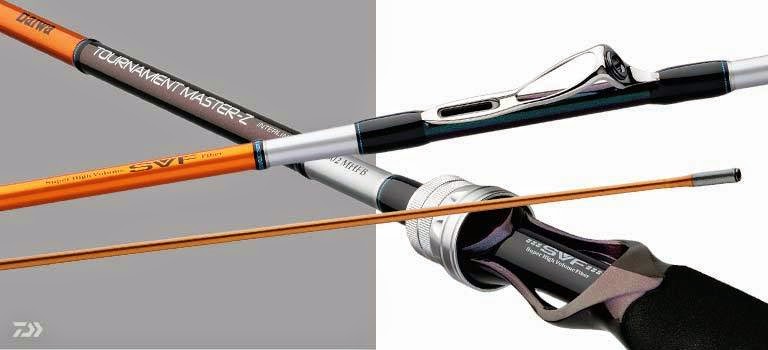
Remember when Daiwa introduced Interline rods (as pictured right) in the mid-1990s? That's when I thought this "revolutionary concept" was born. After all, publicity of the day stressed these "no guides, no tangles, no stress" miracles as "the most advanced design ever."
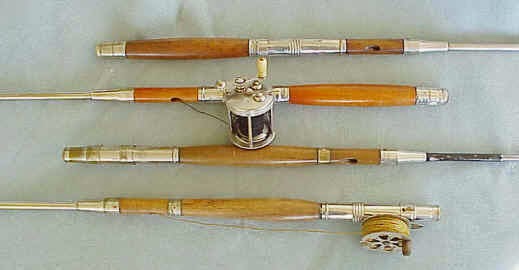
Would you believe, though, that guideless rods actually date back to the 1880s? The "bread and butter" of the Horton Manufacturing Company at that time was their Bristol steel rods (pictured below). The company was named in honor of Everett Horton, the inventor of its first product. It seems Horton wanted to fish on Sunday, but the Puritanical village of Bristol, CT, didn't like Sunday slackers. He solved this dilemma with the easily carried (and hidden) telescopic steel rod.
Through the years, the Horton Manufacturing Company produced many varieties of steel rods. However, the one that still elicits the most interest among collectors is the offspring of Everett's original design--the rod with the line running through it, instead of through outside-mounted guides.
These rods were manufactured in bait-rod and fly-rod versions, and in many different lengths and designs. Although Horton dreamed up his idea in the 1880s, these rods still were popular enough to be listed in catalogs as late as the 1930s. They often were described as "a wonderful rod to poke through a hole in the brush to snag wary small-stream trout, because the line couldn't catch on branches."
According to my research, rod engineers at Daiwa Australia and Daiwa Japan have been working together in recent years to design the most technically advanced rods ever seen--the Tournament Master Z Interlines. These rods utilize the incredible SVF (super high volume fibre) carbon, combining precise resin control with unidirectional graphite fibre, to make one of the lightest, strongest and most sensitive blanks ever developed. Uniting SVF with the famous Linear Interline design, the new "Super Interline" introduces "Hyper Dry" technology--a super water-repellent dry polymer delivering the smoothest casts ever seen.
The Tournament Master Z Interlines (as seen at right) come in six different models (four spinning and two baitcast), all of which are only available in two pieces. The spinning rods come in ultra light, light, medium light, and medium heavy action, while the baitcast rods are available in medium heavy and medium actions.
So what do anglers have to say about these Daiwa Interline rods? According to a fella who used one during a two-day bass-fishing trip, "Everything Daiwa says about them in their advertising seems to be true. My first cast went 6 feet into the mono backing on my spinning reel (first time this ever has happened), and I had to put more line on to compensate (for the improved casting distance)... . Before anyone asks, 'No, I don't work for Daiwa. In fact, my entire closet is Shimano.'"
Here's what another angler had to say: "Was able to use my new Team Daiwa X Interline rod and my new Team Daiwa TDS reel yesterday, and it was awesome. I was able to cast a weightless wacky worm into the wind like it was a 1/2-oz. Rattle Trap... . Most sensitive rod I ever have used... ."
Not everyone shared those positive views, though. As yet another angler noted, "I got two of those rods but hated having to mess around with the little wire to string them up, and they just didn't cast for me worth a darn. I gave away both of them."
And then there was one final angler who referred to the Interline rod as "Daiwa's answer to the Edsel." He added this comment: "In this case, I think it's a different mousetrap and not necessarily a better one."
To be honest with everyone, I personally haven't gone looking for any of these rods since I first saw and handled some of them back in the late-1990s. For that matter, I don't have a clue how readily available they are in the U.S.--if at all. I get the impression you'll find plenty of them in Australia and Japan but not so much anywhere else.
I certainly don't see them as "the coolest, funkiest and sexiest most technically advanced rods available," which is how one Daiwa piece of advertising referred to them.
Saturday, April 18, 2015
No Topwater Arsenal Is Complete Without a Few of These
I'm referring to none other than the Heddon Torpedo, which has been around since the 1920s. Made out of wood until 1936, this lure has a couple of adoring qualities. First and foremost, it catches fish, and secondly, it can be cast a "country mile," thanks to its bullet-like design.
Another benefit of this design is a smoother, more true, retrieve. Here is where the Torpedo really shines. With help from the propeller on the rear, it creates a racket on the surface that really gets "under the skin" of schooling or aggressive fish. The sound, according to some, is like the noise made by bass chasing shad to the surface. As we all know, bass quickly will target a solo baitfish that appears to be injured--hence, a good reason to twitch the lure.
Furthermore, the lure is versatile enough to be fished fast, slow, or with a pattern--all with equal effectiveness. One rule of thumb to remember is this: The warmer the water, the faster you can retrieve effectively.
Some anglers like to fish the Torpedo by reeling in slack line, jerking the rod downward to pull the lure forward a bit, then letting it rest a few seconds before repeating the action. Whatever technique you try, be forewarned that explosive strikes can and often do occur. The secret to fishing this lure is to vary your retrieves until the bass let you know the one they prefer on any given day.
As with all topwater lures, when you see the fish explode on a Torpedo, wait until you feel the weight of the fish before you set the hook. One expert's advice is to "wait about 2 seconds."
The Heddon Torpedo comes equipped with two treble hooks--one beneath the belly, and one at the rear, just below the propeller. And it's available in four sizes, including the Teeny (1/8 oz.), Tiny (1/4 oz.), Baby (3/8 oz.), and Magnum (5/8 oz.). You simply choose the one you feel is best for the situation.
Anyone who ever has used a Heddon topwater bait can tell you how effective they can be on the water. The Torpedo is no exception. "Deadly during the day, downright unfair at night" is how I saw one bass angler refer to this lure. Anyone who doesn't have some of these lures in their tacklebox are missing out on some golden moments.
Consider an item I found while researching the Internet for this story. It reflects some of the thoughts I've been having lately. Here is what the author said:
"Each year, fishermen spend millions of dollars on fishing tackle. We are constantly bombarded with new fishing lures, promising to be better than anything before it. The lures have photo finishes to look like actual fish. They have bodies that replicate the swimming action of baitfish and fry.
"I personally buy into this hype continuously. However, several recent fishing outings have reminded me that, often times, the oldest lure designs still stand the test of time. While bass fishing a few weeks ago, nobody around me was catching anything. I, likewise, had thrown most of my favorite lures without any success, as well.
"Finally, as a last ditch effort, I switched to a Heddon Torpedo--a lure that has been around for almost a century. And before you know it, the water was exploding with bass."
I truthfully can't say I've ever had the water around me "exploding with bass" when I've fished the Torpedo, but I have caught some nice fish with the lure. I also can say, with a certain degree of pride, that I went through this whole past winter without buying into all that hype about new lures--I never bought a single new one. And, for me, that's a real accomplishment.
Thursday, April 16, 2015
A Lure That Lives Up to Its Name
"Something getting ready to transform from a bumblebee to a bird, ready to take off"--that's one way I've seen the Heddon Crazy Crawler described. First introduced in 1940, this lure's unique shape and metal wings are a throwback to the earlier days of bass fishing, when many of the unorthodox topwater lures were manufactured.
The Crazy Crawler originally was designed by New Jersey lure builder Jim Donaly. Complete with the standard "Donaly" clip, used to hold the wings on the side, it first was made of wood. Around 1939, Heddon bought the patent from Donaly Lure Company.
Available in both 1/4- and 5/8-oz. models, this legendary topwater lure has an action that is hard to describe. The perfectly tuned metal wings dip and dive while grabbing a wing full of water, leaving a trail of bubbles behind as the lure is retrieved.
Unlike a lot of other lures that require an angler to master the skill of using it, the Crazy Crawler requires absolutely no skill. You simply reel it fast enough to make the lure splash from one side to the other. Reel it too slowly, though, and the lure won't make the gurgling sound that attracts bass. On the other hand, if you reel it too fast, the lure hydroplanes, with no action. Anytime you can't draw a strike with a steady retrieve, try adding an occasional pause or twitch, say the experts.
Anyone who ever has fished a Crazy Crawler likely would tell you the best part of using this lure is to watch the explosive strikes that usually occur. Game fish just can't seem to resist trying to crush this bait.
While most people fish the Crazy Crawler during the daytime, savvy anglers usually wait until the sun goes down before using the lure. Their advice is to fish the lure around such areas as lighted boat docks and long, extended points. Another popular place is a pond--not surprising, since the swimming action of the Crazy Crawler resembles a frog. It can be thrown out into open water or fished around grass--either can be deadly.
The most desirable Crazy Crawler to collectors is the musky model 2150, which first appeared in 1940. It only was made for a short while before going out of production, then came back for another brief period in 1950. These lures have a value range of $75 to $150, depending on color. Another rare model is the model 2120 chipmunk Crazy Crawler, again first introduced in 1940. Newer plastic Crazy Crawlers have a collector value ranging from $10 to $20, and, again, color makes a difference in the value.
At age 75, there's no denying this lure has withstood the test of time. It also seems a pretty safe bet that everyone will agree no more idiot-proof lure ever has existed.
Saturday, April 11, 2015
Rod Snapped in 3 Pieces and a Lost Big Fish...
That's how my day started, but I'll provide details later. The important facts here are that we had 15 anglers in 9 boats show up for today's fourth event of the 2015 season, and we were greeted with some of the best weather we've seen to date.
This duo of (from left) Allen Napier and Al Napier claimed 1st place with a five-fish limit weighing 17.71 lbs., anchored by one weighing 4.72 lbs., which was good enough to also take big-fish honors.
Finishing in 2nd place, also with a five-fish limit, was this team of (from left) Nate Kilgore and Dave Meers. Their sack of fish weighed 12.42 lbs., with a kicker fish that tipped the scales at 3.65 lbs.
Coming in at 3rd place, again with a five-fish limit, was the team of (from left) Rob Peppers and Don Carter. Their total weight was 12.34 lbs., with a 4.32-lb. big fish.
And winner of the mystery-weight drawing was Jim Bauer, who weighed three fish totaling 4.74 lbs., which came closest to the 5.30 tab that was drawn.
Here is how the rest of the field finished today's tournament:
* The team of Randy Conkle and Bob Glass, five fish, 10.38 lbs. total weight, no big fish.
* Gary Coderre, five fish, 9.60 lbs. total weight, no big fish.
* The team of Chris Fretard and Mike Miller, five fish, 9.57 lbs. total weight, 4.16-lb. big fish.
* The team of Rob Chatham and Ken Testorff, five fish, 7.62 lbs. total weight, no big fish.
* Steve Bailey, three fish, 3.72 lbs. total weight, no big fish.
Overall, the anglers today weighed a total of 41 bass for a total weight of 88.10 lbs. The average weight was 2.14 lbs.
For planning purposes, our next event is scheduled for Saturday, April 25, from safe light (about 6:30 a.m.) to 2:30 p.m. Registration will close at 6 a.m.
Congratulations to all of today's winners and to everyone who showed up to fish.
Before closing, let me explain the rest of the freakish incident that started my day. I just had put down all my crankbaits and the topwater I had been throwing and picked up my favorite chatterbait. I only had made a handful of casts, when I tossed the lure about halfway up a tree. As I'm yanking, my rod suddenly snaps into three sections, followed by the chatterbait falling into the water. In the process of trying to retrieve my line, I notice that a fish is running with it and set the hook, as best I can with the busted rod.
It doesn't take rocket science to quickly figure out the fish has some size, 'cause as soon as I set the hook, he starts taking drag. Now this picture gets even more screwed up. You see, when the rod snapped, both of the smaller pieces somehow managed to take one full loop around what was left of the rod in my hand. So not only am I trying to control the fish, I'm also faced with the challenge of trying to unwrap the two short pieces from the rest of the rod. Simply cranking proves to be impossible, so I start moving the fish toward me by clamping the spool with my thumb and pumping the rod toward me, then trying to reel up the slack before the fish can spit the lure. Ultimately, the fish wins this contest.
Now I'm left to chew on the reality that, not only did I lose the fish, but I can't find a replacement for the Browning Medallion 6-6 medium baitcast rod I lost. It seems Browning only makes this particular rod nowadays with a split-grip handle, instead of the nice full-length cork handle I've come to enjoy. If anyone out there has one like I lost and is willing to sell it, let me know in the next couple of days, and we might be able to work a deal.
Thursday, April 9, 2015
A Mainstay in Many Dads' and Granddads' Tackleboxes
That's one way to describe the Heddon Lucky 13, an infamous topwater lure with antique collectors and fishermen, alike--and not just bass fishermen, either. This proven winner also has been popular with pike, striper, speckled trout, redfish, white bass, and salmon anglers, to name only a few.
The Heddon Lucky 13 is series number 2500 for the regular size (3-3/4 inches long, 5/8 oz.) and series number 2400 for the Baby model (2-5/8 inches long, 3/8 oz.). Both have been around, in some configuration, since the late teens but weren't first catalogued until about 1920.
According to some, the Lucky 13 materialized after the Wiggler King had been done away with because of similarities and name confusion it had with the Creek Chub Wiggler. Whatever the reason isn't really important. What is important is that the Lucky 13 has established itself as one of James Heddon's best selling lures of all time. By some accounts, more than 10 million copies have been sold over the years.
When the Lucky 13 was first introduced, it had cup-rig hardware, with no eyes and an elongated lower lip. Soon afterward, the lure came out with L-rig hardware and a shortened lower lip (thought to give more strength to the hook harness). It was offered in both regular and heavy-duty L-rig, the latter used mostly for salmon and saltwater fishing.
The lure then was offered in toilet-seat (both upturned and regular) and two-piece flap rig, with and without eyes. This modification was followed by a configuration using surface-rig hardware, with tack eyes, and finally came a plastic lure with painted eyes. There also is a musky version of the lure that is larger and made with and without glass eyes, in a Spook body.
While this lure can be fished like any topwater popper, it also scores a lot of success when fished with a slow, steady retrieve--a popular method with tarpon fishermen. With this method, the lure runs just below the surface with a surfacing minnow action. Many times, a mixture of the two retrieves works best. Cast the Lucky 13 and let it sit until the ripples disappear, then pop it and let it sit again. Pop it a second time, then point the rod straight at the water and slow crank it, creating the familiar wide wobble. Vary the cadence until you find the speed and presentation the fish want.
After that, it's a matter of the fisherman's skills, the gear he's using, and how much luck is riding on his side. Here are a couple of tales I found online in which things didn't quite work out right but, nevertheless, are worth repeating in this forum. After all, everybody enjoys a good fish story, right?
The first case involved an 8-year-old boy who was camping with his family at a state park. He was a self-proclaimed "master" at catching bluegill and bullheads, but like most boys his age, he wanted to catch a bass--"like a real man."
So, on this one particular morning, he grabbed his cheap fiberglass rod with a trusty Zebco 202 and a bullfrog-pattern Lucky 13. He then walked down a steeply sloping trail, under some huge overhanging oak trees, until he came to the water's edge. At that point, he started lobbing long casts out into a narrow cove of the state park's lake.
After several casts, the water suddenly erupted around his lure. He set the hook, then started cranking like mad, with the fish taking more drag all the while. In a moment that I'm sure still stands locked in his memory, the fish made a spectacular head-shaking leap that sent the lure flying from its mouth.
Said the boy, "I was left on the bank with my heart pounding and nothing to take back to camp but a story. But from that day forth, I was not just a fisherman--I was a BASS FISHERMAN!
The other case I read about happened one oh-dark-30 (4 a.m., to be exact) morning several years back, when a fella was fishing a lake from his boat. The surface was as smooth as glass when he cast his Lucky 13 toward a big tree standing in the water. He popped the lure only once before a huge fish slurped it under, and the fun began.
"The fish took off, then launched itself way out of the water, landing with a thunderous splash," said the fella. "My blood really was pumping after two more jumps and a drag-peeling run... but then, just as quickly as it all had started, it was over."
A bit later, a friend showed up, and the fella trolled over to where he was on the shore. He told him about losing the fish, at which point the friend asked, "What happened to your popper?"
The fella looked over at it and realized that one of the hook barbs on the rear treble was straightened. "Just made me even sicker," said the fella. "You never forget the big ones you lose."
As these two cases show, that deep, resonating sound a Lucky 13 makes as it's chugged across the water's surface can drive gamefish crazy. The pathway to success, though, is being ready for the strike, being armed with the right gear, and having Lady Luck riding in your hip pocket.
Tuesday, April 7, 2015
Are You Wondering Why There Haven't Been Any Fishin' Reports Lately?
It hasn't been because I'm sick or otherwise incapacitated. The simple truth is that I just haven't been catching enough to make it worth my time to do any blog posts about the trips. You may have noticed I haven't even bothered to fish the last two tournaments. That's mainly because I didn't have a clue where to find any fish.
Here's the "loner" I caught last Thursday, April 2, in the front end of Albright's. He weighed 1-3.
And here's the "loner" I caught yesterday, during another trip to Albright's. He tipped the scales at all of 1-7. Note the rub marks on his side toward the camera--not sure what that was about.
Both of these fish fell for shallow-running crankbaits--in different colors, though. And I missed a solid strike on a chatterbait yesterday, mostly the result of being lulled into a state of inattention (another way of saying I nearly had fallen asleep) after going hours with absolutely no action. The fish hit so hard he nearly yanked the rod out of my grasp, but by the time I was ready to respond, he had thumbed his nose at me and headed for parts unknown.
I've been hitting a few stretches in West Neck each trip, too, but don't seem to be able to generate anything at all there. Even that point I stumbled onto in the early part of this past winter has dried up.
For the first time this season, I noticed some fish busting the surface yesterday, so I broke out a Pop-R and tried to entice one of 'em to hit that, but they weren't having anything to do with it. I also noticed a few swirls in the water.
For part of yesterday, I was following my friend, Skip, as he worked a stretch of shoreline in Albright's with some soft plastics. I watched him boat his first fish of the day, and, as I later learned at the dock, he caught one more and lost two before calling it quits. My friend has been having some fishless days here recently, so I was happy to see him swinging 'em over the side again yesterday. Incidentally, Skip is like a kid with a new toy when it comes to his new, 24-volt trolling motor. Now, he just sticks the nose of his boat into the wind and goes, instead of "running in place" with that 12-volt he had.
With another tourney scheduled for this coming Saturday, I wish I could say that I had a game plan, but I don't. All I know is that I plan to have a full tank of gas, 'cause I have a feeling Rob and I very well may be burning a little fuel as we look for fish. There is one positive from these recent lackluster fishing days--I've been getting more comfortable with this bigger boat. I've had a chance to mix it up with a few of those "big boys" that run the North Landing, and I'm thoroughly enjoying the benefits of having a hot-foot in the boat--not to mention there's a lot of good to be said about those extra 35 horses hanging on the transom, too.
'Till next time, "Tight Lines!" to one and all.
Saturday, April 4, 2015
Put It On, Take It Off... and Repeat Again
That was the story of how today's third event in the 2015 season of this series went most of the morning, with "it," of course, being rain gear. Nevertheless, the 9 anglers in 7 boats fought both that and the wind, at times reportedly gusting to 40 mph, to the weigh-in at 3 o'clock this afternoon.
Claiming 1st place today was Chris Napier, who weighed the day's only five-fish limit, totaling 11.18 lbs. He also walked away with the big-fish award for a bass that tipped the scales at 2.89 lbs.
Finishing in 2nd place today was Chris Fretard, who weighed three bass, totaling 6.72 lbs. His big fish came in at 2.69 lbs. Chris also was the mystery-weight winner. His total weight was closest to the 7.80 tab that was drawn.
Here is how everyone else finished the day:
* The team of Ronnie and Chandler McLaughlin, three fish, 5.07 lbs. total weight, 2.55-lb. big fish.
* Jim Wilder, two fish, 2.43 lbs. total weight, 1.36-lb. big fish.
* The team of Tyler Caldwell and Shane Feken, one fish, 1.02 lbs. total weight, no big fish.
* Gary Coderre, no fish to weigh.
* Jake Milligan, no fish to weigh.
The lone angler to weigh a limit today said he caught all of his fish between 12 and 1 o'clock. Most people's comments, however, centered mostly on the fact they had to fight the windy conditions all day.
Overall, the anglers today weighed a total of 14 bass with a total weight of 26.42 lbs. That figure averages out to 1.88 lbs. per fish.
The next scheduled event in this series is Saturday, April 11. Start time will be safe light (about 6:30 a.m.), and weigh-in is set for 2:30 p.m.
Wednesday, April 1, 2015
It's a Plop-Plop, Without the Fizz-Fizz...
And it has nothing to do with the effervescent antacid and pain-reliever we all know as Alka-Seltzer. Rather, it describes the sound made when an angler fishes a Fred Arbogast jitterbug lure.
I can't begin to tell you how many oh-dark-30 mornings over my lifetime I've pulled up to a spot, especially in early spring, and had goose bumps break out everywhere as I started methodically working an old jitterbug in and around cypress trees or along grassy shorelines. The adrenaline really would get to pumping when I detected, in the dimness of that early-morning light, an all-too-familiar wake following just inches behind the bait. Suddenly, then, my heart would leap into my throat, as that long-awaited C-R-R-R-A-S-H finally came, and the fight would be on. How can I ever forget those times when I was lucky, and it would be a big 'un, causing my reel's drag to scream wildly, as Bubba headed for parts unknown? That's undeniably the best feeling ever for a fisherman.
Not so much in recent years, but in earlier times, I've been blessed to have had days when I caught fish all day long on a jitterbug. And I'm here to tell you that I never ever tired of the excitement such a day brought me.
Since the birth of the Fred Arbogast jitterbug in the 1930s, many other topwater lures have come and gone. Meanwhile, the jitterbug remains on the A-list of must-have bass lures. Some anglers today turn their noses up at this timeless classic, but that's their loss. It very nicely fills the object of bass fishermen everywhere: to catch bass. Despite the fact it's neither the fanciest, nor the highest tech lure available, the jitterbug can hold its own against anything the modern world has to offer--without a doubt.
The thing that makes the jitterbug such a proven fish-catcher is its double-cupped lip at the front of the lure. That plop-plop sound coming from the lure's lip, according to some, "drives bass and other game fish absolutely insane."
The basic design and function of the jitterbug really hasn't changed much over the years. Those few alterations the lure has undergone mostly have been limited to materials and colors. First introduced as a wooden lure with a metal lip, the jitterbug was forced to make a few changes when World War II started. Metal was in short supply, so Arbogast began making both the body and the lip from plastic. Once the war ended, he reinstated the metal lip but let the plastic body remain.
As declared in one account I read, "You must fish this lure with confidence and patience, but don't be surprised when fish come swimming up to investigate your lure seconds after it hits the water. But be warned: Strikes come hard and fast, so you have to be ready to do battle from the moment the lure hits the surface."
After all these years, you still today can find the jitterbug in several different stylistic variations. Colorful plastic models with the trademark metal lip are the most common versions, but you also can find copies of the original wooden models. According to one source I discovered online, "It isn't easy to improve on perfection, and that's precisely what the Arbogast company achieved with the original wooden models of the jitterbug."
The Legendary Fred Arbogast
Born in 1894 in Ohio, Fred attended Central High School in Akron, where he excelled in athletics. He was a starting halfback on their state-champion football team. Graduating in 1913, he went to work at the relatively new Goodyear Tire and Rubber factory in Akron. When not working at the factory, he could be found fishing on the nearby Little Cuyahoga River.
Arbogast entered his first casting competition in 1916, and won the championship in the 1/2-ounce class with a distance of 162 feet--an amazing feat, considering the primitive state of baitcasting gear at the time. It's worth noting here that no spincasting reels existed at that time. They didn't appear until R. D. Hull and the Zero Hour Bomb Company (ZEBCO) invented them in 1949.
In 1922, Arbogast set the world record for distance casting in the 1/2-ounce class with a distance of more than 271 feet. He also won the 1/4-ounce class with a distance of more than 193 feet. In 1923, he set the world record for distance in the 1/4-ounce class with a cast of more than 208 feet, becoming the first person ever to win the competition two years in a row. And he didn't just win the distance competition; he also won awards for accuracy.
What makes these achievements so astounding, besides the primitive state of baitcasting reels then, was the fact there were no graphite, boron, or other high-performance rods available. Fiberglass also hadn't been invented yet. The rods were all either cane or steel. Arbogast preferred short, stiff rods 4-and-a-half or 5 feet long, with only two guides to reduce friction.
Fred also was an ace with a fly rod in both distance and accuracy. He was so proficient with any kind of rod that local tackle shops often would have him put on exhibitions, casting through hoops, breaking balloons, and even knocking cigarettes from an assistant's mouth.
At the same time, he was experimenting with different lure designs in his basement. It wasn't long before tackle shops were asking him to make lures for them to sell. In the mid-1920s, he left Goodyear to pursue lure-making full-time. With his spin-tail kicker lure, Arbogast launched his lure company. His first commercially produced lure was the Tin Liz, which appeared in 1932.
Fred soon had to move into a larger house and hire employees to keep up with the demand and to have a full-scale factory. Among his successful designs were the Hawaiian wiggler in 1936; the hula popper, also in 1936; and the jitterbug in 1938. He also is credited with inventing the world's first rubber skirt for lures, again in 1936. All in all, he created 11 classic designs, most of which still are catching fish today, more than 80 years later.
Mr. Arbogast passed away in 1947, at the age of 53, after collapsing while ice-skating. His memory lives on, though, as do his lures.
I can't begin to tell you how many oh-dark-30 mornings over my lifetime I've pulled up to a spot, especially in early spring, and had goose bumps break out everywhere as I started methodically working an old jitterbug in and around cypress trees or along grassy shorelines. The adrenaline really would get to pumping when I detected, in the dimness of that early-morning light, an all-too-familiar wake following just inches behind the bait. Suddenly, then, my heart would leap into my throat, as that long-awaited C-R-R-R-A-S-H finally came, and the fight would be on. How can I ever forget those times when I was lucky, and it would be a big 'un, causing my reel's drag to scream wildly, as Bubba headed for parts unknown? That's undeniably the best feeling ever for a fisherman.
Not so much in recent years, but in earlier times, I've been blessed to have had days when I caught fish all day long on a jitterbug. And I'm here to tell you that I never ever tired of the excitement such a day brought me.
Since the birth of the Fred Arbogast jitterbug in the 1930s, many other topwater lures have come and gone. Meanwhile, the jitterbug remains on the A-list of must-have bass lures. Some anglers today turn their noses up at this timeless classic, but that's their loss. It very nicely fills the object of bass fishermen everywhere: to catch bass. Despite the fact it's neither the fanciest, nor the highest tech lure available, the jitterbug can hold its own against anything the modern world has to offer--without a doubt.
The thing that makes the jitterbug such a proven fish-catcher is its double-cupped lip at the front of the lure. That plop-plop sound coming from the lure's lip, according to some, "drives bass and other game fish absolutely insane."
The basic design and function of the jitterbug really hasn't changed much over the years. Those few alterations the lure has undergone mostly have been limited to materials and colors. First introduced as a wooden lure with a metal lip, the jitterbug was forced to make a few changes when World War II started. Metal was in short supply, so Arbogast began making both the body and the lip from plastic. Once the war ended, he reinstated the metal lip but let the plastic body remain.
As declared in one account I read, "You must fish this lure with confidence and patience, but don't be surprised when fish come swimming up to investigate your lure seconds after it hits the water. But be warned: Strikes come hard and fast, so you have to be ready to do battle from the moment the lure hits the surface."
After all these years, you still today can find the jitterbug in several different stylistic variations. Colorful plastic models with the trademark metal lip are the most common versions, but you also can find copies of the original wooden models. According to one source I discovered online, "It isn't easy to improve on perfection, and that's precisely what the Arbogast company achieved with the original wooden models of the jitterbug."
The Legendary Fred Arbogast
Born in 1894 in Ohio, Fred attended Central High School in Akron, where he excelled in athletics. He was a starting halfback on their state-champion football team. Graduating in 1913, he went to work at the relatively new Goodyear Tire and Rubber factory in Akron. When not working at the factory, he could be found fishing on the nearby Little Cuyahoga River.
Arbogast entered his first casting competition in 1916, and won the championship in the 1/2-ounce class with a distance of 162 feet--an amazing feat, considering the primitive state of baitcasting gear at the time. It's worth noting here that no spincasting reels existed at that time. They didn't appear until R. D. Hull and the Zero Hour Bomb Company (ZEBCO) invented them in 1949.
In 1922, Arbogast set the world record for distance casting in the 1/2-ounce class with a distance of more than 271 feet. He also won the 1/4-ounce class with a distance of more than 193 feet. In 1923, he set the world record for distance in the 1/4-ounce class with a cast of more than 208 feet, becoming the first person ever to win the competition two years in a row. And he didn't just win the distance competition; he also won awards for accuracy.
What makes these achievements so astounding, besides the primitive state of baitcasting reels then, was the fact there were no graphite, boron, or other high-performance rods available. Fiberglass also hadn't been invented yet. The rods were all either cane or steel. Arbogast preferred short, stiff rods 4-and-a-half or 5 feet long, with only two guides to reduce friction.
Fred also was an ace with a fly rod in both distance and accuracy. He was so proficient with any kind of rod that local tackle shops often would have him put on exhibitions, casting through hoops, breaking balloons, and even knocking cigarettes from an assistant's mouth.
![]() |
| Arbogast at a 1918 casting competition. |
Fred soon had to move into a larger house and hire employees to keep up with the demand and to have a full-scale factory. Among his successful designs were the Hawaiian wiggler in 1936; the hula popper, also in 1936; and the jitterbug in 1938. He also is credited with inventing the world's first rubber skirt for lures, again in 1936. All in all, he created 11 classic designs, most of which still are catching fish today, more than 80 years later.
Mr. Arbogast passed away in 1947, at the age of 53, after collapsing while ice-skating. His memory lives on, though, as do his lures.
Saturday, March 28, 2015
Falling Water Prompts Tourney Director's Call for Early Weigh-In
That's the way today's second event of the 2015 season ended for the eight boats and 13 anglers who had entered the competition. Fishing started at the scheduled 7 a.m. but was terminated three hours early by yours truly at 12 noon, after watching the water fall throughout the morning, capped by a 4-inch fall in a 40-minute period.
First-place finishers in the shortened day were these anglers (from left), Allen and Al Napier. They had a five-fish total weight of 7.97 lbs. and a big fish weighing 2.32 lbs.
In second place after weigh-in was this duo of (from left) Paul Celentano and Sid Ryan, who had a bag of five fish weighing 7.43 lbs., with a big fish tipping the scales at 2.50 lbs.
Big-fish honors today went to this man, Ronnie McLaughlin, who weighed one that went 2.63 lbs. His total weight for three fish was 5.80 lbs.
Walking away as winners of the mystery-weight drawing was this team of (from left) Jeremy Gatewood and Mark London. Their total weight for two fish was 4.14 lbs., which was closest to the 2.65-lb. tab that was drawn.
That brings me to a final matter I must address in this forum. I need to recognize a team who, through no fault of their own, never received my call for an early weigh-in. The problem was that their cellphone somehow had gotten shifted to silent mode, which, of course, rendered my repeated dialings and voicemails null and void until it was too late.
I'm talking about this team of (from left) Mike Miller and Chris Fretard, who finished the day with what would have been a hands-down first-place award for a five-fish limit weighing 13.80 lbs., with a kicker fish that went 6.50 lbs.
My sincere apologies go to these two proven anglers for the unfortunate circumstances that kept them out of the winner's circle today.
As it ultimately worked out, there was enough of a wind shift that occurred shortly after weigh-in to cause the water to start coming back in. As is usually the case, however, that fact only proves, once again, that hindsight is 20-20.
Before closing this entry, let me also recognize the remaining anglers who showed up for this morning's cold start in blustery conditions. Here is how they finished:
* The team of Bob Glass and Randy Conkle, two fish, big fish 2.60 lbs., total weight 4.82 lbs.
* Steve Bailey, one fish, but chose not to weigh.
* Chris Carmell, chose not to weigh.
Overall, a total of 17 bass were weighed today, for a grand total weight of 30.16 lbs., or an average weight of 1.77 lbs.
For planning purposes, our next event is scheduled for next Saturday, April 4, from safe light (about 0630) to 1430. Registration will close at 0600.
Friday, March 27, 2015
Devil's Horse: It Began as a Broom Handle
That's right--Jack S. Smithwick's first Devel's Horses, later renamed Devil's Horses, were carved out of old broom handles his wife had around the house. The year was 1947, which makes this lure a mere youngster by antique lure-collecting standards.
A salesman with a Shreveport, LA, business-machine company at the time, Smithwick started carving these handcrafted lures as a hobby. He would pass them out to customers to set himself apart from other salesmen.
Mrs. Smithwick eventually grew tired of Jack taking her brooms and banned him from the kitchen. He subsequently started buying wood from a nearby lumberyard and went to work carving his lure designs in the garage. By 1949, word-of-mouth advertising was bringing anglers to his door with requests to purchase his lures.
Recognizing the potential business opportunity that existed if he could produce greater numbers of his lures, Jack purchased a wood lathe from Sears and Roebuck Company and moved his new business into a shop garage. The Devil's Horse was the first mass-produced lure made with this equipment.
Because most anglers were using level-wind reels, Smithwick first designed the Devil's Horse as a heavier, slow-sinking lure, to make it easy to cast with these reels. When spinning and spincast reels came along, he started turning out a lighter, floating model of his now locally popular and productive lure.
The growth of the Smithwick Lure Company is legendary. From its humble beginnings in the family kitchen in 1947, to its sprawling facilities today, the lures have become favorites of generations of anglers nationwide.
They're the go-to choice during largemouth prespawn in the southern states. Bass fishermen in Florida ALWAYS have a Devil's Horse tied on during the prespawn. Likewise, it's popular in the northern states for its legendary ability to attract prize smallmouths throughout the summer and fall.
The key to the Devil's Horse is the slender minnow profile and an action that lets you create maximum surface disturbance without moving the lure out of the strike zone. Fore and aft props create resistance with every twitch, so anglers can work the bait longer at the edges of shoreline weeds, near wood cover, along the edges of docks--in short, anywhere fish are holding.
Few topwater propbaits are as legendary as the Smithwick Devil's Horse. The unique buoyancy of handcrafted wood, combined with the props fore and aft, mimics the commotion of a fleeing shad and makes it one of the most effective bass topwaters in history. The lure creates tremendous topwater commotion with each twitch of the rod, but the props keep it from moving away from the strike zone.
The continued development of new Smithwick lures, new colors, and the latest in lure-finish technology is a tribute to the foresight of Jack K. Smithwick. The standards he established for quality, value and performance are attributes anglers have come to know and expect from Smithwick lures for more than six decades.
Smithwick Lure Company was sold to PRADCO in 1991.
Thursday, March 26, 2015
Warmer Weather Making for Some Bang-Up Action
It's not the same everywhere, and it may not last, but in at least a few spots, some anglers are starting to lay claim to braggin'-size catches. I talked to a couple of anglers in a johnboat at West Neck yesterday who only had one bass to show for their efforts. And Taylor, who is Steve's new weekday attendant at the store, said she hadn't talked to anyone yesterday with a good report.
However, my ol' reliable kayaker buddy, Charlie, had one heckuva report from his day yesterday on Back Bay. He launched out of Nawney's Creek and posted a total of 35 bass and 7 pickerel. His best five bass included one that weighed 2-7, two that weighed 2-3, and two that weighed 2-2. His best pickerel tipped the scales at 2-12.
Said Charlie, "I caught a lot of fish on back-to-back casts, and there were even a few instances when I caught 'em on three and four consecutive casts." What was his best lure? That's hard to say, 'cause, according to Charlie, "They were hitting anything I threw in the water."
By the way, I checked a little earlier this afternoon and found that Charlie still hadn't posted a blog entry on his day yesterday. Ya' gotta consider all the editing that's involved from a trip like that, though. I would urge you to be patient, 'cause he'll get it posted eventually. In case you don't already have it, here's the link: http://vbfishguide.blogspot.com/.
Charlie also told me about an email he had received from a couple of his fellow-kayaker buddies of their day on the water yesterday, as well. One caught four bass, weighing 6-3, 4-5, 3-2, and 1-4. The other had three bass, weighing 4-6, 3-5, and 2-2.
The one friend said he also had had hold of a big fish that smashed his lure and then ran under his kayak. "My rod was actually bent underneath the yak, and I only had about a foot of rod and reel above the water," he said. "At that point, he threw the lure, or the hook came dislodged. Gave me shivers thinking about how much that fish might have weighed."
Charlie's friend went on to say they caught their fish on wacky worms, shallow-diving minnow lures, and chigger craws on jig-type lures. He concluded by saying, "We hit them all within a short period of time, in an area covering about 400 yards. When the wind hit, everything stopped. Water was clear, with visibility about 3 feet. Water temp on my buddy's fish finder said 55 degrees, but it's an in-hull transducer, so not sure."
He Invented a Wiggle the Fish Couldn't Resist
I'm talking, of course, about Lauri Rapala, who, in 1936, in Finland, carved a lure out of cork, wrapped it in tinfoil from cheese and chocolate, and covered it in melted film negatives as a cheap alternative to lacquer. That lure is what we know as the original floater.
Available today in at least seven different sizes and 20 or more different colors, the original floater can be found in many anglers' tackleboxes. It's reported to be the best-selling lure that Rapala makes and, possibly, the best-selling in the world. Further, it holds more world records than any other lure.
When retrieved, the original floater swims with a tantalizing action that mimics a wounded baitfish. Lauri designed it this way after watching the behavior of minnows and fish in lakes near his home as a youth in Finland. His observations revealed that an injured minnow, when swimming with an odd wobble in a school of minnows, becomes the target of larger fish looking for an easy meal.
Legend has it that Lauri sometimes caught 600 pounds of fish a day with his new lure. As news of these abundant catches spread, so did the lure's reputation. And as they say, the rest is history.
Fishermen around the globe began catching more and bigger fish with the original floater, and it soon became clear the reason was the lure's unique wiggle and wobble. Accordingly, Lauri tested each lure to make sure it lived up to its billing. Even today, Rapala baits are hand-tuned and tank-tested to ensure they swim perfectly straight out of the box.
With the growing popularity of the original floater, it became abundantly clear that the whole Rapala family would have to pitch in to keep up with the increased demand. Lauri's sons learned to make the lures and soon became so skilled that his son, Ensio, won a national craftsmanship award. The same son also invented a machine to help mass produce the lure.
Even with mass production, though, there have been times when it was difficult for Rapala to keep up with the demand for their products. Take, for instance, when their shad rap made its debut on the fishing scene in 1982.
Word of its amazing fish-catching ability spread so fast that tackle shops all across the country sold out overnight. Resort owners and mom-and-pop operations started renting shad raps by the day--even some by the hour. And more than 30 years later, it's still one of fishing's most successful lures.
Rapala takes great pride in the fact that so many fishermen put faith in their lures. It's a confidence that encompasses 140 countries and is validated each year by the 20 million Rapala lures that are sold.
As Rapala officials noted, "Our products make better fishermen. Nothing rushed to market but carefully crafted from years of experience. No shortcuts. No gimmicks. No flash in the pan, next greatest things. It's a legacy of unwavering quality...a legacy that continues with new offerings of more lures, new actions, new sizes, new colors, new finishes, new tools, new accessories, and new ways of catching more fish.
"The sweet smell of success lingers long after the scent of fish slime fades. Tens of millions of walleye, trout, bass, wahoo, snook, and tarpon later, Rapala continues to stand the test of time. Through the industry's ups and downs, through the coldest cold fronts, through it all, one simple truth has endured: That which is irresistible to fish will always be irresistible to the fisherman," the officials concluded.
Subscribe to:
Posts (Atom)